The strategic plan aims to build a three-node Physical AI data factory network. Initially, a new hub of 5,000 square meters will be established in Italy to connect robot learning in the real world, digital twin simulations with AMD Helios ™ infrastructure, in order to accelerate the deployment of humanoid robots in European industrial scenarios.
Key Points
- Physical AI Data Factory Network:Generative Bionics is developing a proprietary network consisting of three facilities. Initially, a 5,000-square-meter hub will be established in Italy, with plans to put it into operation in the fourth quarter of 2027. Subsequently, a second facility will be expanded in other regions of Europe, and a third facility will be built for the global market. This network will replicate real industrial environments and will be used for robot learning, data generation, and validation.
- European humanoid robots' autonomous capabilities:This network will provide Europe with a proprietary, end-to-end Physical AI infrastructure that covers everything from real-world robot data to large-scale digital twin simulations and AI computing power, enabling the generation, training, and validation of data, models, and technical knowledge behind industrial humanoid robots on the European continent.
- AMD — Strategic Partners from Day One:From AMD Ventures participating in the seed round investment of Generative Bionics, to GENE.01 leveraging AMD computing power, and then to the AMD Helios ™ system that will provide support for the data factory network, AMD has always been a partner of Generative Bionics's entire Physical AI technology stack, offering high-performance computing and storage capabilities for physical and synthetic data processing, model training, as well as parallel digital twin simulations.
- Development process from reality to simulation and back to reality:The tasks performed by GENE.01 in the physical environment will be reconstructed as digital twins and run repeatedly under thousands of different conditions. The models trained in simulation will then be applied to the robots for verification in the real world.
- Industrial verification:This infrastructure will train a world action model ( World Action Models ), verify the complete robot configuration before client deployment, and continuously improve performance over time as it accumulates working hours within the group of robots using operational data.
Milan, October 21, 2026 / PRNewswire / -- Deep technology company Generative Bionics, which develops industrial application humanoid robots, announced today on CES Unveiled Milan that it plans to build a proprietary, multi-site Physical AI data factory. This initiative aims to advance humanoid robots from laboratory demonstrations to reliable industrial deployment and to boost Europe's autonomy in the field of humanoid robotics, ensuring that the data, models, and technical knowledge behind European industrial humanoid robots are generated, trained, and verified on the European continent.
The first hub, covering an area of 5,000 square meters, is planned to be located in Italy and is expected to go into operation in the fourth quarter of 2027; subsequently, a second facility will be built in other regions of Europe, followed by a third facility that will serve the global market. The company stated that these three facilities will together recreate a real industrial environment, generate high-fidelity physical data, and connect this data with large-scale digital twin simulations.
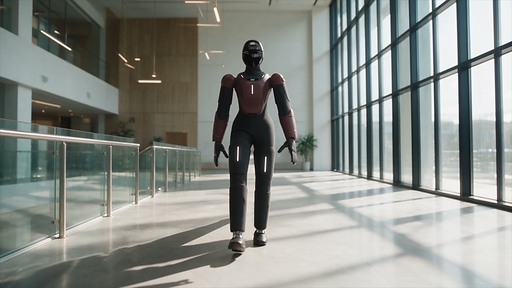
Large language models learn from massive amounts of information on the Internet. Humanoid robots, on the other hand, do not have a comparable source of data regarding how to act in the physical world. This data factory will create such data by collecting data generated when GENE.01 performs industrial tasks, and by leveraging digital twin simulations driven by the computing power of AMD to expand this experience.
Based on the strategic technical cooperation between both parties, AMD will become the AI infrastructure partner of Generative Bionics, and this data factory network will be supported by AMD Helios ™. The company stated that its rack-level architecture will provide the computational foundation for processing physical and synthetic data, training Physical AI models, and running thousands of digital twin scenario variations in parallel.
This data factory will connect the operation of robots in the real world, simulation, and AI development into a continuous cycle of “from reality to simulation and back to reality.” Generative Bionics indicates that this will enable it to configure and verify GENE.01 for specific industrial environments before customer deployment, and then feed the data from the deployed robot groups into subsequent training cycles.
Physical AI Data Factory for Industrial Deployment
Industrial humanoid robots must learn from the conditions they will encounter in their work. This requires the ability to capture data on contact, force, motion, distance, temperature, task constraints, and human-robot interactions, and this data must come from real operating environments. For GENE.01, the dataset will include visual and motion data, as well as signals collected through its multi-modal skin across the entire body.
The company stated that the first data factory hub covers an area of 5,000 square meters and is expected to become the largest humanoid robot Physical AI training facility in Europe. This facility will replicate the environment jointly selected with industrial partners and will allow multiple GENE.01 robots to continuously perform tasks under real conditions. These operations will generate high-fidelity physical data, which will be used to train world action models and to verify the complete robot system, including perception, control, safety behavior, and task execution, before deployment at customer sites.
Every physical environment and robot configuration will also be reconstructed as a digital twin. Subsequently, the same tasks can be repeated under thousands of variations in layout, objects, materials, operating conditions, and failure modes, which are not feasible to replicate in the physical environment. Models that have undergone simulation training and testing will be redeployed on robots for verification, while the data generated during physical operation will be used in the next round of training cycles.
AMD Helios ™ infrastructure for Physical AI
As part of the planned collaboration, Generative Bionics indicates its intention to utilize the high-performance AI computing infrastructure provided by AMD to support the development of its Physical AI data factory network. This infrastructure is expected to offer scalable computing power to meet the needs of AI model training, physical and synthetic data processing, as well as digital twin simulation. Generative Bionics will deploy robot, AI, and data engineering teams at the same location as this infrastructure to manage the entire process from raw multimodal robot data to datasets that can be used for AI, validated models, and the deployment of robot groups. Consequently, this data factory will connect the physical environment, data engineering, simulation, model training, and group deployment through a shared multi-site infrastructure.
Generative Bionics CEO Daniele Pucci stated: "We are replicating this world at both physical and digital levels in order to enable large-scale training before humanoid robots truly enter real-world environments. Physical AI The data factory is precisely how we achieve this goal: GENE.01 groups of machines learn from real industrial work, and we use AMD computational power to stress-test these skills in thousands of digital twin scenarios. Then, the verified world action models are reintroduced into real-world settings. This infrastructure enables Physical AI's action intelligence layer to be implemented in real customer environments. AMD has been by our side from day one, providing support on GENE.01 and now is at the core of the data factory. We are building this network in Europe to ensure that the data, models, and infrastructure that support industrial humanoid robots can be developed and operated across the European continent."
AMD Global AI Senior Vice President Keith Strier stated: " Physical AI represents an exciting opportunity to bring the power of AI into the real world, creating new possibilities for automation and industrial innovation. With AMD Helios ™ supporting Italy's first Physical AI data factory, we are providing scalable, high-performance computing infrastructure to turn this potential into reality. Our collaboration with Generative Bionics marks an important step forward in advancing European AI and industrial autonomy, which will support the development and deployment of the next generation of intelligent robotics applications while enhancing Europe's innovation capabilities."
About Generative Bionics
Generative Bionics is an Italian deep-tech company focused on developing humanoid robots driven by Physical AI. The company combines advanced robotics technology, artificial intelligence, biomechanics, and design to create humanoid robot platforms that can operate safely and reliably in complex industrial environments, while adhering to a human-centered approach throughout the development process. Its solutions aim to enhance safety, ergonomics, and operational continuity, and can be integrated into existing production processes without the need for specialized infrastructure. Generative Bionics indicates that the company has completed a seed financing round of 70 million euros, led by CDP Venture Capital, with participation from AMD Ventures, Eni Next, RoboIT, Duferco, and Tether to support the development of a new generation of human-centered Physical AI for industrial applications.
Media Contact
Ruder Finn : [ email protected ]
Generative Bionics News Office: [ email protected ]