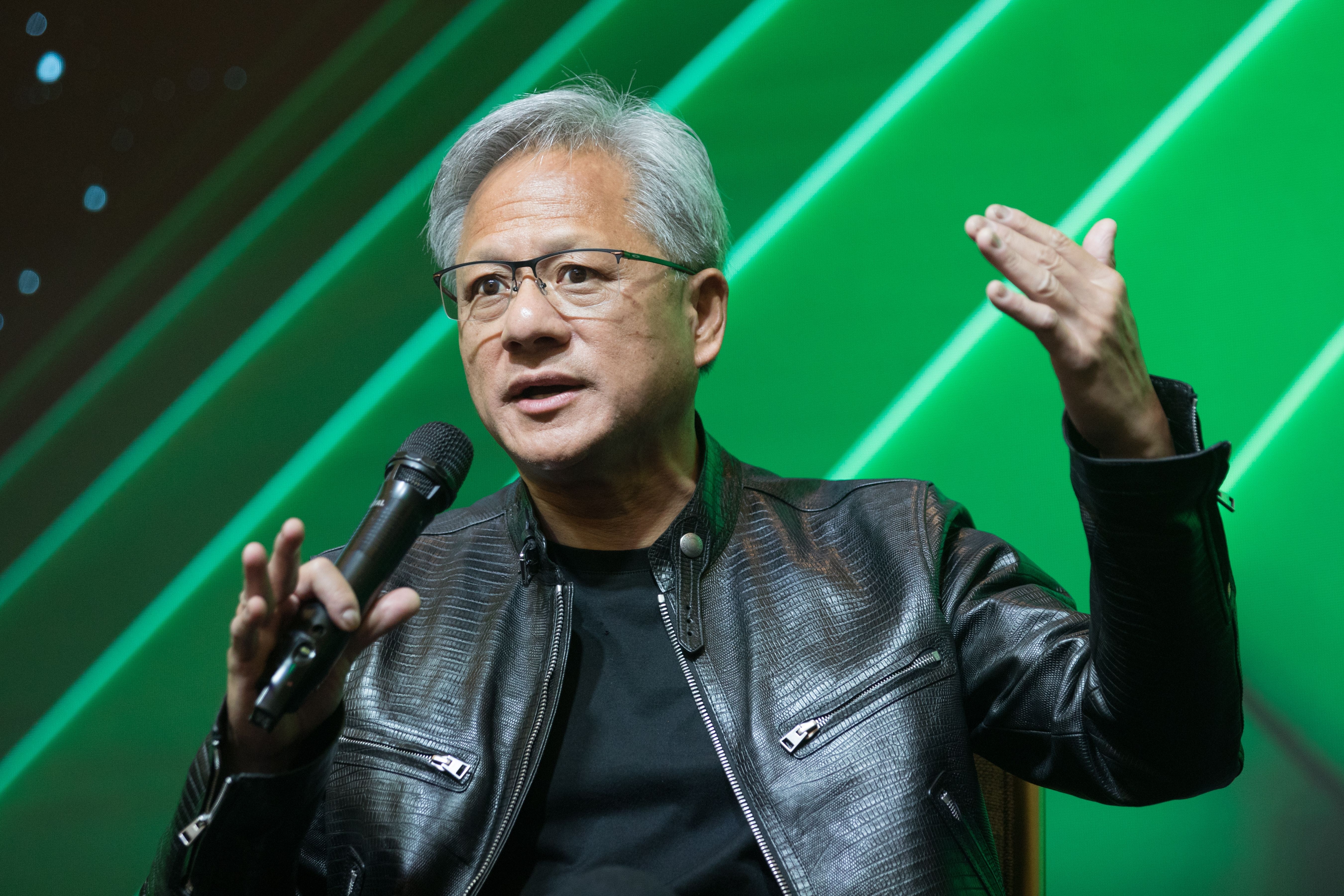
NVIDIA CEO Jensen Huang will deliver a keynote speech at the 2026 Berlin GTC. The Berlin GTC conference will last for three days, and during the same period, over 100 thematic forums will be held at the nearby Berlin STATION convention center. The topics covered include agents AI, robots, physical artificial intelligence, open-source models, and accelerated computing.
Jensen Huang started by posing a question: What do L’Oréal, al, Revolut, Spotify, Merck, Vodafone, Zara, Porsche, Nestlé, and HSBC have in common? He answered that they are all European companies and are all collaborating with NVIDIA to develop AI.
Before this speech, NVIDIA had just completed a one-week tour of Europe, visiting Paris, London, Stockholm, and Dublin. NVIDIA announced that it will invest nearly $10 billion into the entire European technology ecosystem, with over 12,000 partners.
"After decades of development in the computer industry, we are now standing at the beginning of a new round of industrial revolution," said Jensen Huang.
Jensen Huang compares AI to a five-layer cake: the energy-driven high-performance computing devices constitute AI factories; these AI factories rely on the models running on them to generate token and digital intelligence, which are ultimately integrated into various applications.
"Long before the AI model was introduced, the supporting infrastructure had to be in place first," he explained. For example, before the internet was born, a network had to be established first; before electricity became widespread, a power grid had to be built first.
To integrate into the AI economy, one cannot merely be a user of AI; one must also become a producer of AI. Europe is fully capable of achieving all this, and in fact, we have already set off on this journey.
AI Factory Embraces a New Form
Jensen Huang introduced that NVIDIA's full-stack AI factory covers hardware, system software, CUDA-X function libraries, as well as various models, and is a complete platform for building and operating AI infrastructure.
This set of technologies encompasses all the capabilities required to build the AI factory. This is precisely the direction in which NVIDIA is currently focusing its efforts, and it also serves as the cornerstone for empowering Europe to integrate into the AI ecosystem and participate in the AI economy.
He mentioned that the Vera Rubin platform has entered the mass production phase. This computing platform is no longer limited to basic models and large language models; it can process complete AI intelligents. At the same time, he showcased NVIDIA's latest rack-level hardware products.
Subsequently, Jensen Huang released the NVIDIA DSX POD reference plan: Partners will build a complete AI factory based on Vera Rubin within modular containers, completing integration and verification before leaving the factory. As long as the site's supporting public facilities are ready, the on-site deployment cycle can be reduced from 6 months to just 14 days.
"This will completely reshape the global supply chain," said Jensen Huang. "It will change the way data centers are built and implemented, and is expected to significantly improve delivery times."
The NVIDIA DSX AI factory platform can achieve zero consumption of cooling water, and on the premise of outputting the same AI computing power, it can reduce power consumption by up to 30%.
Agents are the new generation of computing platforms; security is essentially an engineering issue.
Jensen Huang proposed that agents possess the abilities to think, reason, iterate, and utilize tools; as their practicality improves, they will also continue to drive the consumption of token.
He disassembles the five main components of an agent: a model, a control framework for scheduling tasks and managing memory, a sandbox to isolate the framework, a knowledge base, and a toolkit. According to this definition, an agent is not just a model used to answer questions; it is capable of retrieving knowledge and performing actions with the help of tools.
"Top priority is to ensure the security of intelligent agents," said Jensen Huang. Autonomous intelligent agents have access to files, resources, networks, and tools, therefore they must adhere to the principle of least privilege and be under monitoring throughout the process.
NVIDIA offers a solution – a brand-new OpenShell secure AI intelligent agent reference architecture. This is a full-stack design that relies on an NVIDIA OpenShell open-source project at its core: a runtime that is subject to policy control and comes with kernel-level sandboxing, deployed between the intelligent agent and the systems it can manipulate.
Permissions, policy execution, and monitoring mechanisms all need to be dynamically adapted. 'Every time an agent is launched, the permissions it obtains are different.'
Open-source models transform industry expertise into competitive advantages.
Jensen Huang introduced that NVIDIA's open-source models provide a high-quality starting point for enterprises to customize AI capabilities.
NVIDIA's cutting-edge open-source models cover multiple fields: Nemotron language models, Cosmos world baseline models, GR00T humanoid robot models, Alpamayo autonomous driving models, Ising quantum-classical hybrid computing models, and Earth-2 physics models.
"We stand at the forefront of technology," he said, "in these various directions, we open our models up to everyone and continue to iterate on them. We have been deeply involved for ten years, and we will continue to invest in the future as well."
NVIDIA provides models, supporting data, and reproduction scripts to the public; companies can perform further training based on their own business data to create what Jensen Huang refers to as "sovereign intelligence ( sovereign intelligence )".
"You can start with top-tier open-source models like Nemotron, use your own exclusive data for post-training, adapt it to your business scenarios, and ultimately obtain powerful exclusive intelligent capabilities. This solution is very reasonable, and all the necessary technologies are now ready."
NVIDIA adds a new knowledge layer to agents
Jensen Huang then introduced the NVIDIA Agent Knowledge Base ( Agent Knowledge Foundation ): a set of models and function libraries designed to connect agents with enterprise data, whether it's unstructured information such as documents or structured data within databases.
He focused on introducing the Nemotron blockchain, which supports document parsing, query vectorization, and information rearrangement; there is also the brand-new Kumo model, which is specifically designed for making predictions based on structured data.
After all, the key to evolving an ordinary intelligent agent into a super intelligent agent is to enable it to access the enterprise's own knowledge base.
CUDA-X: Agent-oriented Acceleration Toolkit
Jensen Huang explains CUDA-X: A collection of acceleration libraries for scientific, engineering, research, and creative fields.
The number of developers using NVIDIA's accelerated computing platform has exceeded 11 million.
These acceleration libraries can empower simulators, solvers, and data processing engines, which are the professional tools that agents rely on to complete their tasks.
“CUDA-X tool is the professional toolbox for agents.”
Intelligent agents in laboratory, factory, and engineering scenarios
A demonstration video shows how the NVIDIA Intelligent Agent Toolkit integrates corporate knowledge, models, and tools, including three industry cases:
- Lila Sciences: Agents assist in the development of candidate therapies for B-cell lymphoma, utilizing virtual simulation experiments to guide automated laboratory research.
- Siemens Erlangen Plant: Agents make preliminary preparations for the launch of new products, first verifying production plans in digital twins before implementing them on the physical production line.
- Dassault Systèmes: Engineering agents complete vehicle design iterations, identify issues through simulation, and optimize solutions.
After the video playback, Jensen Huang stated, "The ownership of this knowledge and these tools belongs to the companies themselves. These are your industry expertise, and now all of this can be made a reality."
Telecommunications base stations, distributed AI infrastructure
Jensen Huang believes that AI is reshaping the communications industry, significantly improving spectrum utilization, and transforming cellular base stations into distributed AI infrastructure.
He mentioned that there are currently about 100,000 sites around the world that can support distributed data centers with a combined computing power of 100 gigawatts. NVIDIA, in collaboration with Nokia, completed the first commercial call over the T-Mobile network, and the related research and development took nearly 8 years.
"Now, CUDA can also support call services. AI will completely transform the communications industry and greatly improve spectrum efficiency."
AI Enters the consulting room
Medical and life science companies are leveraging NVIDIA technology to accelerate new drug development and expand diagnostic and treatment services.
NVIDIA collaborates with Siemens HealthCare to develop AI radiation therapy solutions:
The Nemotron intelligent entity is responsible for planning treatment plans; the Isaac medical platform and the digital twins of Omniverse library construction equipment and the patient's anatomical structure are used to simulate tumor-targeted irradiation; the Holoscan linked with IGX Thor connects real-time imaging and sensor data, and automatically adjusts the radiotherapy output when the patient's position changes.
Jensen Huang defines adaptive radiotherapy as a typical application of physical AI. During the treatment process, the shape of the tumor and the patient's physical condition continue to change. The system must be able to perceive these changes, lock in the tumor area, accurately segment the lesion, and simultaneously adjust the radiotherapy rays.
"The tumor morphology is changing, and the patient's body is also changing during the treatment process. This adaptive radiotherapy robot system must be able to perceive the dynamic environment, locate the tumor, precisely segment the target area, and adjust the radiotherapy plan accordingly."
Travel Sector: Multiple Leading Automakers Join NVIDIA's Automotive Ecosystem
Jensen Huang introduced that the NVIDIA Hyperion computing platform is being adopted by an increasing number of vehicle models, and autonomous driving software is integrating autonomous taxis into ride-hailing services.
Lucid cooperation projects Bolt, Mercedes-Benz, Volkswagen Commercial Vehicles, Einride. On-site demonstrations of autonomous driving implementation cases based on the Hyperion platform were presented, covering L3 and L4 level vehicles, as well as future Robotaxi fleets.
Volvo Cars announces the adoption of the Hyperion platform and the NVIDIA Alpamayo software stack for the development of safe autonomous driving. NVIDIA also releases the new AI and safety technologies to help developers scale up the construction, verification, and deployment of autonomous driving systems.
Volkswagen hatchbacks, Jaguar Land Rover, Volvo, and the next generation of Mercedes-Benz models will all be equipped with the Hyperion platform. Jensen Huang announced: "Welcome to join the Hyperion ecosystem."
Reference humanoid robots for robotics researchers
Jensen Huang has released the Agile ONE SN humanoid robot, which is built based on Isaac GR00T. The robot has 31 degrees of freedom and is expected to be launched next year; it can reduce the debugging cycle for researchers from several weeks to just a few days.
The platform adopts a modular design, allowing researchers to use the entire workflow or to select individual components as needed.
"This is a very high-quality starting base."
It relies on NVIDIA's open-source physics AI stack: Isaac Capture data collection, GR00T robot intelligent models, Isaac Lab simulation training, Isaac OS runtime, and is complemented by NVIDIA's open-source physics AI dataset. Partners such as Agility Robotics, Figure, KUKA, and NEURA Robotics have already commenced research and development on this platform.
Personal AI welcomes new hardware
At the end of his speech, Jensen Huang introduced the RTX Spark laptop released last week: a thin and high-end notebook equipped with a RTX graphics card, integrating NVIDIA's full AI platform, supporting creative acceleration, immersive gaming, and local large model inference.
Its computing power reaches 1 PFLOPS, with 128GB of memory; Jensen Huang used it to compare with DGX-1 which was delivered to OpenAI in 2016, making a poignant comparison:
"In 2016, I handed over a device with 1PFLOPS performance and 128GB of memory to the then still small OpenAI company." He raised this compact laptop, "This one also has 1PFLOPS performance and 128GB of memory. The only difference is that I can pick it up with one hand; back then, the DGX-1 required two people to carry it upstairs."
He played a video showing how an agent assists in training the Hugging Face Microduck robot, automatically setting up training tasks, conducting simulations in Isaac Sim, delivering the training tasks to the cloud, then transmitting the learned strategies back to RTX Spark for verification, and finally deploying them to the physical robot.
Four Microduck robots came onto the stage, obeying commands to sit down, stand up, and even "doze off" in place. Jensen Huang explained that they were developed on RTX Spark, trained on NVIDIA's supercomputing cloud, and acquired their skills in a digital twin environment.
"You were born in RTX Spark, trained on NVIDIA's massive supercomputers in the cloud, and learned various skills in RTX Spark and digital twins."
Speech Summary
Jensen Huang reviews the entire keynote speech: Europe is building its own AI economy; AI factories are continuously iterating, optimized for agents; physical AI is the next frontier direction.
That's all for today's key points. Everyone can develop intelligent agents, and every company in Europe will transform into a AI company. Here, we aim to build a prosperous AI economy.
"Let's work together to build the European AI economy and let AI take root to create value. Wishing this GTC conference great success." Jensen Huang concluded his speech.