On October 23rd, according to reports from the IT community, on October 22nd local time, Microsoft announced that when evaluating common emergency department cases in the United States using a dataset based on MIMIC-IV-ED, its developed AI diagnostic system achieved a diagnostic accuracy 1.7 times that of human doctors.
The system is named Microsoft AI Diagnostic Orchestrator, abbreviated as DxO. It simulates the process of a joint consultation by a team of expert doctors by coordinating multiple AI intelligents. Each intelligent agent collaborates to inquire about the patient's condition, orders laboratory tests, and conducts in-depth analysis and debate regarding potential diagnoses.
In a simulation assessment based on complex cases from the New England Journal of Medicine ( NEJM ), the diagnostic accuracy rate of MAI-DxO reached as high as 83%. In contrast, the accuracy rates for general practitioners and internists who can independently consult reference materials were only 36%.
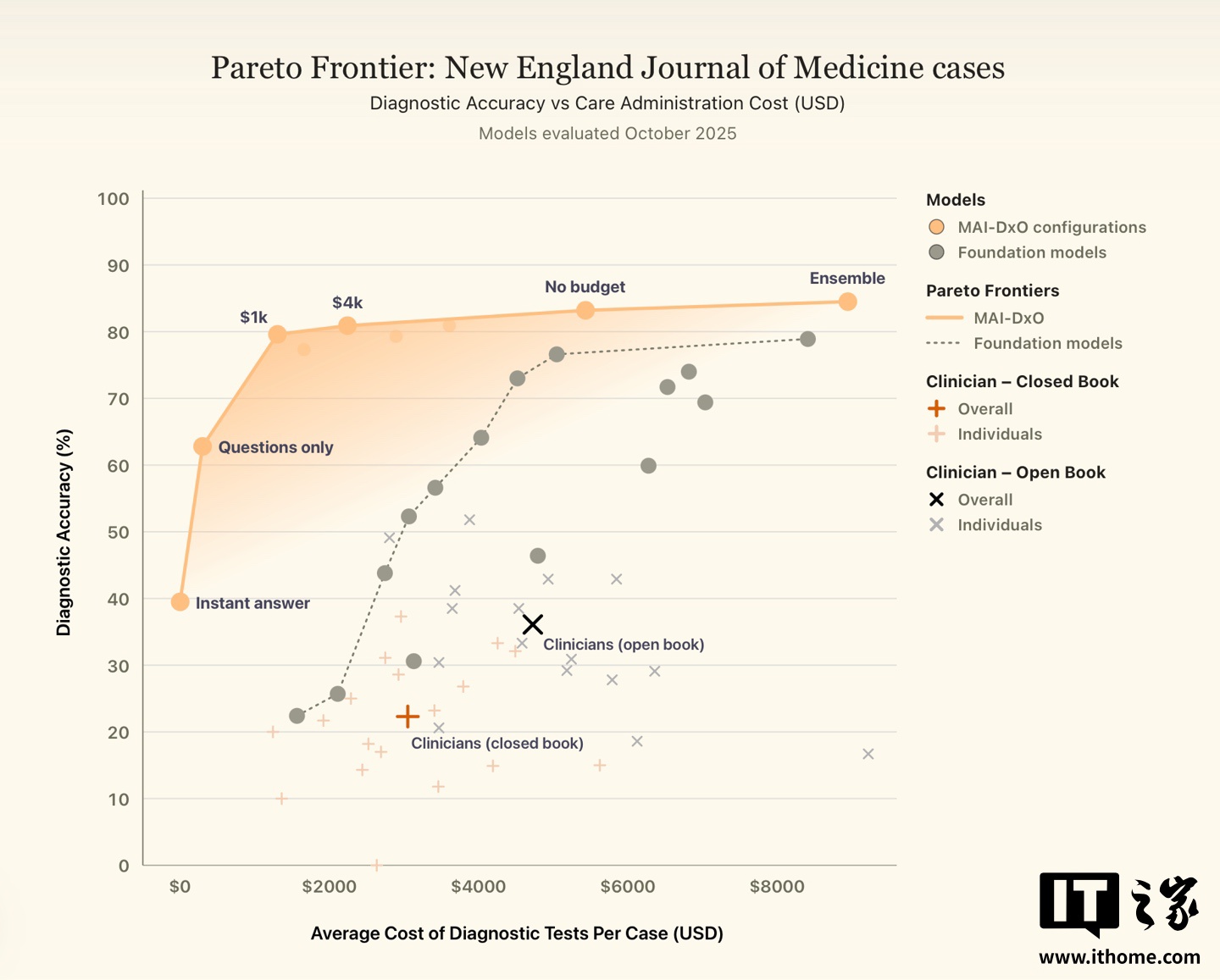
It is worth noting that such complex cases are usually treated in real clinical practice by specialized experts or through multidisciplinary medical teams, and these specialists were not included in this controlled experiment.
Officials stated that the cost required for this system is only half or even a third of that for doctors, and it can accurately determine the correct diagnosis with fewer laboratory tests and diagnostic procedures. This research finding has been officially published in the journal "Science."
The data from the study itself also shows that the significant improvement in the system's diagnostic capabilities is largely attributed to the enhanced performance of the underlying AI model, and Microsoft's orchestration architecture further amplified this performance gain.
Microsoft tested MAI-DxO against models from multiple institutions, including OpenAI, Google, Anthropic, Meta, and DeepSeek. Among them, the most outstanding performers were GPT-5 and GPT-5.5 under OpenAI.
IT Home with paper links:
https :// www.science.org / doi /10.1126/ science.aeh7930