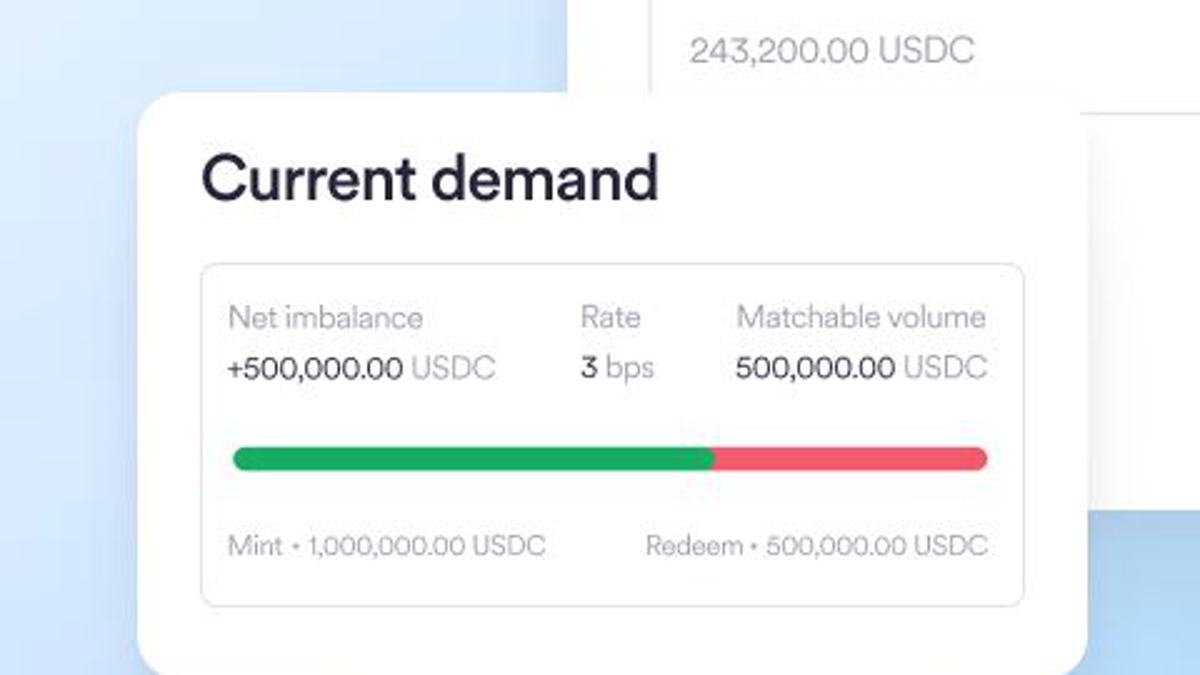


On October 22, Circle introduced Circle Match: Eligible Circle Mint customers can match minting and redemption requests for USDC in hourly auctions. The matching orders on the minting side receive rebates, while the redemption side pays settlement fees within the rules. At first glance, it seems like a new stablecoin trading market, but the legal terms of Circle draw clear boundaries: Match specify the fees and rebates for matching orders, but do not determine the price of USDC, nor do they change the holders' right to exchange one USDC for one dollar after deducting the corresponding fees according to the applicable terms. What it attempts to optimize is the flow of funds entering and exiting the issuance system, rather than re-pricing the dollar-stablecoin.
In traditional processes, if one institution wants to mint USDC and another institution happens to want to redeem it, both parties submit orders to the issuance system and then wait for the funds and tokens to be transferred. If it were possible to match qualified requests in opposite directions first, some of the fund transfers could be processed internally, reducing friction among participants. The product description for Circle Match sets auctions to occur once per hour; however, whether a transaction is completed still depends on the counterparty's requirements, submission conditions, qualifications, and settlement rules. Just because the system provides auctions does not mean that all mints and redemptions will be completed immediately, nor can planned efficiency improvements be claimed as already verified industry averages.
How do orders enter the auction, and who can participate?
According to the Circle Mint user agreement, Match is only available to customers who have completed the applicable admission process and received approval from Circle. The US dollars transferred into the minting side will become a separate, restricted balance labeled "for Circle Match only," which cannot be directly sent to external blockchain addresses. If a customer decides to withdraw, they can apply for redemption in accordance with the terms and have the corresponding US dollars remitted back to their registered bank account. This design indicates that the balance used in the auction is not a USDC that can be freely used from a regular wallet at any time. If the term "restricted" is overlooked in reports, institutions may mistakenly assume that the invested funds can still be used on the blockchain simultaneously.
There are also constraints on the redemption side of the order. According to the protocol, when a redemption request is submitted, the corresponding weekly withdrawal limit is checked and reduced to reflect the anticipated payment in US dollars. There is a lock-up period before the settlement of each auction, during which new orders can be submitted or price conditions can be improved, but cancellations or other modifications are not allowed. Such micro-rules are related to risk management: if the finance team misjudges the timing of the lock-up period or liquidity needs, they may not be able to make adjustments at the time when they most wish to redeem the order. Auctions are not a shortcut to bypassing traditional bank risk controls; instead, they require institutions to manage deadlines and authorizations more meticulously.
The fee structure can easily lead to another misunderstanding. As mentioned in Circle, the successful redeemer pays the settlement fees, which are then allocated to the matching creator as a rebate; the specific economic parameters are disclosed on the Match interface. From this, one cannot deduce a fixed rebate rate, nor should the rebate be considered risk-free interest. For creators, the actual net profit must take into account the occupation of funds, bank wire transfers, operational costs, and potential opportunity costs; for redeemers, it is necessary to compare these with ordinary redemption channels in terms of time, cost, and certainty. Whether the price improves depends on whether there are people willing to take the other side in the same round.
Why is net settlement still inseparable from bank time?
The terms of Circle clearly state that the fiat settlement for matching redemption orders is subject to the business hours of US banks. The fact that USDC on the blockchain allows transfers throughout the day does not mean that the US dollar banking system will also complete the final payment throughout the day. To label it as round-the-clock fiat settlement just because there are "hourly auctions" would confuse the two levels of digital asset transfer and bank payments. This is particularly important for cross-border funds teams: a successful auction in one time zone does not guarantee that the local bank account will receive the US dollars at the same moment.
The business logic of Match is more akin to bringing the issuance and redemption demands in opposite directions to a controlled environment, thereby enhancing institutional clients' visibility into the price of funds. The potential benefits include reducing unnecessary turnover, allowing redeemers to choose acceptable fees, and enabling issuers to compete for rebates. However, all these effects must be verified by the actual depth of orders. If there are only redemptions and no issuances in the market during a certain period, auctions cannot create a counterparty out of thin air; moreover, if large clients possess better operational capabilities, whether smaller institutions will also benefit requires data to answer that question.
It should also be noted that the so-called 'net amount' does not mean that all funds do not need to be recorded in the issuer's books, nor does it imply that customers can bypass their own audit responsibilities. The institutional finance team still needs to align each order with bank statements, Circle Mint balances, on-chain transfers, and the internal general ledger. If the auction only matches part of the orders, how to handle the remaining demand, when to exit or transfer it, will affect the final funding plan. The product description explains the general direction of the mechanism, but the actual operational boundaries must still be based on the complete rules and contracts that are visible to the customers.
Investors should next pay attention to three verifiable indicators. First, the scope of participation by qualified institutions and the actual trading volume of the auction, rather than just whether the product page is launched. Second, the proportion of matched orders in the total Circle Mint traffic, to avoid exaggerating a marginal feature as a major restructure of the issuance mechanism. Third, the fees, waiting times, and failure rates before and after transactions, especially distinguishing between the completion of auction settlement and the arrival of bank fiat currency in accounts. Without these indicators, "efficiency improvement" remains mainly a product claim.
The stablecoin industry often promotes on-chain speed as a selling point, but Circle Match reminds the market that the real bottlenecks for institutions lie off-chain: cash management, bank operating hours, quota limitations, and compliance requirements. It is an operational transformation aimed at both the issuance and redemption processes, not a trading experiment that USDC seeks to decouple from the US dollar peg. Understanding this distinction is crucial to appreciating the significance of the news: Circle is designing new matching mechanisms for institutional traffic, and the effectiveness of these measures on a larger scale remains to be verified by subsequent public data.