

Key Points
More news is coming soon, with continuous updates.
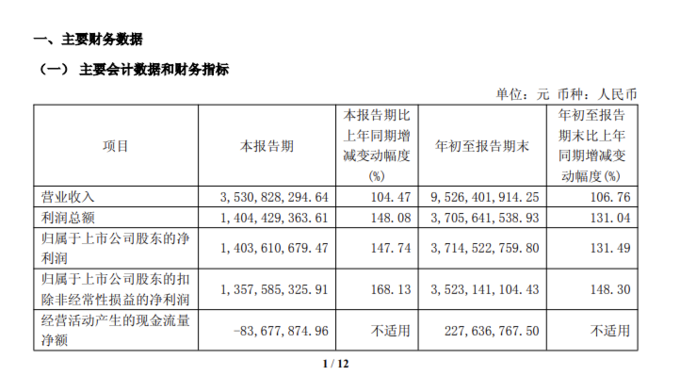
In the third quarter of the Cambrian period, revenue and net profit continued to grow at a high rate, and the implementation of artificial intelligence applications further expanded the business scale. On October 23, Cambrian disclosed its report for the third quarter of 2026, which showed that it achieved operating revenue of 3.531 billion yuan in the third quarter, a year-on-year increase of 104.47%; the net profit attributable to shareholders of the listed company was 1.404 billion yuan, a year-on-year increase of 147.74%.
In the first three quarters, the company achieved a cumulative operating revenue of 9.526 billion yuan, a year-on-year increase of 106.76%; net profit attributable to the parent company was 3.715 billion yuan, a year-on-year increase of 131.49%. Both revenue and profit growth rates exceeded 100%, with the net profit growth rate being higher than that of revenue, further expanding the scale of profitability.
In its financial report, Cambrian stated that the revenue growth was mainly due to the continuous expansion of the market and active support for the implementation of artificial intelligence applications. With the growing demand for AI computing power and the gradual advancement of related applications, the company's business scale continues to expand.
At the same time, there have been significant changes in the company's balance sheet. As of the end of the third quarter, total assets reached 22.364 billion yuan, an increase of 66.43% from the beginning of the year; inventories, prepaid expenses, and notes payable all increased substantially, reflecting the expansion of business along with an increase in procurement and supply chain settlement activities.
Revenue and profits maintain high growth, with enhanced profitability of core business operations
In the first three quarters of 2026, Cambricon achieved operating revenue of 9.526 billion yuan, a 106.76% increase compared to 4.607 billion yuan in the same period of the previous year. The company attributed the revenue growth to its continuous market expansion and active support for the implementation of artificial intelligence applications.
In terms of profitability, the net profit attributable to the parent company in the first three quarters was 3.715 billion yuan, a year-on-year increase of 131.49%; after deducting non-recurring gains and losses, the net profit was 3.523 billion yuan, a year-on-year increase of 148.30%, which is higher than the net profit attributable to the parent company. In the third quarter, the net profit attributable to the parent company and the net profit after deducting non-recurring items increased by 147.74% and 168.13% respectively year-on-year.
In the first three quarters, the company's non-recurring gains and losses totaled approximately 191 million yuan, of which government subsidies accounted for about 123 million yuan, and gains from changes in the fair value of financial assets and their disposal amounted to about 55.52 million yuan. The growth rate of net profit after deducting non-recurring items was higher than that of net profit attributable to the parent company, indicating that profit growth after excluding non-recurring gains and losses was even faster.
In addition, the net profit after deducting the impact of share-based payments for the first three quarters was 3.905 billion yuan, a year-on-year increase of 120.32%. This indicator reflects the impact of share-based payment expenses on the current period's profits and is different from the net profit attributable to the parent company as calculated under accounting standards.
R&D investment continues to increase, but operating cash flow still fluctuates.
In terms of research and development, Cambricon invested 523 million yuan in the third quarter, a year-on-year increase of 73.66%; the cumulative investment for the first three quarters was 1.225 billion yuan, a year-on-year increase of 45.35%. Since the growth rate of revenue exceeded that of R&D investment, the proportion of R&D investment to revenue for the first three quarters dropped to 12.86%, a year-on-year decrease of 5.43 percentage points. Despite this, the total amount of R&D investment is still increasing, and the company continues to intensify its efforts in technological development.
In terms of cash flow, the net cash flow generated from operating activities in the first three quarters was 228 million yuan, compared to a net outflow of 29.3 million yuan in the same period last year, indicating a turnaround from negative to positive. However, the net cash flow from operating activities in the third quarter alone was -83.68 million yuan, showing fluctuations in cash flow between quarters.
As of the end of the third quarter, the company's prepaid expenses amounted to 3.044 billion yuan, a significant increase from 745 million yuan at the beginning of the year; inventory was 11.665 billion yuan, also notably higher than the approximately 4.943 billion yuan at the start of the year. The simultaneous growth in prepaid expenses and inventory may be related to procurement and supply chain arrangements, but the specific impact still needs to be assessed in conjunction with order delivery, inventory turnover, and sales collection situations.
Significant increase in inventory and notes payable, with an expansion in the scale of supply chain funds
As of the end of the third quarter, Cambricon's total assets amounted to 22.364 billion yuan, a 66.43% increase from the beginning of the year; the net assets attributable to shareholders of the listed company were 15.124 billion yuan. As the asset scale expanded, there were also significant changes in the company's working capital-related items.
On the asset side, inventory increased from approximately 4.943 billion yuan at the beginning of the year to 11.665 billion yuan, and prepaid expenses rose from 745 million yuan to 3.044 billion yuan. On the liability side, notes payable increased from 351 million yuan to 4.966 billion yuan, accounts payable increased from 765 million yuan to 1.827 billion yuan, and contract liabilities increased from about 610,000 yuan to 141 million yuan.
The aforementioned changes indicate that the company's procurement and inventory management, as well as its supply chain settlement scale, have significantly expanded. An increase in inventory helps to ensure resources for subsequent production and delivery, but it also means that more funds are tied up in stock. Whether inventory can be successfully converted into revenue and cash flow in the future will become an important indicator for assessing the quality of the company's operations.
At the same time, the company's debt-to-asset ratio increased from 11.87% at the beginning of the year to 32.36%. Although the net assets attributable to shareholders of the listed company still amounted to 15.124 billion yuan, with the increase in inventory, prepayments, and notes payable, it will still be necessary to pay attention to changes in inventory digestion, supplier settlements, and operating cash flows in the future.