


Key Points
- AI Investment returns and the valuation of tech stocks are becoming key considerations in the market's reallocation of funds.
- As investors assess the return prospects of massive capital expenditures, funds may shift from high-valued tech stocks to other sectors, and the rising demand for U.S. Treasuries also reflects a defensive sentiment.
- However, whether the market style has truly shifted remains to be seen. The key lies in whether tech stocks can continue to face pressure and whether the upward trend can spread to more sectors.
There is a clear divergence in the U.S. stock market: tech stocks are suffering heavy losses, while more than 300 components of the S&P 500 index are closing higher. U.S. Treasuries have seen their largest single-day yield decline since the banking crisis of 2023. The market performance on Thursday indicates that the sell-off in tech stocks has not yet turned into a general market decline, and investors' attitudes towards AI transactions are also changing.
On October 22, the S&P 500 index fell by 1.2%, recording the largest single-day decline since July; the Nasdaq Composite Index tumbled 2.6%, and the Philadelphia Semiconductor Index plummeted by 6.7%. In sharp contrast, the Dow Jones Industrial Average remained relatively stable, while the small-cap Russell 2000 Index closed slightly higher. Weighted indices such as the S&P 500 also rose by 0.7%, indicating that most of its constituent stocks performed better than the market capitalization-weighted index.
Meanwhile, the yield on 10-year U.S. Treasury bonds fell by 19.3 basis points to 4.952%, marking the largest single-day decline since March 2023. Tech stocks came under pressure, bonds strengthened, while other stocks remained relatively resilient, posing a key question for the market: Is this merely a short-term adjustment after investors pulled out of overvalued AI assets, or is there a change occurring in the tech-driven market trend that has persisted for several years in the U.S. stock market?
Tech stocks go their separate way from other sectors
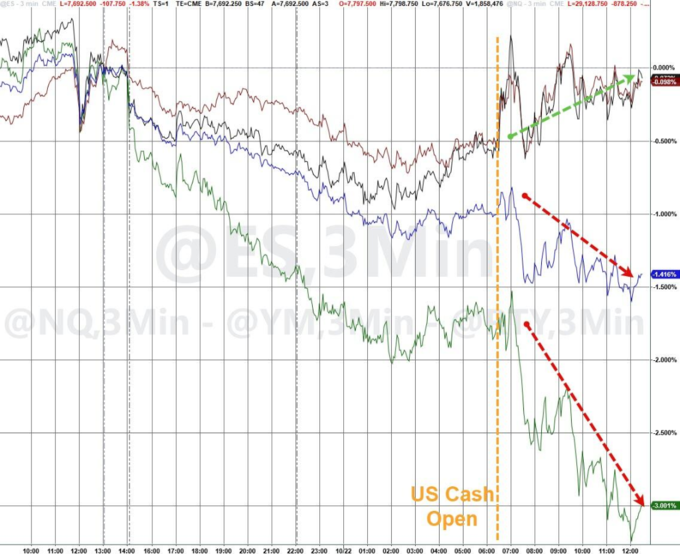
According to MarketWatch, on Thursday, over 300 components of the S&P 500 index closed higher, yet the index still recorded a decline of more than one percentage point. This divergence reflects an increasingly evident split within the U.S. stock market: the decline in a few high-weight technology stocks was sufficient to offset the gains of a large number of other stocks.
AI transactions previously drove U.S. stocks higher, but as related companies announced their financial results and disclosed capital expenditure plans, investors began to pay more attention to when the substantial AI investments would translate into actual returns. On Thursday, the semiconductor sector saw particularly significant declines, with the Philadelphia Semiconductor Index falling by more than 26% from its June high, entering a bear market zone in a technical sense.
In contrast to tech stocks, defensive sectors such as consumer staples have performed relatively strongly. Market strategist Mark Hackett pointed out that since 2026, the leading sectors in the U.S. stock market have been changing frequently, and the divergence in trends between AI stocks and other sectors has become increasingly prominent.
However, the broad increase in individual stocks does not necessarily mean that a new round of style transition has been established. Only if tech stocks continue to weaken while other sectors can maintain their relative strength is it possible for funds to gradually spread from a few large tech stocks to a broader market.
U.S. Treasury yields plummet, increasing demand for safe-haven assets
As the stock market adjusts, there is strong buying interest in U.S. Treasuries. On Thursday, the yield on 10-year U.S. Treasuries fell by 19.3 basis points to 4.952%, marking the largest single-day decline since the banking crisis in March 2023. The yield on 2-year U.S. Treasuries also dropped significantly, reflecting investors' re-evaluation of interest rate prospects and short-term risks.
The strengthening of bonds occurring simultaneously with the decline in tech stocks indicates that investors are adjusting their asset allocation in search of more defensive investment options. However, this does not necessarily mean that the market has shifted towards a recessionary trading pattern. Geopolitical tensions, rising oil prices, and re-evaluations of the Federal Reserve's future interest rate path could also collectively drive funds towards U.S. Treasuries.
Therefore, what is more worth paying attention to on Thursday's market is not the daily gains and losses, but whether the internal capital preferences of the market are continuing to change. If tech stocks continue to be under pressure, while other sectors remain strong and demand for U.S. bonds remains high, then the U.S. stock market may enter a broader phase of style rebalancing; conversely, if tech stocks stop falling and rebound, the divergence on Thursday may just be a short-term adjustment.
At present, the AI trades remain a key variable in observing the trend of the US stock market. The market has not simply shifted from bullish to bearish; rather, it is re-evaluating the returns on AI investments, the valuations of tech stocks, and the relative attractiveness of other industries. Whether a new round of style shifts has truly taken place will need to be verified by the performance over more trading days.