Key points:
- Two medical technology companies are said to have reached an agreement on the economic terms of the merger and acquisition.
- A dispute over executive leadership rights brought an end to negotiations for this $34 billion deal.
- This failed transaction indicates that control of the company is of paramount importance in mergers and acquisitions.
Two medical technology companies are said to have reached an agreement on the financial terms of a $34 billion merger. The two parties negotiated over equity, valuation, and even payments in the billions of dollars. However, the deal ultimately fell through due to one issue on which neither side was willing to compromise: who will take on the role of CEO?
The proposed merger involves the orthopedic business of Johnson & Johnson (Johnson & Johnson), as well as British medical device manufacturers Smith & Nephew. According to a survey by The Financial Times on October 23, the negotiations broke down a few weeks before they were scheduled to be announced.
This reminds people that even large-scale corporate mergers and acquisitions depend on decisions that cannot be resolved solely through financial calculations.
A $34 billion deal for which almost all terms have been agreed upon
Smith and Nephew came into contact with Johnson & Johnson at the beginning of 2026, proposing to merge its business with DePuy Synthes. DePuy Synthes is one of the largest manufacturers of artificial joints and orthopedic equipment in the world.
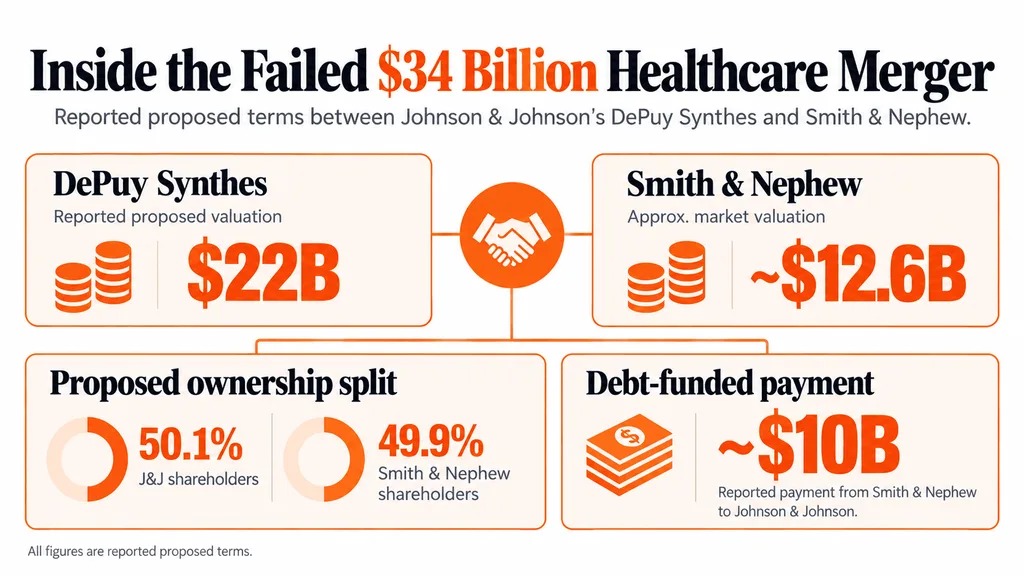
The proposed transaction values Johnson & Johnson's department at approximately $22 billion, while the market value of Smith & Nephew is about $12.6 billion.
Smith and Nephew will also arrange for approximately $1 billion in debt financing to be used to make payments to Johnson & Johnson, in order to help balance the differences in business valuations between the two parties.
This transaction could have integrated complementary hip and knee replacement product portfolios, bringing greater scale to both companies at the same time.
But as other abandoned mergers and acquisitions cases have shown, financial logic does not necessarily guarantee that both parties will reach an agreement on the final transaction.
CEO, who left the company in 2019, has returned to the negotiating table.
The disagreement focuses on two senior executives: Namal Nawana and Deepak Nath.
Nawana served as the Chief Executive Officer of Smith and Nephew for approximately 18 months before leaving in 2019 due to a salary dispute. Six years later, he joined Johnson & Johnson, where he was responsible for leading DePuy Synthes in its planned division.
According to people familiar with the matter, Johnson & Johnson hopes that Nawana will serve as the CEO of the merged company. However, Smith and Nephew insist that the current CEO Deepak Nath should retain this top position.
Chairman Rupert Soames is said to have required Nath to take on the position of CEO as a condition for closing the deal.
This controversy illustrates why corporate governance can determine the success or failure of a transaction worth billions of dollars.
When two management teams have different visions for the future of a company, the issue becomes particularly thorny.
What happens after a $34 billion merger and acquisition fails?
Johnson & Johnson previously announced plans to split up DePuy Synthes in October 2025; the business generated sales of approximately $9.2 billion in 2024.
After the negotiations failed, Johnson & Johnson stated that they prefer to advance an independent split plan.
This also indicates that an acquisition proposal that seems highly attractive may fall through even before investors receive a formal offer.