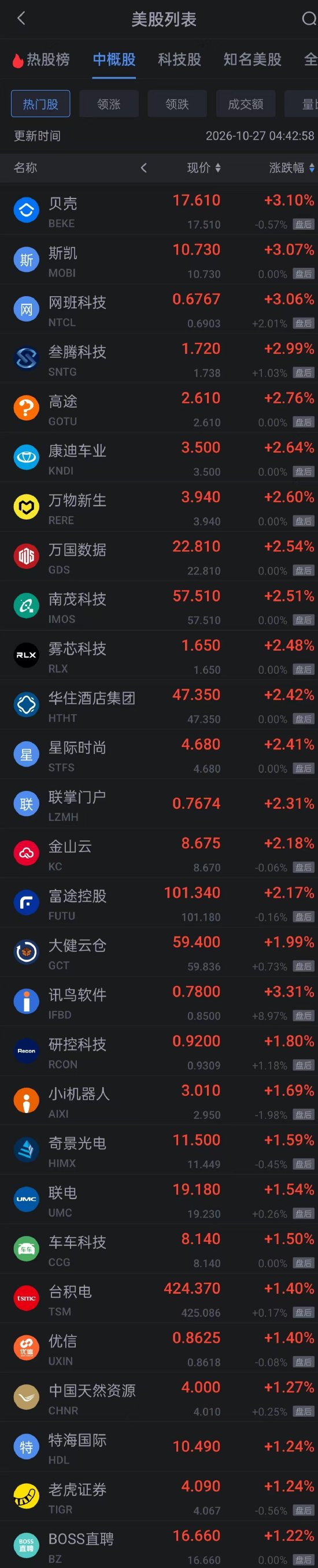
On Monday, U.S. stocks rose. Previously, Anthropic submitted the IPO document, reigniting the market's enthusiasm for artificial intelligence trading, and the stock prices of semiconductor manufacturers soared as a result.
The Dow Jones Industrial Average rose by 146.36 points, an increase of 0.28%. The S&P 500 Index rose by 0.7%, and the Nasdaq Composite Index rose by 0.82%.
After the public submission of Anthropic and the application for IPO, chip stocks and other AI related stocks rose. Investors are betting that this issuance will inject new vitality into the weak tech sector. The AI company, which develops Claude, reported that its revenue for the six months ending June was 16.29 billion US dollars, a 1304% increase from 1.16 billion US dollars in the same period last year. The company plans to list on NASDAQ, with the stock code " ANT ".
Other major AI news also boosted risk appetite. On Monday, Meta Platforms stated that it plans to raise $95 billion to support its AI investments. SpaceX CEO Elon Musk said over the weekend that the satellite and rocket launch company has reached a $40 billion debt deal for AI chips.
The semiconductor sector is on the rise, with iShares semiconductors ETF ( SOXX ) soaring by nearly 3%. NVIDIA's stock price increased by 2.4%, Micron rose by 3%, Broadcom increased by 2.3%, and Supermicro Semiconductor increased by 2.8%.
Freedom Capital Markets Chief Market Strategist Jay Woods said when talking about Anthropic: "The market needs this, just as it needs SpaceX. This is a big boost to confidence, and I expect demand to be there because people have been waiting and discussing this for a long time."
This news alleviates some concerns regarding the AI transaction. In recent weeks, due to growing market concerns that the large-scale expansion of data center spending is not sustainable, the AI transaction has been performing weakly. The S&P 500 index and the Nasdaq index have been declining for two consecutive weeks. Chip manufacturers are in a bear market, with SOXX falling by about 25% from its peak. This ETF has already declined by 13% just this month.
"New Cloud" ( neocloud ) concept stocks rebounded on Monday, despite Elon Musk previously stating that more than 200 companies in this field are facing "guppy-level extinction." New Cloud is a cloud computing company that specializes in building and renting AI dedicated infrastructure. The stock price of CoreWeave soared by nearly 2%, and Iren rose by 2.1%.
The decline in oil prices also helped to boost major stock indices. Brent crude oil futures fell by 0.8%, closing at $115.81 per barrel; US West Texas Intermediate (WTI) crude oil fell by 1.5%, to $101.76 per barrel. News reports suggest that the United States and Israel may plan to strike Iran after the mid-term elections, and Brent crude oil reached its highest level since April on Friday.
Wall Street is entering the busiest week of the earnings season, with 163 companies comprising the S&P 500 index set to release their third-quarter results. Following last week's Meta unsettling announcements, investors are eagerly awaiting the financial reports from major tech corporations Alphabet, Amazon, and Microsoft.
Traders are awaiting the Federal Reserve's decision on Wednesday. Futures trading in federal funds indicates that there is a 90% likelihood that policymakers will maintain interest rates within the current target range of 3.75% to 4%.
Bank of America, on the other hand, expects the Federal Reserve to raise interest rates by 25 basis points, noting that this would be a move with “significant resistance.”
In a research report, Claudio Irigoyen, an economist at Bank of America, wrote: "The decision in October will test Chairman Powell's determination to bring about a 'radical transformation' to the Fed's forward guidance strategy. The challenge Powell faces at the press conference is to prevent the market from betting on 'policy mistakes.' If the Fed raises interest rates, investors will worry about excessive policy tightening; if the Fed remains inactive, the market will question the Fed's credibility in fighting inflation."
BTIG Cautions: Midterm elections may mark the "starting point for a decline" rather than a "starting point for a rebound."
Wall Street investors who are hoping for a rise in the stock market after the mid-term elections in November may be disappointed. Strategist Jonathan Klingsky believes that as the credit situation deteriorates and multiple sectors show signs of fatigue, the risk of a stock market decline is on the rise. BTIG
Klinsky stated in his research report that the S&P 500 index could fall back to around 7,300 points, near its 200-day moving average and the summer low. This would represent a decline of about 4.3% from the index's recent level of 7,631 points. If this technical support level is broken, the benchmark index could continue to fall further. This warning poses a challenge to the widespread expectation that the stock market will rise after the uncertainties surrounding the "November 3 election subside."
Historically, mid-term elections have often been turning points for the stock market, but Klingsky believes that the market's exceptionally strong performance this year reduces the likelihood of that scenario recurring.
Klinsky wrote, "The reason why the stock market tends to perform well in November, a year of mid-term elections, is that the S&P 500 usually weakens before the elections. This year, however, the situation is exactly the opposite."
Goldman Sachs: Retail trading to decline by 45% by the end of 2025, while maintaining a bullish outlook for the S&P 500 to reach 8,000 points by year's end.
Goldman Sachs stated that in recent months, retail investors have significantly reduced their stock trading, but the overall demand for stocks among American families remains strong enough to help support the market amidst increasing selling pressure and an increase in stock supply.
Goldman Sachs strategist Ben Schneider stated in a research report on October 23 that retail trading volume has declined by 20% since the summer and by 45% since the end of 2025. Individual investors currently account for about 9% of the total trading volume in the U.S. stock market, which is lower than 15% at the end of last year and near the lowest level since 2020.
Meanwhile, after a week of turmoil for stocks heavily held by hedge funds, these funds have reduced their market exposure. This divergence, characterized by "cooling down of speculative activities while household investment demand remains strong," is of great significance to the stock market.
Households are the largest holders of US stocks, and their willingness to invest is an important source of support for stock prices.
Goldman Sachs expects that in 2027, the net supply of publicly traded stocks in the United States will see the largest increase since 2000, making it particularly important for households to continue buying.