Newsletter
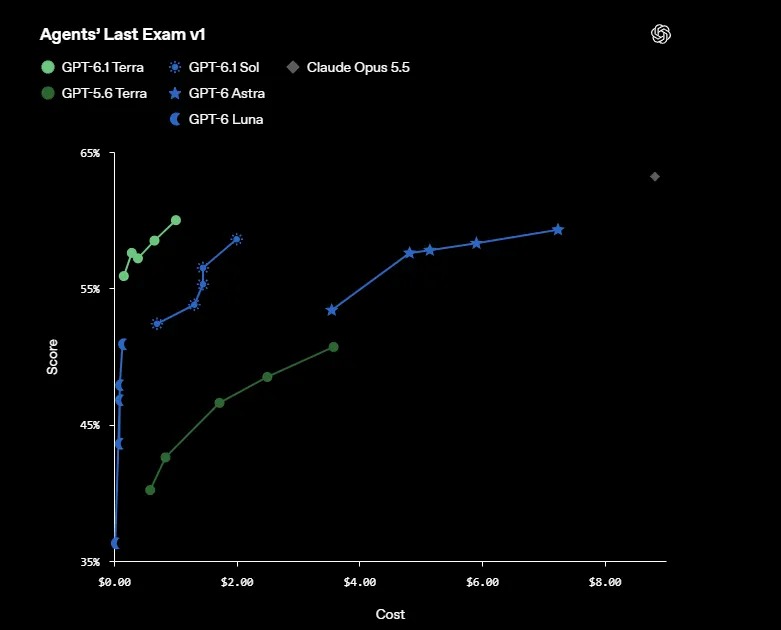
OpenAI released GPT-6.1 on October 26th. The standard API price is 50% lower than GPT-5.6 and Terra.
This model is available for users Plus, Pro, Enterprise, and Edu within ChatGPT Work and Codex. Developers can invoke it through gpt-6.1-terra.
In an internal test of OpenAI, the factual error rate of Terra decreased from 53.6% to 16.7% under low inference intensity; at the highest inference intensity, its completion rate in task Terminal-Bench was 50.3%, while for GPT-5.6 and Terra, it was 21.5%.

OpenAI released on Monday, GPT-6.1, Terra. This represents an upgrade to the middle-layer models in their product line. The company stated that this model costs developers 50% less than GPT-5.6 and Terra, and it also processes computer tasks faster with higher accuracy.
Terra is a model designed for everyday use, suitable for routine office tasks such as reading screen content, clicking between applications, and drafting responses. These capabilities are referred to as computer and use, which mean that AI can view screens, click, and input just like a human. A 50% discount applies to the standard API price, which is the fee developers pay when integrating the model into their own applications.
OpenAI stated in the announcement: 'Compared to GPT-5.6 and Terra, this is a significant upgrade, with the standard API price reduced by 50%.' The company also mentioned: ' GPT-6.1 and Terra have now been launched, and all Plus, Pro, Enterprise, and Edu users of ChatGPT Work and Codex can use them.'
ChatGPT Work is the proxy mode of OpenAI within ChatGPT; it can work across applications, browse websites, and complete tasks on behalf of users; whereas Codex serves as a programming tool for OpenAI. Free users will utilize a lower-tier version of GPT-5.6 Luna.
In an internal test with OpenAI, which utilized prompts specifically designed to induce errors in the model, the factual error rate of Terra decreased from 53.6% at a low level of reasoning intensity to 16.7%. At the highest level of reasoning intensity, this ratio further dropped by 18 percentage points to 4.3%.
On Terminal-Bench 4.0, this test is used to evaluate the performance of the encoding proxy when executing tasks in the computer command-line terminal, and scores are determined based on the proportion of tasks completed successfully. Terra completed 50.3% of the tasks at the highest inference intensity, while GPT-5.6 and Terra completed 21.5%. OpenAI also indicates that Terra completed tasks at an average speed more than three times faster than GPT-6, Astra, GPT-6.1, and Sol. All of the above data come from OpenAI itself, and the error rate testing is also an internal test.
On June 26th, OpenAI launched Terra as part of the GPT-5.6 family. Initially, it was only available in a limited preview version due to requests from the Trump administration, and later on July 9th, it was made available to the public. At that time, it was positioned as a model that was competitive with GPT-5.5 and had approximately half the cost of the latter.
In September, within a few minutes of Anthropic releasing Claude Opus 5.5, the company launched GPT-6, Sol, and Luna, but did not release a new Terra.
For in-depth research or complex coding, OpenAI still recommends that users use GPT-6.1 Sol or GPT-6 Astra.