

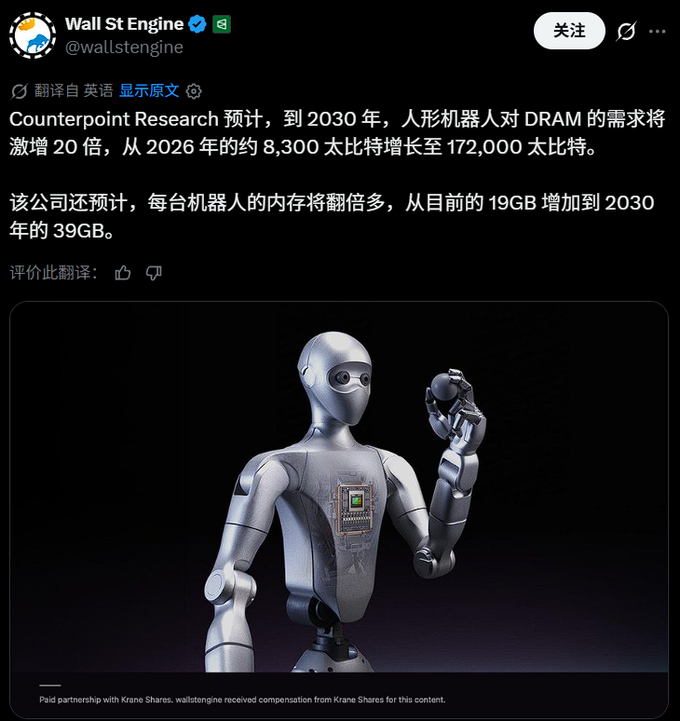
Counterpoint Research It is predicted that the storage demand for humanoid robots will increase by 20 times in 5 years. Elon Musk directly dismissed this as "absurd" and asserted that the demand for robots RAM will surpass that of everything else on Earth, while the demand for super-intelligent computing power will far exceed that of robots. This statement has once again raised the potential of the humanoid robot storage market to a new level.
At the same time, memory chip giant Micron Technology has identified humanoid robots as an important driving force for future storage demand, placing them on par with autonomous vehicles as a core incremental market for "physical AI" devices, and directly linking this demand to its existing high-bandwidth, large-capacity storage product line.
Elon Musk's stance echoes Micron's strategic layout, both pointing towards a market narrative that is taking shape: humanoid robots and the super intelligence behind them may become the core drivers of the next round of storage and computing power demands, with a scale that could far exceed current market expectations.
On the 26th local time, @wallstengine posted on the social platform X, stating that Counterpoint Research predicts that by 2030, the demand for humanoid robots in DRAM will surge by 20 times.
In response to the external predictions and analyses regarding the storage needs of humanoid robots, Musk made a strong statement. He wrote, "Absurd analysis. The storage needs of robots will surpass everything else on Earth, because robots need to operate on a physical basis in order to manipulate atoms."
The core logic of this statement is as follows: As the executing agents in the physical world, humanoid robots need to perceive, make decisions, and manipulate matter in the real-world environment. This imposes structural and continuous demands on real-time computing and storage capabilities, rather than being marginal or incremental. Musk's implication that the storage requirements for humanoid robots will only increase by 20 times over a period of 5 years seriously underestimates the actual scale of this industry.
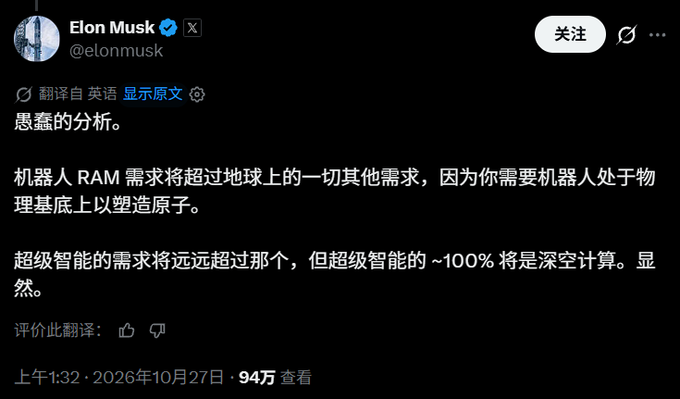
What is more noteworthy is that Musk further highlighted super intelligence ( Super Intelligence, SI ) as a separate category, stating that its demands "will far exceed those of robots," and added that approximately 100% of the super intelligence computing power will be deployed for deep space computing ( deep space compute ). This assessment extends the ultimate realm of storage and computing power requirements from Earth to the level of space infrastructure.
Against the backdrop of Musk's aforementioned comments, Micron Technology has taken the lead in incorporating humanoid robots into its core strategic narrative at the commercial level.
According to Yahoo Finance, in the latest round of comments related to AI, Micron's management clearly identified humanoid robots as an important source of future storage demand, categorizing them alongside autonomous vehicles under the emerging category of "physical AI devices." The company's management directly linked this anticipated demand to its existing high-bandwidth memory (HBM) and large-capacity storage product lines, emphasizing that there is no need to develop new products. The existing core products aimed at AI servers and data centers are sufficient to meet the storage needs of humanoid robots.
The strategic significance of this positioning lies in the fact that humanoid robots are expected to use server-level DRAM and storage solutions similar to those used in data centers and autonomous driving platforms. This means that Micron can repurpose its existing production capacity and technological accumulation to this emerging end-market without the need for large-scale capital restructuring.
Micron's current overall narrative relies heavily on AI and the demand from data centers, the tight supply and demand situation of DRAM and NAND, as well as the high-profit margin cash flow supported by long-term customer agreements. Positioning humanoid robots as another outlet for server-level storage is highly consistent with the aforementioned narrative, but the pace of their implementation still depends on whether Micron can continue to execute advanced manufacturing processes and fill the production capacity linked to its large-scale capital expenditure plans.
For investors, the storage needs for humanoid robots are currently still in the strategic positioning phase and have not yet resulted in a quantifiable contribution in financial data.
The most critical observation window in the near term is Micron's earnings guidance for the first quarter of its 2027 fiscal year. Management has provided expectations for that quarter: revenue of approximately $61.5 billion and earnings per share after dilution of about $37.84. The market will closely monitor whether management will provide an update on the specific contribution of physical AI devices—including those used in autonomous driving systems and early humanoid robot deployments—to these expectations, in order to determine at what pace this theme will actually translate into revenue.