Key points:
- Ripple has received final approval from the US Federal Reserve to establish a national trust bank
- RLUSD Reserve Management to Come Under Increased Federal Regulatory Supervision
- Despite achieving milestone progress at the bank level, the price reaction of XRP is limited.
Ripple has obtained final approval from the US Federal Reserve (Office, of, the, Comptroller, of, the, Currency, OCC), and is now able to establish Ripple National Trust Bank. As the market value of its RLUSD stablecoin reaches approximately $2.5 billion, this federal authorization process has also been completed.
In an official announcement on October 26, the company confirmed this decision, bringing to an end the conditional approval phase that began in December 2025. This federally regulated institution will be responsible for managing the RLUSD reserve, acting as a collateral trustee for token holders, and providing entrusted digital asset custody services.
This decision completed the earlier bank application process for Ripple, further integrating its institutional infrastructure into the US banking system, but it did not transform the company into a traditional retail bank.
Ripple National Trust Bank has obtained federal regulatory oversight over the reserves of RLUSD.
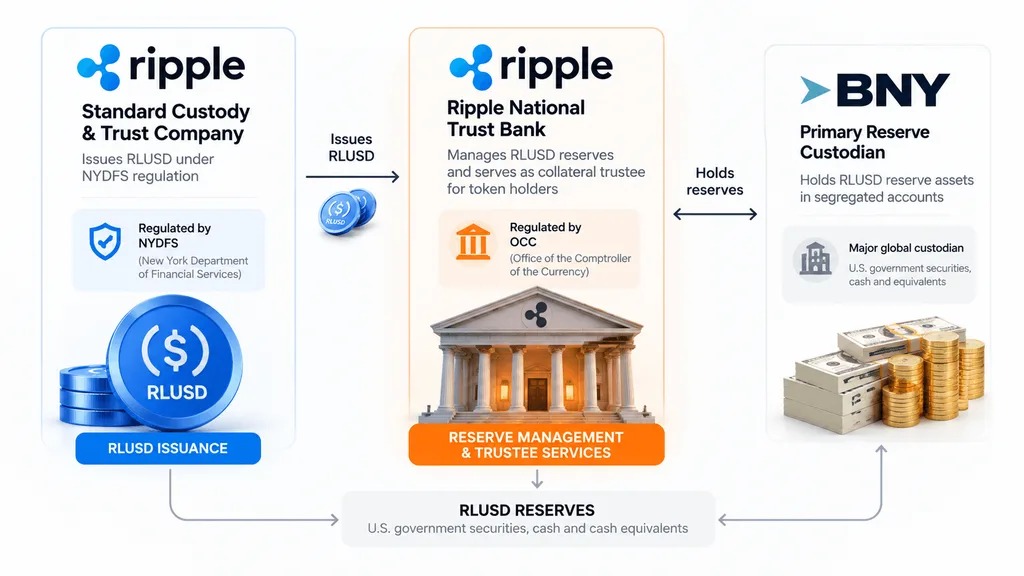
The approved architecture divides responsibilities among two subsidiaries of Ripple.
Standard Custody and Trust Company, which are regulated by the New York State Department of Financial Services, will continue to issue RLUSD. Ripple National Trust Bank will manage the isolated reserves and act as the trustee for the interests of the holders.
This means that the underlying reserve management infrastructure of this stablecoin will be supervised by OCC, while its issuance will still remain within the existing regulatory framework in New York.
Ripple indicates that RLUSD is fully supported by US dollar deposits, US government securities, and cash equivalents. BNY remains its primary reserve custodian, and independent monthly reports provide information regarding the circulating tokens and reserve assets.
The growth of this stablecoin has attracted mature financial institutions. Standard Chartered Bank recently launched a RLUSD custody service related to institutional trading infrastructure.
At the same time, RLUSD is also expanding the uses of this token beyond simple payment and transfer functions in its lending market.
New licenses may enhance the positioning of Ripple towards institutional customers, however, federal regulation does not guarantee redemption performance, nor can it eliminate all financial risks.
What exactly is permitted by the bank approval for Ripple?
Ripple National Trust Bank will be authorized to provide entrusted custody services after its opening, including managing digital assets on behalf of institutional clients.
However, this national trust license does not permit ordinary retail banking services, such as lending to consumers or traditional deposit services.
This distinction is very important, as earlier approvals from OCC clearly limited the proposed bank to the scope of activities permitted to trust companies.
This milestone of Ripple follows closely after the final establishment of the relevant regulations for GENIUS Act by OCC. These regulations set federal operational standards for payment-type stablecoins, with a timeline before January 2027.
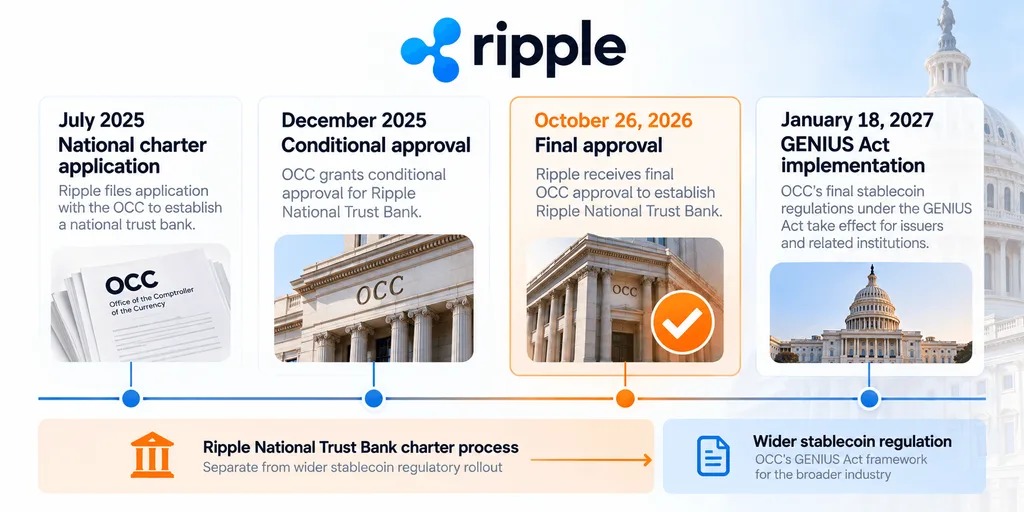
This license provides a federally regulated institution for Ripple, but it does not automatically address all obligations of issuers under the upcoming regulations.
What does the approved pair of Ripple to XRP price mean?
Despite milestone progress in regulation, according to market reports from the same period, XRP traded at around $1.30 on October 27, indicating a relatively mild short-term price reaction.
RLUSD is issued on blockchain networks including XRP Ledger and Ethereum. Expanding the management of stablecoins or reserves does not necessarily require institutions to purchase XRP additionally.
Ripple is also developing separate lending and payment financing services based on XRP. These services may establish a more direct connection with that token.
Whether an institution adopts it also depends on whether the enterprise chooses the services of Ripple. Previously, the payment cooperation between RLUSD and Arf demonstrated a path to enter cross-border finance, but their transaction volumes should not be regarded as the transaction needs of XRP.
Marcus Hale
Marcus Hale is a cryptocurrency and financial markets contributor who reports on Bitcoin, Ethereum, digital assets, regulation, ETF, and institutional adoption. His work focuses on driving market progress, investor trends, and the broader forces shaping the crypto economy.