Key Points
- Boeing's profits fall short of expectations, despite a rise in quarterly revenue
- The commercial aircraft division incurred a loss of $697 million amidst production challenges.
- A record backlog of $745 billion in orders highlights that demand remains strong.
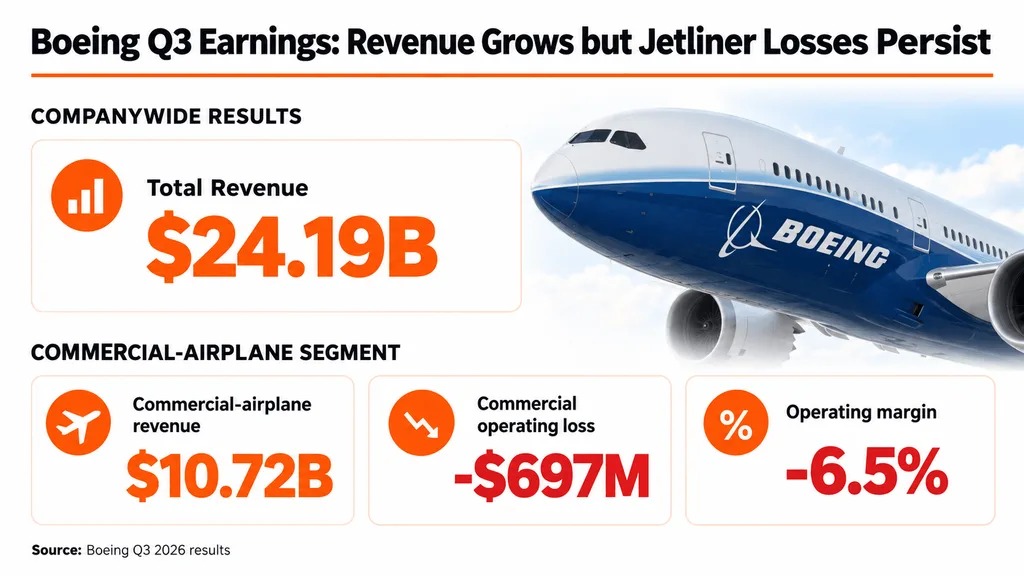
Boeing announced revenue of $24.2 billion for the third quarter on October 27, but due to higher production costs, its commercial aircraft division incurred an operating loss of $697 million, resulting in earnings that fell short of Wall Street's expectations.
According to Boeing's third-quarter performance, the company also achieved positive free cash flow and expanded its order backlog to a record $745 billion, indicating that its financial recovery is still progressing unevenly.
Boeing's commercial aircraft business has yet to achieve profitability.
Boeing's commercial aircraft business reported revenue of $10.72 billion this quarter, a decrease of about 3% year-on-year, and its operating margin fell to negative 6.5%.
The operating loss of $697 million reflects the expected higher production and supply chain costs, as well as a combination of weaker profitability in the aircraft delivery structure.
Boeing delivered 161 commercial aircraft this quarter, which is lower than the 171 delivered in the previous quarter. The effort to increase the monthly production of the 737 from 42 to 47 units has faced challenges, partly due to limitations in wing manufacturing.
Nevertheless, there has been recent progress in regulatory aspects. The Federal Aviation Administration (FAA) of the United States has completed certifications for the 737 MAX 7 and MAX 10 models, clearing an important hurdle for these two models that had experienced long delays.
Boeing's production issues also stand in contrast to the strong demand from airlines, including some that are considering purchasing new aircraft for international expansion.
A record backlog of $745 billion in orders obscures an uneven recovery.
Boeing's backlog of orders as of the end of September reached a record $745 billion, up from $715 billion at the end of June, including more than 6,300 commercial aircraft.
However, backlogs of orders represent unperformed contractual work, not immediately identifiable revenue. Boeing must manufacture and deliver aircraft while controlling costs in order to convert these demands into sustainable profits.
This is similar to the company's previous $13.1 billion F-15 contract, where the contract ceiling does not imply that an equivalent amount of revenue can be obtained.
Boeing's defense business, on the other hand, is a more impressive segment, with revenue of approximately $7.94 billion, a year-on-year increase of 15%, and operating profits close to $500 million.
Its defense business portfolio also benefits from Apache helicopter support efforts, but long-term orders must still be executed on a profitable basis.
Can Boeing convert strong demand into cash?
Boeing had approximately $464 million in free cash flow in the third quarter, and despite ongoing aircraft production issues, this is yet another quarter with positive free cash flow.
However, the free cash flow for the first nine months was still approximately negative $359 million, which means that the company still relies on a stronger fourth quarter to achieve a positive annual free cash flow.
This turning point also occurs against the backdrop of a challenging aviation market. American Airlines recently announced a significant increase in fuel expenses, indicating that even though travel demand remains resilient, rising operating costs will put pressure on customers.
Adrian Cole
Adrian Cole has been engaged in financial market reporting for over 6 years, with a focus on cryptocurrencies, stocks, and macroeconomic trends. He tracks Bitcoin, major altcoins, the U.S. stock market, interest rates, commodities, as well as data points that drive market changes. Over the years, he has written hundreds of market updates and analysis articles, with an emphasis on price trends, investor sentiment, and the connections between traditional finance and digital assets.