Key Points
- U.S. 10-year Treasury yield returns above 5%
- The market generally expects that the Federal Reserve will maintain interest rates unchanged after raising them in September.
- The expectation of interest rate hikes in December continues to put pressure on stock valuations.
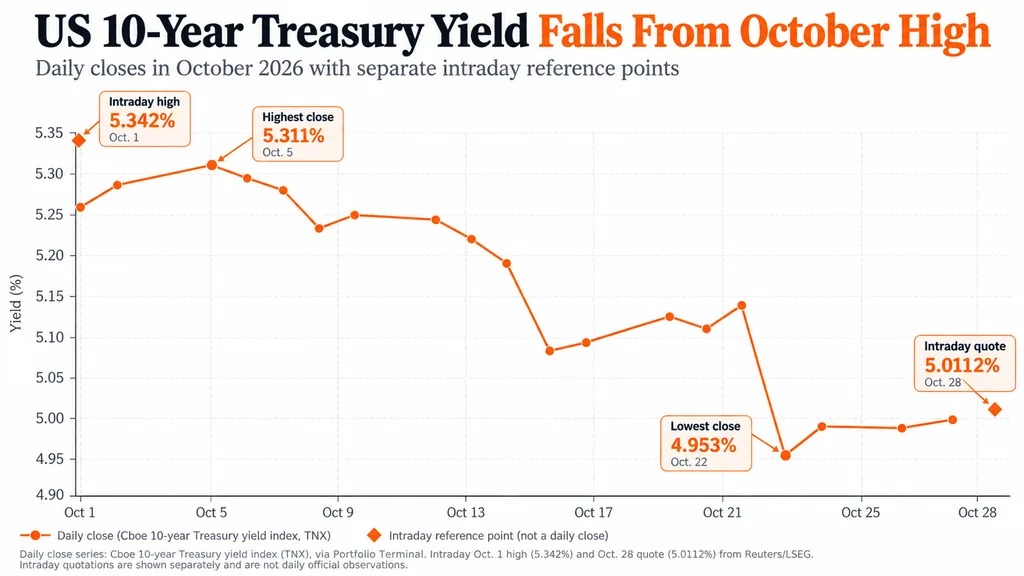
On Wednesday, October 28th, as investors awaited the Federal Reserve's interest rate decision and weighed the possibility of another interest rate hike before the end of the year, the yield on U.S. Treasury bonds rose back above 5%.
According to the data from Trading Economics, the yield on 10-year benchmark government bonds is approximately 5.01%, which is higher than the previous trading day's rate of around 5.00%. Last week, this yield briefly fell below that level, as concerns about the valuation of artificial intelligence stocks in the market prompted funds to flow towards government bonds.
The market generally expects that the Federal Reserve will maintain the benchmark interest rate at 3.75% to 4.00% unchanged, but the bond market indicates that investors are still concerned about inflation and longer-term borrowing costs.
Treasury bond yields have returned to 5%, despite market expectations that the Federal Reserve will remain inactive.
The previous round of bond sales reflected rising energy prices, persistent inflation, and concerns about the market's demand for U.S. government borrowing.
It is of great significance for the yield rate to return to 5%, as the yield rate of government bonds affects mortgage loan rates, corporate financing costs, and the discount rates used by investors to assess future returns.
Even companies with strong performance face a more stringent valuation environment in an environment where investors can obtain relatively high returns from government debt.
Coinpaper Previously, there have been analyses of this tension between corporate profitability and high bond yields, especially in the case of technology companies with relatively high valuations.
Federal Reserve Interest Rate Decision: Why December is More Important than October
The Federal Reserve raised interest rates by 25 basis points in September, raising its benchmark range to 3.75% to 4.00%.
However, economists almost unanimously expect that policymakers will pause interest rate hikes this month.
A survey by Reuters among 100 economists found that 94 expected interest rates to remain unchanged in October, while all respondents predicted another interest rate hike in December.
Coinpaper The Federal Reserve's previous outlook also discussed these expectations, but as new data is released, market probabilities may change.
Inflation remains the core challenge.
In September, the consumer inflation rate reached 3.7% year-on-year, and the persistently high energy costs have also made it more complicated for central banks to strive for price stability.
This combination presents an uneasy trade-off: raising interest rates can curb inflation, but it also increases the borrowing costs for households and businesses.
What does a 5% Treasury yield mean for stocks and Bitcoin?
Even if the Federal Reserve maintains the short-term benchmark interest rate unchanged, higher long-term yields will still put pressure on stocks.
During the decline of the S&P 500 index in September, this relationship became apparent. At that time, stronger economic data raised expectations for borrowing costs and dragged down the stock market.
Bond yields also affect technology companies that finance expensive artificial intelligence infrastructure, making future earnings less valuable when calculated based on today's values.
Cryptocurrencies also face similar macroeconomic challenges.
At the same time, when higher yields make fixed-income investments more attractive, investors have also turned to government bonds in the past, which is reflected in the assessment of national debt by PIMCO.
Maya Bennett
Maya Bennett is a financial journalist with experience covering cryptocurrencies, stocks, and broader market trends. Her areas of focus include Bitcoin, major digital assets, the stock market, monetary policy, as well as economic developments that influence investor sentiment. She is adept at transforming rapidly changing market news into clear and concise reports.