Key Points
- Cloud market channels accounted for nearly half of the revenue, Anthropic.
- Amazon and Google generated millions of dollars in revenue by distributing the Claude model.
- The declaration documents show that Anthropic's dependence on AI's competitors is deepening.
The revenue of Anthropic has grown at an astonishing rate, yet nearly half of its business flows through technology companies that are also in competition with it.
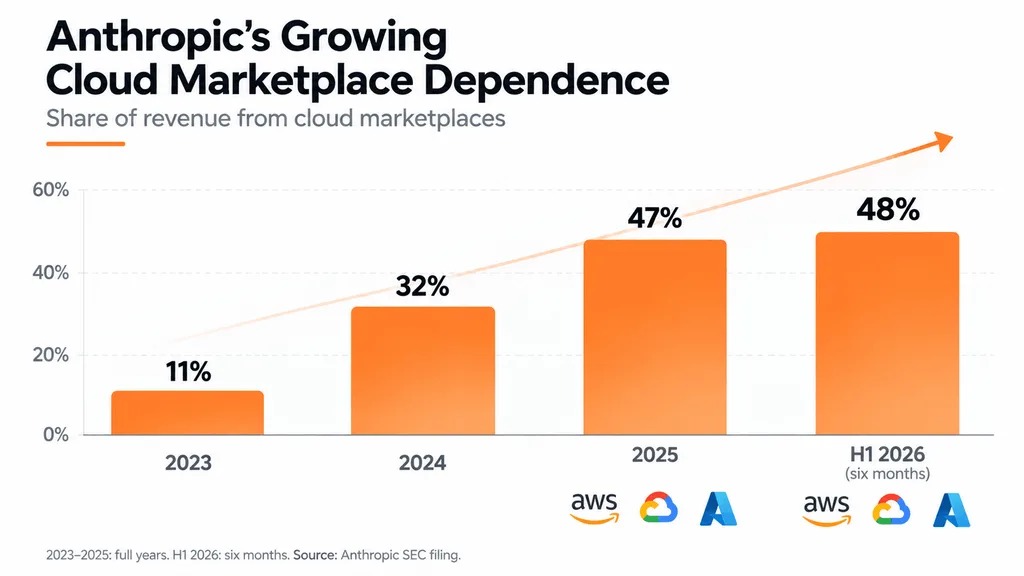
This Claude developer achieved revenue of $16.29 billion in the first six months of 2026, which is about $1.2 billion higher than the same period last year. However, 48% of that revenue came from cloud markets operated by Amazon, Google, and Microsoft.
According to the documents submitted to the U.S. Securities and Exchange Commission on October 26 by Anthropic, this ratio has increased from 11% in 2023 to 32% in 2024, and is expected to reach 47% in 2025.
These figures reveal the financial contradictions behind one of the fastest-growing AI companies in the world: Anthropic is becoming increasingly dependent on those companies that not only provide it with funding, distribution, and hosting services but also compete with its technology.
Amazon and Google helped generate $2.16 billion in sales.
The cloud market model of Anthropic allows enterprise customers to purchase Claude through the platforms they are already using.
For example, a company operating on Amazon Web Services can connect to Claude through AWS Bedrock, without having to establish separate business partnerships with a brand-new infrastructure provider.
This arrangement allows Anthropic to access mature corporate clients, but it also comes at a cost.
In 2025, approximately $2.16 billion in sales were completed through the market channels of Amazon and Google. According to calculations by Reuters, Anthropic paid about $351 million in distribution fees to these platforms, which means that about 16% of each dollar in cloud market sales went to the platforms.
These payments bring about an important accounting distinction. Anthropic includes all sales revenue from the cloud market in the total revenue, and then lists platform fees as expenses.
Different accounting treatment methods have made the comparison of OpenAI complex, therefore without examining distribution costs, the revenue figures are not so comparable.
The investors of Anthropic are also its suppliers and competitors.
Amazon and Google both play multiple roles in the business of Anthropic.
They not only provide computing power infrastructure, distribution of Claude, and investment in Anthropic, but also develop competing AI products. This brings commercial advantages, but it may also lead to potential conflicts in pricing, computing power capacity, and customer acquisition.
These relationships also explain the huge infrastructure costs behind the growth of Anthropic.
In 2025, the company spent approximately $7.3 billion on computing and infrastructure, while its revenue for the same period was only $4.6 billion.
Its cloud financing arrangements also explain why AI developers can commit to investing billions of dollars to lock in future computing power capacity without owning the underlying infrastructure.
Why IPO makes cloud dependency issues more prominent
The company's recent IPO filing has allowed potential investors to more clearly see the risks underlying its sales expansion.
The file also shows a high concentration of customers. If the main customers cut back on AI expenditures, this will constitute another risk.
Meanwhile, Anthropic continues to expand its computing power capacity through agreements reached with Broadcom, Google, and other technology suppliers.
Adrian Cole
Adrian Cole has been engaged in financial market reporting for over 6 years, with a focus on cryptocurrencies, stocks, and macroeconomic trends. He tracks Bitcoin, major altcoins, the U.S. stock market, interest rates, commodities, as well as data that drives market fluctuations. Over the years, he has written hundreds of market updates and analysis articles, with an emphasis on price trends, investor sentiment, and the connections between traditional finance and digital assets.