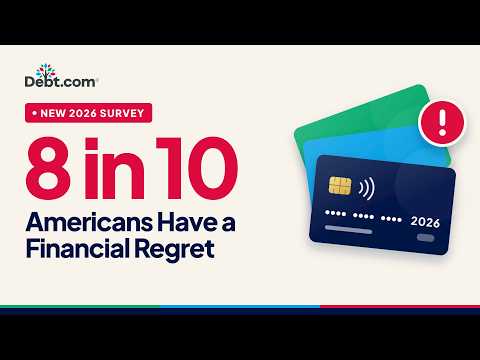
Fort Lauderdale, Florida, October 28th / PRNewswire / -- Financial regret has now officially become a national epidemic. According to a comprehensive new survey by Debt.com, nearly eight in ten Americans (78%) carry at least one major financial regret, and for an increasing number of consumers, this burden seems to haunt them almost all the time.
Although the pressure of daily living costs occupies the headlines, the most shocking finding of this survey is that Americans are increasingly relying on high-interest credit cards to sustain their lives, while others are entering retirement without any preparation.
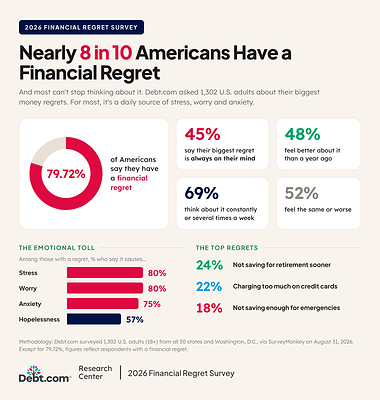
The main findings of the Debt.com financial review investigation include:
- "Plastic Trap" Continues to Expand: For the second consecutive year, spending too much on credit cards remains the number one financial regret in the United States, with the proportion rising to 24% (up from 21% last year).
- Debt never sleeps: Financial stress is causing a heavy psychological burden. Among those who regret using credit cards, more than a third (37%) say that debt is always on their minds, and another 32% say they think about it multiple times a week.
- Retirement Blind Spot: Among those who regret not saving for retirement, one-fifth (20%) say they haven't saved a single penny for the future, a proportion that has further worsened compared to last year. At the same time, the baby boomers have the highest level of regret for not starting to save earlier, at 48%.
Debt.com Chairman and Certified Public Accountant Howard Dvorkin stated: "When people are juggling six different credit cards at the same time and carrying balances month after month, they are not managing their money; they are dealing with a crisis. People use credit cards as a buffer to absorb inflation and rising living costs. But you can't overcome high interest rates. When more than one-third of consumers say that credit card debt is always on their minds, what we see is not just a balance sheet problem; what we see is a crisis of exhaustion."
A startling glimpse into consumers' reality:
- Among those who regret using credit cards, the vast majority carry significant balances: 40% have debts ranging from $5,000 to $15,000, and 22% have debts ranging from $15,001 to $30,000.
- Regret stemming from six-figure student loans has significantly decreased (only 4% of the debt is between $100,000 and $200,000), but the level of regret among borrowers with medium amounts of debt has risen sharply—nearly four in ten (39%) regret borrowing between $25,000 and $50,000.
- For millennials, owning a home is a double-edged sword; while some regret missing out on the opportunity to buy a house, 9% also regret buying a home in the first place, mainly due to unexpected maintenance and repair costs (57%) as well as high interest rates (43%).
Take Back Control: Debt.com Proposes 4 Steps to Overcome Financial Regret
- Take stock of your credit cards: As the problem of multiple card debts intensifies, stop using the credit cards that you are trying to repay. List each card, along with their corresponding balances and interest rates, so that you can determine which one to repay first.
- Confronting Psychological Burden: Recognize that persistent worry is a sign of burnout. Allow yourself to break this cycle and shift your mindset from passive coping (“just barely getting by month after month”) to an active recovery plan.
- Seek professional guidance: Don't bear it in silence. Contact certified financial professionals to learn about structured solutions that may help you get back on track.
- Establish a small emergency buffer: Since many credit card pitfalls begin with unexpected emergency expenses, try to establish even a small safety cushion. This way, minor car repairs or medical bills won't immediately force you to rely on high-interest credit cards again.
For access to the complete survey data, detailed results by generation, and research methods, please visit the financial regret survey page at Debt.com.
About Debt.com: Debt.com is a trusted source of information for consumers seeking help with credit card debt, student loans, tax debts, credit repair, and more. By connecting people with screened financial professionals and educational tools, Debt.com helps Americans make smarter decisions regarding debt reduction and financial management, taking control of their finances once again.