


Google and Microsoft released their quarterly financial reports on the same day, and the landscape of the cloud computing market has quietly changed. However, the fates of the two companies in the capital market are quite opposite.
On October 28th, Google's parent company Alphabet announced its third-quarter revenue, which increased by 25% year-on-year to $127.58 billion, slightly below Wall Street's expectations.
Despite the impressive performance of Google Cloud's business, concerns among investors have arisen due to the slowdown in the growth rate of search advertising revenue, causing Google's stock price to plummet by 10% after the market closed.
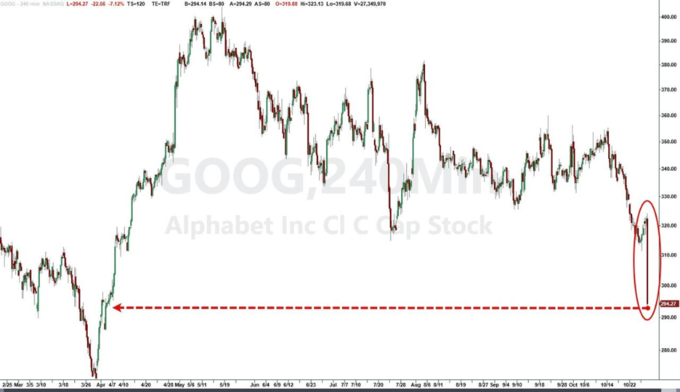
Microsoft, on the other hand, saw its overall performance exceed expectations, with its stock price rising by about 3% after the market closed, and the cumulative increase for the year reaching 12%.
The Information analysis suggests that these two financial reports reflect the different monetization challenges and growth strategies of tech giants under the AI investment trend: Google is facing the pain of monetization due to the AI reengineering of the search experience, while Microsoft, driven by both enterprise software and cloud services, has demonstrated a more stable AI monetization path to the market.
Google search ads experience a slowdown; the AI monetization model becomes a weakness
Wall Street Journal mentioned that Alphabet's total revenue in the third quarter increased by 25% year-on-year to $127.58 billion, slightly below Wall Street's expectations.
Dragged down by large-scale AI expenditures, the company's free cash flow turned negative, recording a loss of over $9 billion, whereas in the same period last year it was positive at over $24 billion.
What truly worries investors is the performance of Google's search advertising business. In that quarter, search revenue increased by 12% year-on-year to $63.35 billion, a slowdown from the previous quarter's growth rate of 17%, and it represents the lowest level since the second quarter of 2025.
This forms a sharp contrast with the statement made by Alphabet CEO Sundar Pichai during the teleconference, which claimed that the year-on-year growth in search volume was the highest in five years.
Google's Chief Commercial Officer Philipp Schindler explained this during a teleconference:
The strong growth in queries in the AI mode has had a certain impact, as our monetization level in the AI mode is relatively low.
He added that the average query duration under the AI mode is three times that of traditional searches, but currently, the efficiency of advertising monetization is relatively low. The company also mentioned that exchange rate fluctuations have had a certain negative impact on search revenue.
Direxion Senior Vice President Ryan Lee referred to the aforementioned combination as a "terrible overlay" in a research report on Wednesday, and pointed out:
In the situation where core business has not grown sufficiently, and there is still no clear return on investment from AI, continuous cash consumption is becoming increasingly difficult to justify to external parties.
Analyst Nick Jones pointed out in a research report that this quarter's financial reports are likely to reignite market attention towards AI's competitors, including ChatGPT under OpenAI, as well as the Muse intelligents of Meta continuing to erode Google's search market share.
A deeper concern in the market is that if the AI intelligent entity gradually replaces users in web browsing and shopping decisions, Google's business model, which is centered around advertising, will face structural pressure.
Google Cloud is making a strong comeback, but its growth rate cannot hide the overall decline in performance.
Cloud services are one of the few highlights in Google's financial report this time.
Google Cloud's quarterly revenue more than doubled compared to the same period last year, reaching over $30 billion, while operating profit increased to $11.12 billion, approximately tripling from the same period last year.
This figure is already very close to Microsoft's Azure revenue for the same period, which was $33 billion, representing a year-on-year increase of 48%. If Google Cloud maintains its current high growth rate, it will not be far off in catching up with Azure.
However, the revenue measurement methods of the two are not entirely comparable. Google Cloud's income includes a growing server hardware business, which involves selling its self-developed AI chip tensor processors (TPU) systems to customers for deployment in their own data centers.
Google did not disclose the specific sales figures for TPU this quarter, only stating that it is an "important source of revenue growth." Google Cloud CEO Thomas Kurian stated during the conference call:
We have seen an unusual level of demand.
Company executives also previewed to analysts that the sales of TPU will have a greater impact on Google Cloud next year.
Nevertheless, analyst Mark Shmulik pointed out that some institutional investors had anticipated Google Cloud's growth rate to exceed 115% before the financial report was released. This means that even this result, which exceeded expectations, is still somewhat insufficient for those with the highest bullish forecasts.
Microsoft stops disclosing the number of Copilot users; its monetization strategy quietly shifts.
Wall Street Journal mentioned that for Microsoft, overall revenue in the third quarter increased by 19% year-on-year to $92.3 billion, with the growth rate accelerating by 1 percentage point compared to the previous quarter. Its 365 Business Cloud business (covering Copilot and Office software suites) saw revenue grow by 17% to $27.7 billion, with a growth rate also slightly higher than that of the previous quarter.
However, there is one notable omission in Microsoft's financial report this time. The Information pointed out that previously, Microsoft had disclosed the number of paid users Copilot – which was 30 million as of the end of June, doubling from 15 million at the end of 2025.
This data was once regarded as strong evidence of Microsoft's commercialization of AI software, and it also helped to alleviate some investors' concerns about the return on investment of AI. However, in this quarter's financial report, this figure is nowhere to be seen, raising doubts among the public about whether the subscription growth rate of Copilot remains strong.
In this regard, Microsoft's explanation points to a deeper transformation of its business model.
CEO Satya Nadella emphasized during the teleconference that the number of users of the Copilot feature that is paid on a usage basis increased by 75% this quarter; CFO Amy Hood stated that with the increase in the usage of the pay-as-you-go AI tool, the average revenue per user has also increased.
Microsoft is shifting its focus from "expanding paid seats" to "enhancing the depth of single-user usage," and has integrated a number of new features, including the AI smart proxy.
At the same time, facing competitive pressure from OpenAI and Anthropic, Microsoft has begun to offer larger discounts on seat subscriptions, and the pricing war in the AI software market is intensifying. Whether Microsoft can maintain its growth momentum in AI software revenue will be a core issue of continuous concern for investors.