Key Points
- XRP Ledger has 10 amendments awaiting activation on the mainnet.
- The lending upgrade still requires 10 fewer votes from the required number of verifiers.
- The cleanup and upgrade in November are underway, yet the institutional functions are still lagging behind.
XRP Ledger currently has 10 amendments in progress, but the proposed native lending system is still far from gaining the necessary validator support to be activated, which highlights the gap between the network's continuously expanding development roadmap and the features available on the mainnet.
Another signed network snapshot shows that 19 out of 35 validators voted in favor, while 29 votes are required to pass. Both sets of data indicate that native lending has not yet gained a supermajority of support.
Of these 10 amendments that are in the process of being implemented, only the technical cleanup amendment fixCleanup3_4_0 has entered a two-week activation countdown.
XRP Ledger Borrowing still requires the support of 10 validators.
XRPL The proposed lending architecture will allow institutions to directly initiate fixed-term loans on the ledger by utilizing pooled assets.
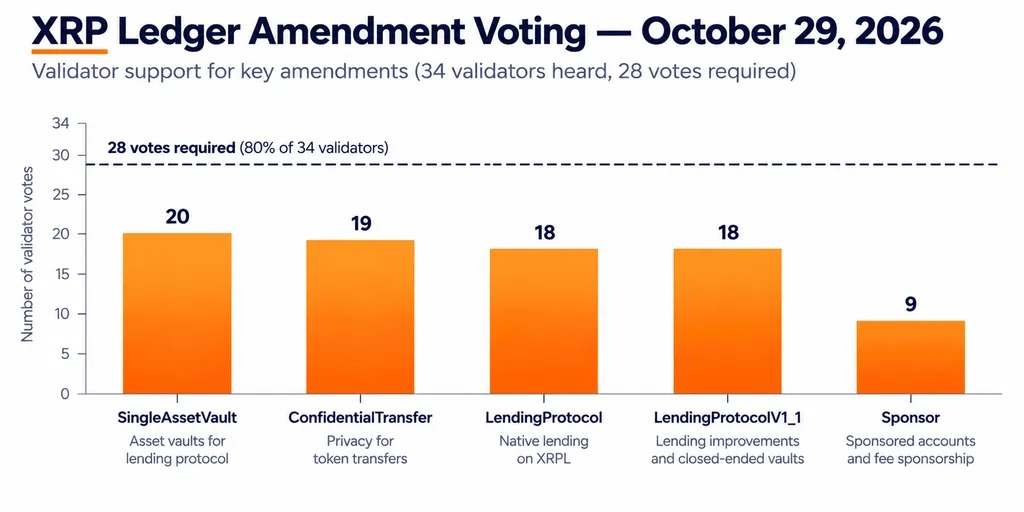
The system relies on two main components: SingleAssetVault, which is used to aggregate XRP and eligible issued tokens; and LendingProtocol, which is used to handle loan initiation and repayment.
The third amendment, LendingProtocolV1_1, will introduce a closed vault and updated interest accounting rules.
However, none of these three items have yet received the required approval.
The results of the voter roll call on October 29th showed that SingleAssetVault received 20 votes, while LendingProtocol and LendingProtocolV1_1 each received 18 votes.
Progress has stalled, continuing the previous reports regarding the lending vote; the results on October 20th also showed that there is still a shortage of 10 votes to pass it.
The proposed system may ultimately support financial strategies that involve the aggregation of XRP and tokenized assets.
The collaboration between Ripple and Arf provides a potential use case for connecting the settlement and financing of RLUSD with the infrastructure that may support native lending in the future.
However, this protocol relies on off-chain credit verification, which means that blockchain-based settlement cannot eliminate the risk of borrowers defaulting.
Other proposed institutional functions also face similar obstacles.
This feature will not make ordinary XRP transfers private.
An earlier privacy upgrade report indicated that on October 15th, 22 validators expressed their support, suggesting that the level of approval could fluctuate.
That proposal will allow companies to pay transaction fees and account reserves for users, and may support the zero-XRP wallet feature that is currently under development.
This distinction is very important for RLUSD payments, as users may be able to receive stablecoins in the future without having to personally provide funds for the XRP reserves required to activate their accounts.
Upgrades were advanced on November 4th, yet the loan application has still not been approved.
Unlike these proposed financial functions, fixCleanup3_4_0 has continued to receive sufficient support, allowing its activation countdown to proceed.
This amendment involves technical issues regarding vault calculations, token permissions, custody processing, and other network functions.
Previously, due to verifiers temporarily falling below the required threshold, their anticipated activation was postponed, and a mandatory two-week waiting period was reinstated.
If the supermajority supports continuous and uninterrupted progress, the current target activation date for this upgrade is November 4th.
According to the XRPL rule, an amendment must maintain a support rate of over 80% for two consecutive weeks in order to be activated.
This voting process demonstrates that including code in a software version does not necessarily mean it will be available on the mainnet.
As Coinpaper previously explained in the lending analysis, the proposed credit infrastructure by XRPL may ultimately create more uses for XRP and tokenized assets.
Marcus Hale
Marcus Hale is a cryptocurrency and financial markets contributor who reports on Bitcoin, Ethereum, digital assets, regulation, ETF, and institutional adoption. His work focuses on driving market developments, investor trends, and the broader forces shaping the crypto economy.