Microsoft's performance in the last fiscal quarter was overall stronger than Wall Street's expectations, bringing a pleasant surprise of improved AI capital efficiency.
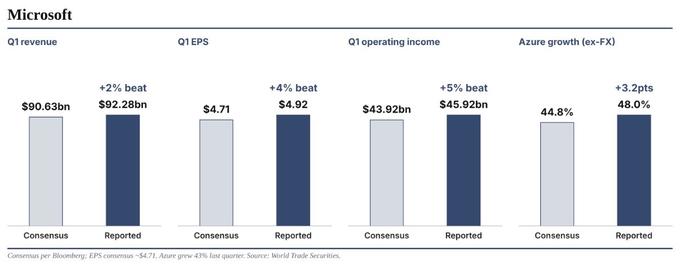
After the U.S. stock market closed on Wednesday, October 28th, Eastern Time, Microsoft announced that for the first quarter of fiscal year 2027, which ended on September 30, 2026, revenue increased by 19% year-over-year to $92.28 billion, exceeding analysts' expectations by 1.8%; operating profit increased by 21% year-over-year to $45.92 billion, exceeding analysts' expectations by 5.4%; and earnings per share after non-GAAP adjustments increased by 18.4% year-over-year to $4.89, exceeding expectations by 3.4%.
The biggest highlight of the first fiscal quarter is still cloud and AI. Microsoft's cloud revenue increased by 30% year-on-year to $63.9 billion, 3.7% higher than market expectations; more importantly, the revenue from its cloud computing platform Azure increased by 48% year-on-year, not only faster than the 43% in the previous quarter but also higher than the analysts' consensus forecast of 44.8%. During that quarter, Azure revenue reached $33.165 billion, about 3% higher than market expectations.
For the AI transaction, what excites the market even more is the combination of "high growth + capital expenditure below expectations." Microsoft's cash capital expenditure in the first fiscal quarter was $39.37 billion, which although more than doubled year-over-year, was 14.3% lower than analysts' expectations and also lower than the approximately $41 billion in capital expenditure required to support cloud and AI demand in the previous quarter. In other words, the market saw an acceleration in Azure growth, but the cash capital expenditure for that quarter did not continue to expand beyond expectations.
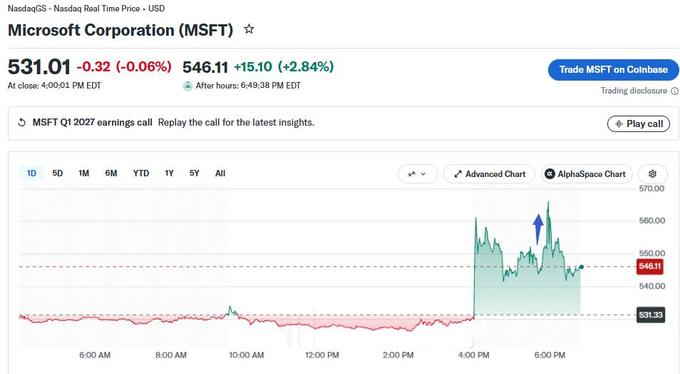
After the financial report was released, Microsoft's stock price, which had closed down slightly by less than 0.1% during regular trading on Wednesday, soared after the market closed, with an increase of nearly 5.7%.
The reason for the significant increase after the market close is not complicated: As one of the key indicators measuring demand for AI, the growth rate of Azure revenue not only exceeded the sellers' expectations but also surpassed the more optimistic forecasts of some buyers, which were around 47%. Both revenue and profit exceeded expectations, with an operating margin of nearly 50%, indicating that AI investments have not yet significantly undermined Microsoft's profitability. At the same time, cash capital expenditures were lower than anticipated, which was interpreted as meaning that the return on AI investments was better than expected, thus alleviating the market's concerns about AI "spending money without generating revenue" in the short term.
During the earnings conference call, Microsoft executives revealed that revenue for the second fiscal quarter Azure is expected to grow by 49%-50%, with the growth rate accelerating further. The annual capital expenditure guidance for 2026 is approximately $170 billion, which is slightly lower than previous expectations. As a result, Microsoft's stock price soared again, with the post-market increase exceeding 6% at one point.
Core Performance: Revenue, Profit, EPS All Met Expectations
In the first fiscal quarter of 2027, Microsoft's total revenue was $92.279 billion, exceeding the $90.63 billion expected by analysts compiled by Bloomberg, representing a year-over-year growth of 19%, slightly faster than the 18% growth in the previous quarter. Services and other revenue reached $77.648 billion, the main driver of growth; product revenue was $14.631 billion, a decrease compared to the same period last year.
Profits were also strong. Microsoft reported gross profits of $62.559 billion and operating profits of $45.915 billion for the quarter, which exceeded analysts' expectations of $43.92 billion, representing a year-on-year increase of 21%; when calculated using a fixed exchange rate, operating profits increased by 22% year-on-year. The operating margin was approximately 49.8%, higher than the market's expectation of around 48.3%, and also improved compared to the same period last year.
In terms of net profit, GAAP reported a net profit of $36.629 billion, a year-on-year increase of 32%; the diluted earnings per share were $4.92. However, this figure is significantly affected by changes in the valuation of OpenAI investments. Excluding the impact of OpenAI investments, the non-GAAP net profit was $36.422 billion, a year-on-year increase of 18%; the diluted earnings per share without GAAP were $4.89, also a year-on-year increase of 18%, which is still significantly higher than Wall Street's expectations.
From the perspective of expense structure, Microsoft still demonstrates strong operational leverage. Research and development expenses amounted to $9.047 billion, an increase of about 11% year-over-year; sales and marketing expenses were $5.716 billion, nearly the same as in the same period last year; general and administrative expenses were $1.881 billion, showing a slight increase. Although the rising service costs due to AI infrastructure have lowered the gross margin, expense control has helped maintain an operating profit margin at a high level of nearly 50%.
Azure revenue breaks through $30 billion, AI cloud demand continues to accelerate
The most important figure in this quarter's financial report is undoubtedly Azure. In September, Microsoft announced that it would start disclosing the specific revenue of its Azure cloud computing business on a quarterly basis from this quarter onwards, which is also part of the company's most significant business divisional adjustments since 2015.
The first independently disclosed Azure report is quite impressive: revenue increased by 12.8% month-over-month to $33.165 billion, compared to $22.384 billion in the same period last year, representing a year-on-year growth of about 48% regardless of exchange rate fluctuations. Analysts expect that after excluding the impact of foreign exchange, the year-on-year growth would be 45.2%, and without excluding that impact, it would be 44.7%.
The significance of this growth rate is that Azure is no longer a business with a low base. In September, Microsoft disclosed that in the fourth fiscal quarter of fiscal year 2026, which ended in June 2026, Azure revenue amounted to $29.4 billion; for the entire fiscal year 2026, Azure revenue reached $101.94 billion, an increase of about 40.4% from $72.61 billion in the previous fiscal year. With annual revenue already exceeding $100 billion, Azure was still able to achieve a growth rate of 48% in its first fiscal quarter, indicating that demand for AI and cloud migration continues to rise rapidly.
Microsoft Cloud's overall performance also confirms this point. In the first fiscal quarter, Microsoft Cloud revenue reached $63.9 billion, a year-on-year increase of 30% and a growth of 31% at constant exchange rates, exceeding market expectations of $61.62 billion. Chief Financial Officer Amy Hood stated in the financial report that Microsoft Cloud's revenue growth accelerated, and both revenue, operating profit, and earnings per share exceeded expectations.
From a product line perspective, the 365 Business Cloud revenue of Microsoft increased by 17% year-on-year according to the reporting criteria, and by 18% at a fixed exchange rate; if the impact of a one-percentage-point gain from one-time revenue recognition in the same period last year is excluded, the year-on-year increase is 18% after adjustment, and it grew by 19% at a fixed exchange rate. The 365 Consumer Cloud revenue of Microsoft also increased by 17% year-on-year. This indicates that the cloud business of AI is not growing in isolation, as enterprise software subscriptions continue to contribute stable cash flow.
Capital expenditure fell short of expectations, and the market sees an improvement in "_AI capital efficiency".
Over the past year, one of the biggest doubts about large tech companies has been: Will AI's capital expenditures continue to inflate indefinitely, with no return in sight? This quarter, Microsoft has provided a response that satisfies the bulls for now.
Microsoft's cash capital expenditure for new property and equipment in the first fiscal quarter was $39.367 billion, a significant increase of 103% year-over-year, but it was clearly lower than analysts' expectations of $45.93 billion. Compared to Microsoft's total capital expenditure of about $41 billion in the fourth fiscal quarter, the cash capital expenditure in the first fiscal quarter did not continue to rise.
This is precisely one of the key catalysts for Microsoft's stock price to surge after the financial report: Azure grew by 48%, and cash capital expenditure was lower than expected. For investors, this means that every dollar invested in AI may be generating higher revenue conversion, and there is no pressure of "the more you invest, the worse the profit" in the short term at least.
World Trade Securities Chief Investment Officer Nicholas Mugalli commented that Microsoft has "put an end to the AI spending debate," as the company achieved faster growth, higher profits, and lower capital expenditures than expected in the same quarter. He believes that Azure continuing to accelerate on the basis of over $100 billion in annualized revenue is the most important figure announced by tech companies on Wednesday.
However, this judgment also needs to be viewed with caution. Microsoft's cash capital expenditure for the quarter falling short of expectations does not mean that the investment pressure on AI has disappeared. The company's balance sheet shows that the net amount of property and equipment increased from $313.076 billion at the end of June to $346.844 billion at the end of September; the assets related to operating lease rights also rose from $24.177 billion to $30.178 billion. The scope of capital expenditure, including finance leases, still needs to be further confirmed during the financial report conference call and in the 10-Q documents.
Free cash flow has declined by 27%, while AI investments continue to consume cash.
Although the income statement shows strong performance, the cash flow statement presents a different picture. Microsoft had operating cash flow of $58 billion in its first fiscal quarter, a year-on-year increase of about 29%, indicating that the core business's ability to generate cash is still very strong.
However, after deducting $39.367 billion in cash capital expenditures, the free cash flow was approximately $18.633 billion, which represents a decrease of about 27% compared to the same period last year's $25.663 billion. In other words, while revenue increased by 19% year-over-year and operating profit increased by 21%, free cash flow saw a significant decline.
This reflects the typical characteristics of the current AI infrastructure cycle: The income statement is able to maintain impressive performance through revenue growth and cost control, but upfront investments in data centers, GPU, network equipment, and energy support will continue to suppress free cash flow.
In addition, Microsoft repurchased $4.379 billion in shares during its first fiscal quarter, which is lower than the $5.65 billion in the same period last year; it paid out $6.757 billion in cash dividends; and it also repaid $4.85 billion in debt without issuing any new bonds. The company still has $64.509 billion in cash, cash equivalents, and short-term investments, giving it financial flexibility that is much stronger than that of most companies. However, AI capital expenditures are significantly changing its cash distribution pattern.
Orders and RPO leave concerns: Revenue is accelerating, but backlogged orders are not increasing.
This financial report is not without flaws. The most concerning aspects are commercial bookings and remaining commercial performance obligations ( RPO ).
Microsoft's first fiscal quarter business revenue was $677 billion, a year-on-year increase of 73%. While the total scale is still substantial, it is approximately 4% lower than analysts' expectations of $705.6 billion. There was almost no growth compared to the fourth fiscal quarter's $678 billion, and the year-on-year growth rate also slowed down from 84% in the fourth quarter. RPO represents the amount of contracts that have been signed but not yet recognized as revenue, including Azure, Microsoft, 365, and other long-term commitments for enterprise services. This has always been one of the indicators most closely watched by bulls in Microsoft's AI cloud growth story.
What's more subtle is that commercial bookings decreased by 12% year-on-year, whereas in the previous quarter they were still increasing by 10%. This indicates that Microsoft was able to convert backlogged contracts into revenue quite quickly during that quarter, which supported the strong growth of Azure and cloud revenue; however, the pace at which new contracts were signed to replenish this revenue did not keep up accordingly.
In other words, Microsoft has demonstrated a strong ability to convert revenue into actual profits this quarter. However, whether they can maintain the same growth rate in the coming quarters will depend on the recovery of new orders. If business bookings continue to be weak, the market may re-evaluate the sustainability of the current high growth rate of Azure.
Microsoft The slowdown in the growth of 365 business seats is also a noteworthy detail. It is reported that the growth of M365 business seats has slowed down from 7% in the previous quarter to 5%. For a software company that charges significantly based on the number of user seats, this may reflect that corporate clients are becoming more cautious in terms of recruitment, IT budgeting, or automating processes.
After the reorganization of branches: Agents and Infra drive Microsoft's revenue
Microsoft began adopting a new business division structure this quarter, merging the previous "Intelligent Cloud" and "Productivity and Business Processes" into "Agents and Infra", which refers to "Agents and Infrastructure"; the former "More Personal Computing" was renamed to "Devices and Consumer", which stands for "Devices and Consumers". This adjustment strengthens Microsoft's narrative around the integration of AI agents, cloud infrastructure, and enterprise software stack.
In the first fiscal quarter, Agents and Infra generated revenue of $76.795 billion, a year-on-year increase of 25%, accounting for over 80% of Microsoft's total revenue; the operating profit of this division was $40.558 billion, a year-on-year increase of about 24%, making it the absolute core of Microsoft's profits.
Among them, Azure generated $33.165 billion in revenue, Microsoft's cloud revenue was $27.778 billion, productivity and server licensing revenue amounted to $8.407 billion, industry solutions revenue was $5.337 billion, and Frontier and support services revenue totaled $2.108 billion. It can be seen that Azure and Microsoft's cloud business constitutes the two main pillars of Microsoft's new division.
In contrast, Devices, and, and Consumer generated revenue of $15.484 billion, a year-on-year decrease of 3%, but their operating profits were $5.357 billion, showing a slight increase compared to the same period last year. Within this division, search and advertising revenue, excluding traffic acquisition costs, increased by 12% year-on-year and continued to grow at a double-digit rate; Xbox's revenue from content and services decreased by 2% year-on-year; Windows OEM and device revenue saw a significant year-on-year decline of 22%, which was the business segment that had the most noticeable impact on performance.
This indicates that Microsoft's current focus on growth is now clearer: AI cloud, enterprise subscriptions, and infrastructure are the main priorities, while traditional PC and hardware devices continue to face pressure.
OpenAI investment returns boost GAAP profits; it is not GAAP that can better reflect the quality of operations.
In the first fiscal quarter, Microsoft's GAAP reported a year-over-year net profit growth of 32%, which seems significantly higher than the growth rates of revenue and operating profit. However, this figure includes the impact of changes in the valuation of OpenAI investments.
Microsoft disclosed that investments in the first fiscal quarter generated a net profit of $207 million, contributing $0.03 to earnings per share after dilution; whereas investments in the same period last year resulted in a net loss of $3.086 billion, dragging down earnings per share by $0.41. As a result, the year-over-year growth rate under the GAAP metric was significantly affected by the large base effect.
Excluding the impact of OpenAI investments, Microsoft's non-GAAP net profit increased by 18% year-on-year, and non-GAAP earnings per share also increased by 18% year-on-year. This metric better reflects the true growth momentum of Microsoft's core business operations.
However, OpenAI remains a key variable in Microsoft's AI strategy. It not only brings about the demand for Azure computing power and the AI product ecosystem but also causes fluctuations in investment valuations on the income statement. In the future, the market will not only pay attention to the strength of cooperation between OpenAI and Microsoft but also whether the demand for AI is sufficiently diversified, and whether it can expand from a few major customers to a wider range of corporate clients.