Key Points
- Moody's assigned a rating to RLUSD A2 and a top-tier short-term rating to P-1.
- The goal of Ripple is to achieve a reserve coverage rate of 103% through custody by Bank of New York Mellon.
- Despite having obtained relevant bank approvals, bankruptcy protection is still considered a weakness.
Just one day after the stablecoin RLUSD obtained final approval from a national trust bank in the United States, it received an investment-grade rating from Moody's. As the market value of this token exceeds $2.5 billion, this development also enhances its qualifications for the institutional market.
On October 27, Moody's assigned a long-term deposit rating to RLUSD A2 and a short-term rating to P-1. A2 represents above-average credit quality, while P-1 is Moody's highest short-term rating.
Moody's has assigned a rating of RLUSD A2 to it, with a reserve coverage target of 103%.
Moody's evaluated the reserve quality, liquidity, redemption arrangements, custody structure, and operational safeguards of RLUSD.
This stablecoin is issued on XRP Ledger and Ethereum by Standard Custody & Trust Company, which are subsidiaries of Ripple. Its reserves are mainly composed of short-term U.S. Treasury bonds, other highly liquid government assets, and cash.
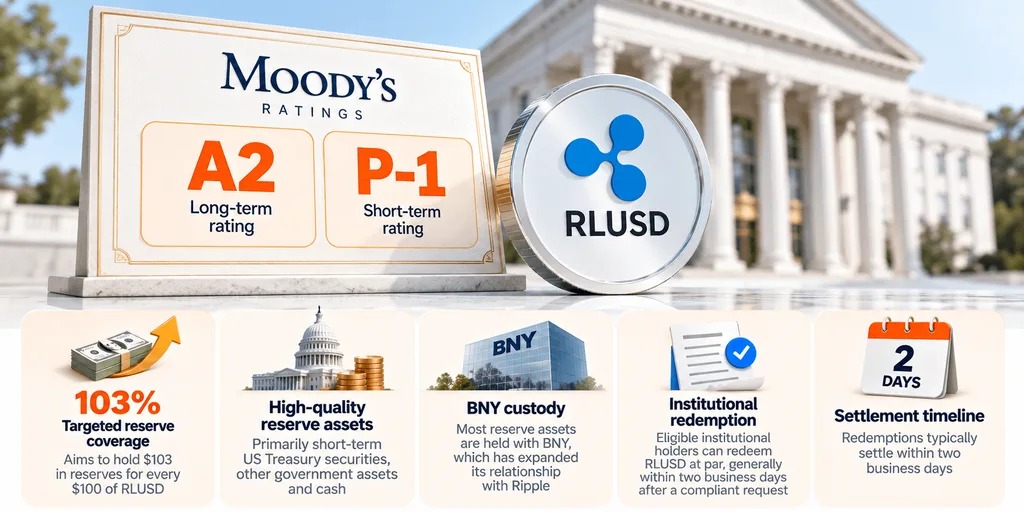
The goal of Standard Custody is to maintain a reserve coverage rate of 103%, which means it plans to allocate 103 dollars in supporting assets for every 100 dollars of RLUSD in circulation.
However, this is merely a target, and there is no guarantee that the reserves will always be precisely maintained at this level.
The majority of the reserve assets are held by Bank of New York Mellon ( BNY ). The bank has also expanded its cooperative relationship with Ripple by adding new custody services provided by XRP and RLUSD.
Moody's also reviewed the redemption arrangements. Eligible institutional holders can redeem RLUSD at face value, with settlement typically completed within two working days after submitting a compliance application.
However, this direct redemption arrangement will not automatically apply to all retail holders.
Ripple approved to establish a bank, strengthening the institutional structure of RLUSD
Prior to the release of this rating, Ripple received final approval from the US Federal Reserve (OCC) on October 26th to establish Ripple National Trust Bank.
According to the approved structure, Standard Custody will still be the issuer of RLUSD, while the federally regulated trust bank will be responsible for managing the isolated reserves and act as the collateral trustee for the token holders.
This development adds federal-level regulation to the stablecoin infrastructure of Ripple, but it does not mean that RLUSD will become a bank deposit covered by the insurance of FDIC.
Institutions are also expanding their adoption of such services. Standard Chartered Bank has launched the RLUSD custody service, which is linked to the proposed transaction collateral arrangements.
Meanwhile, Coinbase has recently launched RLUSD on its exchanges, institutions, and retail platforms, extending its distribution beyond Ripple's existing banking cooperation network.
Why Moody's Still Believes There Is a Risk of Bankruptcy
Despite receiving an investment-grade rating, Moody's still pointed out that legal protection is an area that needs improvement.
Standard Custody is not designed to be a bankruptcy-remote entity, and the current holders of RLUSD do not directly possess the ownership interests in the reserve assets.
This means that if the issuer enters a state of insolvency, complex situations may arise, including delays in fund withdrawals.
Moody's stated that stronger legal protection measures—including the provisions related to GENIUS Act which are expected to come into effect in 2027—may support an upgrade in ratings.
On the contrary, if the quality of reserves deteriorates, liquidity weakens, or operational errors occur, it may trigger a downgrade.
This rating also does not guarantee that RLUSD will always trade at exactly $1, nor does it guarantee that each holder will be able to redeem it immediately.
For XRP investors, this distinction is still important. The expansion of RLUSD has strengthened the financial infrastructure of Ripple, but the growth of stablecoins does not automatically lead to a proportional demand for XRP.
It is also mentioned in the text that earlier analyses of the RLUSD payment campaign showed that token circulation, the number of transactions, and actual economic usage must be evaluated separately.
Marcus Hale
Marcus Hale is a journalist who focuses on cryptocurrency and financial markets, covering topics such as Bitcoin, Ethereum, digital assets, regulation, ETF, and the adoption by institutions. His work focuses on developments that may drive market changes, investor trends, and the broader forces shaping the crypto economy.