Amazon and Intel's financial reports disappointed the market, and investors are increasingly skeptical about the returns that tech giants can achieve from their massive investments in artificial intelligence. Meanwhile, the demand for safety-driven investments has pushed U.S. Treasury bonds and the Swiss franc higher.
All three major U.S. stock indices closed lower. The S&P 500 index fell to 7,580.07 points, a decrease of 1.82%; the Nasdaq Composite Index dropped to 25,437.00 points, a decline of 2.86%; and the Dow Jones Industrial Average fell to 51,770.31 points, a loss of 1.09%. Among the S&P 500's eleven sectors, six rose and five fell. Energy and Consumer Staples led the gains with increases of 1.91% and 1.38%, respectively, while Technology and Industrials led the losses with declines of 4.24% and 1.57%, respectively.
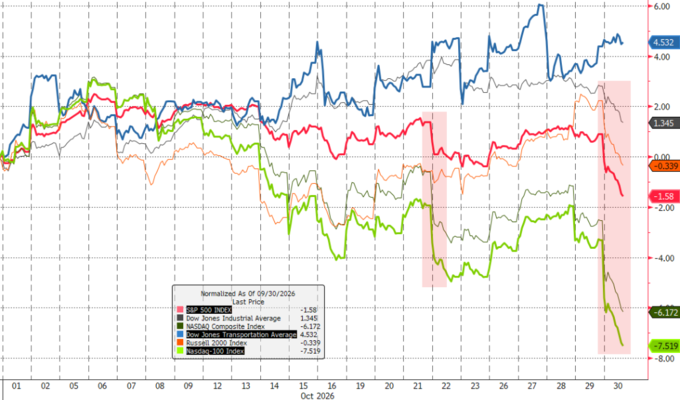
Intel's revenue guidance for the fourth quarter is $15 billion to $16 billion, lower than the market expectation of $17.07 billion, and it warned of a net outflow of cash flow for the whole year. The company's stock price experienced the largest single-day decline in over forty years. Amazon had a negative free cash flow of $42.4 billion in the third quarter, yet it still plans to maintain its capital expenditure of $220 billion for 2026.
On the same day, international oil prices rose to a six-month high, while U.S. Treasury yields fell to a seven-week low.
AI Capital expenditure financing issues dominate pricing, Intel experiences its largest single-day decline in over forty years
Intel expects revenue in the fourth quarter to be between $15 billion and $16 billion, which is lower than the market forecast of $17.07 billion; it also expects adjusted earnings per share to be $0.25, which is below the expected $0.43. The company also warns that cash flow this year will be a net outflow.
Intel closed down 28.58% at $65.76, recording the largest one-day decline in over four decades, with its market value evaporating by approximately $150 billion. Its five-year credit default swap widened by 17.5 basis points to 124.75 basis points, reaching a historical high.
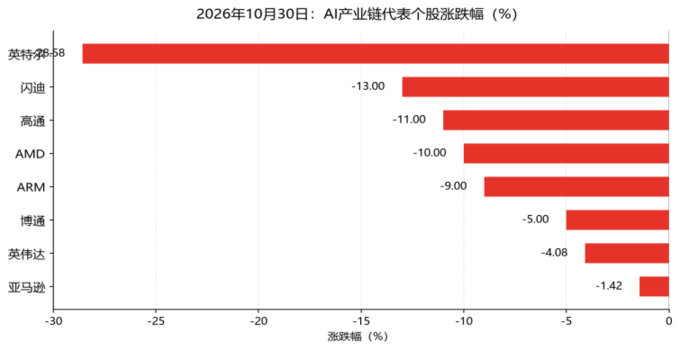
Amazon's revenue and profits in the third quarter fell short of expectations, with free cash flow at -$42.4 billion. The company still maintains its capital expenditure plan of $220 billion for 2026 and has added $48.1 billion in long-term debt. Amazon's stock price dropped by 1.42% to $240.35.
All seven giants of the U.S. stock market closed down on that day. NVIDIA fell by 4.08%, Meta fell by 1.49%, Microsoft fell by 1.47%, Google fell by 1.37%, Apple fell by 1.11%, and Tesla fell by 0.86%.
Goldman Sachs reported 191.7 basis points for its ultra-large-scale cloud vendor credit default swap basket, and 108.4 basis points for its investment-grade 100-basket portfolio.
The bond market has priced this expense more strictly than the stock market. The bond spread for CoreWeave is reported at 994.14 basis points, while Oracle's is 322.54 basis points, indicating that the financing costs for both companies are significantly higher than the average for investment-grade bonds.
Blackstone has informed investors that Anthropic may not immediately obtain an investment-grade rating after listing, that is, a rating of BB or above. This means that the financing costs for AI are being re-evaluated.
Goldman Sachs strategist Privorotsky stated that the risk lies in the fact that financing constraints will ultimately force capital expenditure to become more disciplined, but this is not yet evident in companies' current willingness to spend; he also raised the question of whether artificial intelligence is consuming the advertising revenue that funds it, which remains an unanswered question.
Chip stocks tumbled across the board, with funds shifting to energy and essential consumer goods.
The Philadelphia Semiconductor Index fell by 7.20%, with 29 out of 30 constituent stocks declining. The index has seen a cumulative decline of 15.4% in October, making it the worst-performing major U.S. stock index for the month.
The decline was concentrated in the chip industry chain. SanDisk fell by more than 13%, Qualcomm fell by more than 11%, AMD fell by more than 10%, ARM fell by more than 9%, Broadcom fell by more than 5%, and ASML and Lam Research fell by more than 6%.
Sandisk's first-quarter performance exceeded market expectations, but the company also announced a 1-to-8 stock split plan. Nevertheless, the stock price still fell significantly, and the performance did not serve as a basis for pricing on that day.
The defensive sector absorbed the outflow of funds. Walmart and Coca-Cola both rose by more than 1%, while Merck and Amgen also saw increases in their prices. The need to lock in profits at the end of the month, combined with the uncertainty ahead of the mid-term elections, jointly drove this round of portfolio adjustments.
On October Invesco, funds tracking the S&P 500 index, such as Invesco, rose by 4.72%, while the SPDR market-capitalization-weighted S&P 500 index fund fell by 1.31%.
Globalt Senior Portfolio Manager Keith Buchanan stated that last year the market was focused on expectations and imagination, while this year the core issues have shifted to how to raise funds and who will benefit from the profits; whether the cycle of style changes can continue remains to be seen.
Iranian conflicts drive up oil prices; Brent crude touches $118 during trading
A fourth oil tanker struck a mine in the Strait of Hormuz that day, carrying more than 2 million barrels; a U.S. transport plane landed in Israel, and the U.S. has briefed the president on military options; the Qatari mediator returned to Tehran.
The settlement price of the December contract for crude oil was reported at $104.12 per barrel, an increase of 2.08%. The settlement price of the December contract for Brent crude oil was reported at $117.64 per barrel, up 2.4%, and it touched $118 during trading, which is the highest level since late April; the January contract for the following year rose by 2.63% to $113.43.
In October, Brent crude oil rose by 13.6%, while WTI rose by 15.2%, both marking the fourth consecutive month of increases.
BOK Financial Dennis Kessler, Senior Vice President of Trading, stated that traders will continue to focus on the situation of Middle Eastern oil exports, as well as potential escalation actions that the United States and its allies may take.
U.S. Treasury yields drop to seven-week lows; rising oil prices fail to push up borrowing costs
The yield on 10-year U.S. Treasury bonds closed at 4.93%, the lowest level in seven weeks, with a cumulative decline of 36 basis points in October.
2-year yield reported 4.60%, 30-year yield reported 5.31%, with both down 29 basis points and 33 basis points in October respectively.
The Federal Reserve maintained interest rates at 3.75% to 4.00% this week, with a vote of 10 to 2 in favor of the decision. Cook and Harker advocated for an interest rate hike. The market still expects an interest rate hike in December with over 70% probability.
Inflation data does not support loose monetary policies. In September, the U.S. Personal Consumption Expenditures Price Index rose 0.5% month-on-month and 3.6% year-on-year, with the core price index rising 3.1% year-on-year. The real GDP for the third quarter grew at an annualized rate of 3.4%.
Rising oil prices did not drive up yields, which fell along with the decline in the stock market. In the bond market, the first factor considered was the downward revision of growth due to the obstacles in AI financing; the inflationary pressure from rising oil prices came later in consideration.
Gold falls to a one-year low, Bitcoin breaks below $77,000
Spot gold closed at $3,881.93 per ounce, down about 3.5%, marking its lowest level since October 2025, with a cumulative decline of around 6.6% since that month. The December gold futures settlement price on the New York Mercantile Exchange was $3,898.90 per ounce, a decrease of 3.3%.
Spot silver tumbled more than 6%, breaking below the $50 mark for the first time since November 2025, with a cumulative decline of about 18.4% in October.
UBS analyst Giovanni Staunovo stated that rising oil prices increase inflationary pressures, prompting markets to expect the Federal Reserve to raise interest rates further, thereby suppressing gold prices.
Zaner Metals, Vice President and Senior Metal Strategist, stated that concerns about inflation are prompting many central banks to adopt a more hawkish stance, and maintaining high interest rates for a longer period will suppress precious metals prices.
Bart Melek, the head of global commodities strategy at TD Securities, stated that rising oil prices have triggered a flight to safety, pushing up the price of U.S. Treasury bonds and simultaneously reducing liquidity in the stock market. Gold has also been caught up in this selling trend.
Ole Slot Hansen, head of commodity strategy at Shengbao Bank, stated that a decline in the stock market could trigger a broader wave of deleveraging and liquidity-driven selling.
Bitcoin fell below $77,000, with a 24-hour decline of over 4%, reaching a low of $76,519 during the session. Binance claimed to have been attacked by hackers, with $6.3 billion in assets affected, and approximately $3 billion has been frozen. Investigators are pointing towards a North Korean-related TraderTraitor organization.
The volatility in the foreign exchange market is limited. The US Dollar Index fell by 0.16% to 101.878; the euro traded at 1.1167 against the US dollar, the pound at 1.3394 against the US dollar, the US dollar at 157.37 against the Japanese yen, and the US dollar at 0.8236 against the Swiss franc. Both the yen and the Swiss franc strengthened slightly.
As of October 23rd, within a week, gold, NASDAQ 100 futures, and Bitcoin declined, while WTI crude oil and the US Dollar Index saw a slight increase.