Key Points
- The yield on 10-year U.S. Treasury bonds approached 5% before the election.
- The decline in AI shares exposes the rising risks of tech financing.
- The results of the parliamentary elections could reshape expectations in the bond market.
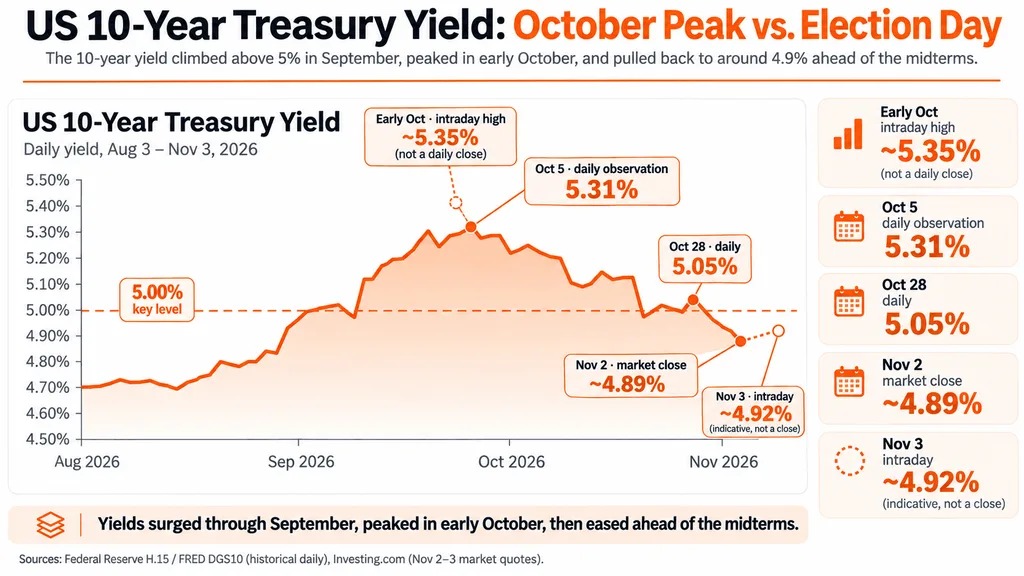
On November 3rd, as investors weighed the concerns associated with artificial intelligence spending and the uncertainty of the U.S. mid-term elections, the yield on 10-year U.S. Treasury bonds rose to 5%.
Previously, the yield on government bonds had exceeded 5% at the end of October, which once again sparked concerns about borrowing costs in the market. For those companies that have already committed to investing billions of dollars in the construction of AI infrastructure, higher financing costs are of particular concern.
Why is the yield on government bonds once again approaching 5%?
The bond market is facing competitive pressures, and investors are awaiting the election results. The election outcomes could reshape fiscal policy, government borrowing, and expectations regarding corporate regulation.
If the Republican Party sweeps the elections, the market may raise expectations for more spending or tax cuts; if investors expect the federal deficit to widen, yields could rise further.
On the contrary, a divided government might reduce market expectations for significant fiscal changes. However, neither of these outcomes can guarantee that bond prices will move in a particular direction.
The 10-year yield remains below the approximately 5.35% level reached during the sell-off of U.S. Treasury bonds in October. At that time, concerns about inflation and the government's borrowing needs put pressure on long-term debt.
AI Stock pullbacks bring another layer of risk to the bond market
For investors evaluating the sustainability of AI's expansion, the U.S. Treasury bond market is becoming increasingly important.
Higher yields on government bonds will increase the borrowing costs for businesses and at the same time reduce the present value of future earnings; this mechanism has already been discussed in our analysis of the valuation of AI stocks.
For companies that finance data centers, semiconductor purchases, and power infrastructure through debt, these pressures are particularly significant.
Recent AI stock corrections indicate how quickly investors will re-evaluate tech valuations when spending growth exceeds expected financial returns.
Oracle, Alphabet, and other companies that rely on infrastructure expansion are now facing more stringent scrutiny, with the market paying attention to how they will finance their expansion plans.
At the same time, the relatively high bond yields indicated that credit investors were demanding significantly higher compensation from certain highly leveraged AI enterprises.
What will happen after the midterms?
Investors are watching whether the Republican Party will be able to retain control of Congress, or whether the Democratic Party will win one or both of the Senate and House of Representatives.
A market analysis by MSCI has found that there is no consistent historical pattern in Treasury bond yields before and after mid-term elections, indicating that the economic conditions may be more important than the election results themselves.
The Federal Reserve's future interest rate decisions, inflation data, and corporate financing needs may ultimately be more crucial.
The author, Ethan Mercer, is a financial journalist who covers cryptocurrency, stocks, and the global economy. He studied economics and finance before turning to market reporting, with a particular focus on Bitcoin, stocks, monetary policy, and investor sentiment. His work focuses on explaining daily market fluctuations and the broader trends behind them.