

Intel's CEO Chen Liwu ( Lip - Bu Tan ) increased his holdings after the company's stock price experienced a significant correction, sending a signal of confidence to the market.
According to Document Form submitted to the U.S. Securities and Exchange Commission (SEC), Chen Liwu purchased 150,000 shares of Intel common stock on the public market on November 2 for a transaction amount of approximately $9.71 million.
The weighted average price of this increase in holdings was $64.7312 per share, and the transaction was completed through a family trust. The filing shows that after the transaction, the family trust's holdings of Intel shares increased to 1.4647 million shares, an increase of about 11.4% compared to before the transaction.
After the announcement, Intel's stock price rebounded briefly, with the peak decline narrowing to 1.2%, before it fell back slightly. As of press time on Wednesday, the stock was still down 3.6% during trading.
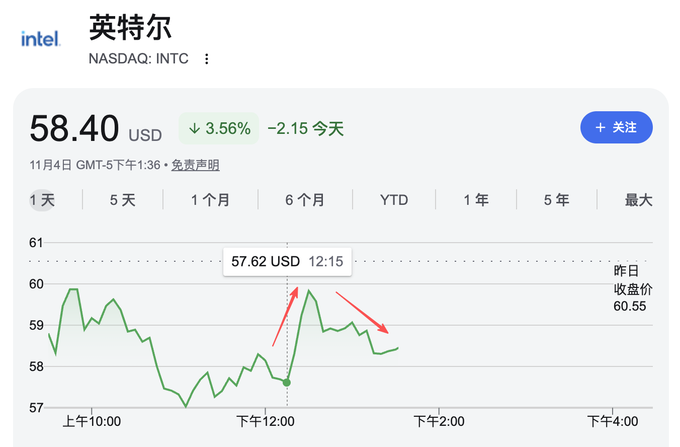
This increase in holdings occurred after Intel's stock price faced intense selling pressure. Last Friday, Intel's stock price plummeted by 28.6% in a single day, marking one of the largest daily declines in decades.
Previously, Intel's fourth-quarter performance guidance was significantly lower than market expectations, exacerbating investors' concerns regarding its supply capacity, profit prospects, and capital expenditure pressures.
The company expects its revenue for the fourth quarter to be between $15 billion and $16 billion, which is lower than analysts' previous forecast of around $17.07 billion; adjusted earnings per share are expected to be $0.25, also below the market's expectation of $0.43. The company also stated that factors such as a weak PC market, limited chip supply, and the shutdown of its factory in Israel will continue to put pressure on its business, and it is not expected to achieve positive free cash flow this year.
Chen Liwu's additional investment this time is close to 10 million US dollars, and it is a transaction in the public market, rather than being part of stock compensation or the exercise of options.
For investors, the management's continued investment of personal funds after a significant pullback in stock prices may be seen as a sign that they still have confidence in the company's long-term prospects. However, whether Intel can overcome supply bottlenecks, improve profitability, and fulfill its growth expectations for its manufacturing business and the AI chip business remains key to determining the subsequent performance of the stock price.