According to data released today by the German Federal Motor Transport Authority ( KBA ), battery-powered electric vehicles ( BEV ) accounted for 37% of the German new car market in October, setting a record. In October, a total of 94,086 electric vehicles were registered in Germany, representing a 79.5% increase from 52,425 in the same period last year.
For the second consecutive month, the number of pure electric vehicles registered by German buyers has exceeded the total number of gasoline and diesel vehicles. With only two months left in this year, Germany has already surpassed the automotive industry's forecast for annual electric vehicle sales for 2026.
A record-breaking month, a record-breaking year
In October, there was virtually no growth in Germany's overall automobile market. The total number of new car registrations increased by only 1.7%, to 254,492 units, which means that the growth in electric vehicles came entirely from fuel-powered cars.
Plug-in hybrid vehicles ( PHEV ) decreased by 7.9%, to 28,499 units, accounting for 11.2%. As a result, last month plug-in hybrid models accounted for approximately 48% of the German market. The average carbon dioxide emissions per new vehicle decreased by 21.1% year-on-year, to 79.4 grams per kilometer.
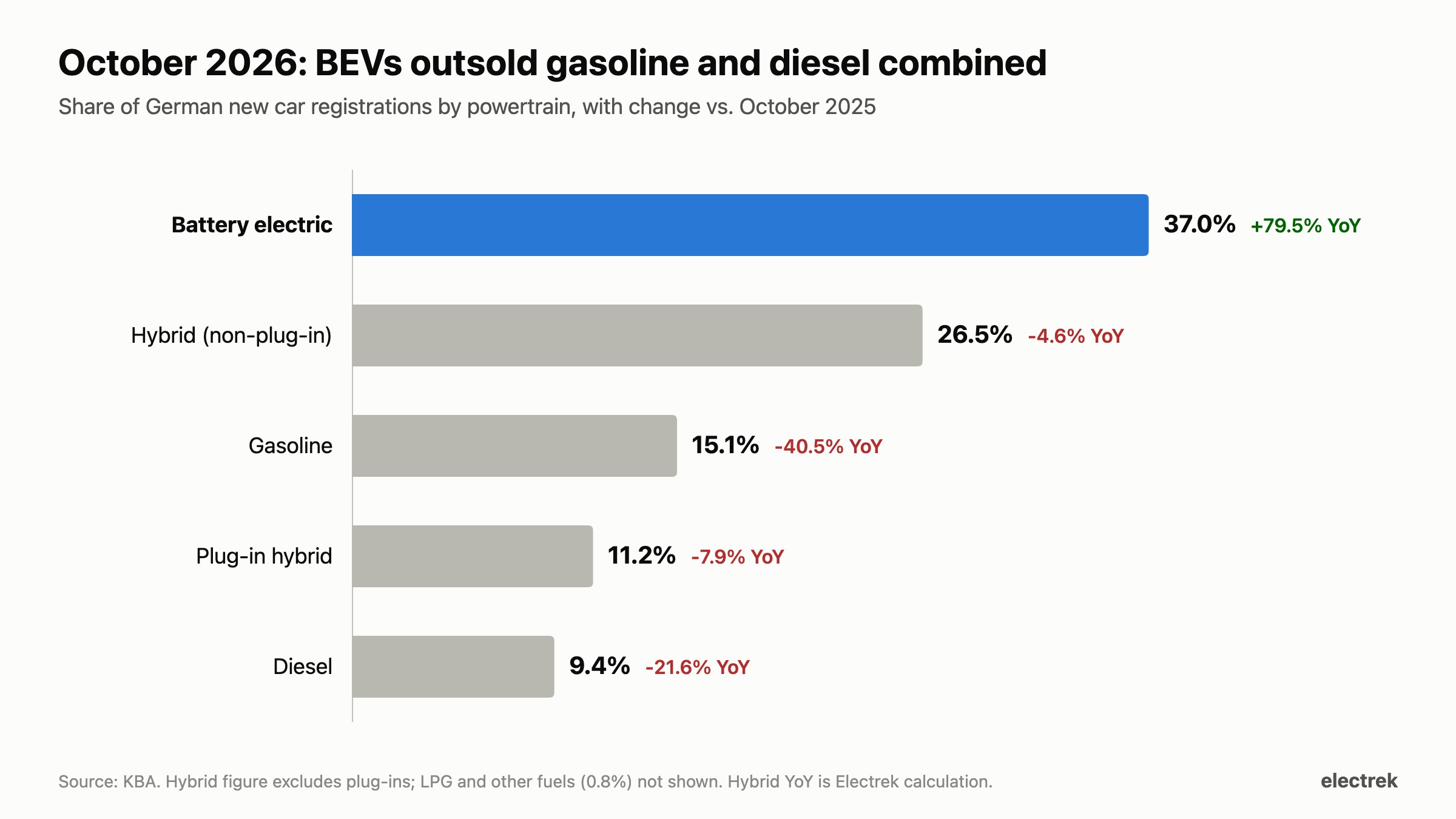
In the first 10 months of this year, Germany registered 698,230 pure electric vehicles, a year-on-year increase of 60.7%. This accounts for about 28.2% of the 2,476,290 new vehicles registered since 2026, which is higher than the level of around 19% for the whole of 2025.
Moreover, the industry did not anticipate this. The German Association of the Automotive Industry VDA predicted in December that the total number of pure electric vehicle registrations for the year 2026 would be around 693,000 units. Germany had already surpassed this figure in October. At the current rate, it is expected to reach around 875,000 units by the end of the year.
Subsidies are having an effect.
The main driving factor is Germany's new electric vehicle incentive policy, which applies retroactively to vehicles registered since January 1st. Purchasing or leasing a new pure electric vehicle is eligible for a subsidy of 3,000 euros; families with low incomes and children can receive up to 6,000 euros. Families with taxable income exceeding 80,000 euros are not eligible; for families with children, the threshold is 90,000 euros.
This program is mainly targeted at private buyers, and data from KBA also indicates that growth is occurring within this group. In October, the number of private registrations increased by 20.6%, while business registrations decreased by 8.2%. Currently, private buyers account for 40.7% of the market.
Germany is not without experiencing similar situations. In December 2023, the government suddenly canceled previous electric vehicle subsidies, which led to a significant decline in pure electric vehicle sales in 2024. This time, by directing funds to buyers who need help the most, the effects have been quickly apparent.
BYD slightly surpasses Tesla; Chinese brands are accelerating their growth
Tesla's sales in Germany fluctuate significantly with the quarterly delivery schedule. In September, at the end of the quarter, Tesla registered 12,552 cars in Germany, a year-on-year increase of 268.7%, and the Model Y model remains the best-selling car in Germany. In October, Tesla only registered 2,932 cars; although there was still a year-on-year increase of 290.9%, the base number was small, resulting in a market share of 1.2%.
Calculated from the beginning of the year to date, Tesla's registration volume has increased by 206.1%, reaching 47,742 units. This represents a significant rebound from its poor performance in 2025, but BYD currently leads slightly with 47,961 units sold, representing a year-on-year increase of 216.1%. BYD registered 5,173 units in October, a year-on-year increase of 54.3%; however, the majority of its sales in Germany are plug-in hybrid vehicles, rather than pure electric cars.
Other Chinese brands are growing even faster. ZeroRun registered 3,661 vehicles in October, a year-on-year increase of 288.6%, with a cumulative total of 19,705 vehicles for the year. Xpeng's growth was 284.4%, reaching 1,380 vehicles; SAIC's MG brand grew by 48.5%, to 4,140 vehicles.
However, Volkswagen Group still occupies the top positions in the electric vehicle rankings. According to data as of September, the Skoda Elroq became the best-selling electric vehicle in Germany with 30,845 units sold, ahead of Tesla Model Y with 29,464 units and Volkswagen ID.3 with 24,352 units.
German automakers have not truly benefited.
The electric vehicle boom occurred in one of the most difficult years in the history of Germany's automotive industry.
In October, Volkswagen's registration volume in Germany decreased by 4%, Audi by 8.4%, Porsche by 5.7%, and Opel plummeted by 24.1%. BMW remained relatively stable with a 0.1% increase; Mercedes-Benz was an exception, with a 8.5% growth. Volkswagen is still the largest brand in Germany, holding a market share of 18.2%, but this share has decreased by 5.6% since the beginning of this year.
Last week, Volkswagen Group announced a third-quarter operating loss of 5.9 billion euros, which is the largest quarterly loss since the "dieselgate" scandal. The reasons include write-downs on its stake in Porsche, weak sales in China, and relatively low profit margins for electric vehicles. The group has approved layoffs of 100,000 employees and the closure of several factories in Germany. Mercedes-Benz also lowered its automotive profit margin forecast for 2026 to between 2% and 3% last week, with China being a major factor contributing to this decision.
Electrek Perspective
Germany has once again proven what we have been saying for many years: if buyers are able to afford truly suitable electric vehicles, they will quickly make the switch. Pure electric vehicles accounted for about 19% of the market last year, and by October that figure had risen to 37%. Moreover, Germany surpassed the industry's annual forecast by two months. This is not a gradual transition.
Some comments point out that when discussing the issue of "electric cars not being manufactured in Germany," it is important to consider that German automakers are not unwilling to produce them, but rather they do not produce them fast enough. Many models are already selling out, with customers waiting in line for months. This is not an excuse, but it is worth keeping in mind.
In contrast to North America, after the United States abolished federal electric vehicle tax credits, electric vehicle sales declined by 44%. It's the same technology, and sometimes even the same model of car, but the difference lies in the policies.
The problem in Germany is who will take on this demand. Hint: it's not German car companies.
But then, who can be blamed for this? If one has delayed the electrification process for many years, repeatedly lobbied the government to change electric vehicle incentive policies, and then complains that those companies that have fully invested in electric vehicles are better able to seize the opportunities brought about by consumers' shift towards them, that doesn't quite make sense either.
If you are purchasing an electric vehicle, using household solar power can reduce fuel costs to almost zero. With electricity prices rising by nearly 10% last year and expected to continue to increase, installing solar energy is one of the best ways to counter these rising costs. Through leasing and the PPA program, you can even start saving money with no down payment at all. If you want to find the best option, you can check out EnergySage. This is a free service, and hundreds of carefully selected installers will compete for your business, allowing you to save 20% to 30% compared to searching on your own. There will be no sales calls before you choose an installer. Click here to get a free quote.
FTC: We use car alliance links that can generate income. For more information.