


Pfizer’s ( Pfizer ) third-quarter performance exceeded market expectations, with growing demand for new drugs helping the company offset the pressure from declining sales of COVID-19 products. As performance surpassed expectations, Pfizer raised its full-year revenue and adjusted earnings per share guidance, continuing to advance its business transformation in the post-pandemic era.
Pfizer expects its annual revenue for 2026 to reach $62 billion to $64 billion, up from the previous forecast of $60.5 billion to $62.5 billion; adjusted earnings per share are expected to be $2.95 to $3.05, compared to the previous forecast of $2.80 to $3.00.
In the third quarter, Pfizer achieved revenue of $16.58 billion, which exceeded the market's expectation of $15.87 billion; the adjusted earnings per share were $0.87, surpassing analysts' forecast of $0.73.
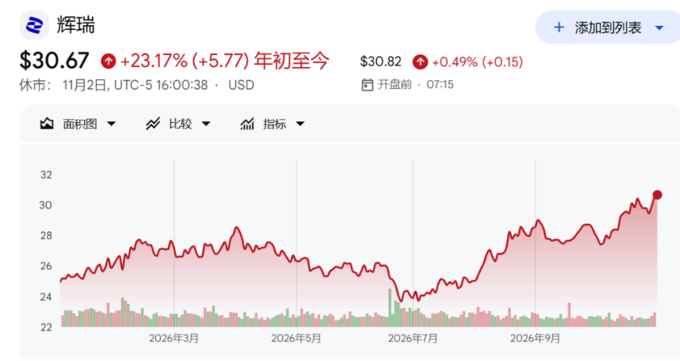
The company's stock price rose by less than 1% in early trading in New York, and as of Monday's close, the cumulative increase for the year has reached 23%.
Pfizer's improved performance is not an isolated phenomenon. Last week, pharmaceutical companies such as Eli Lilly, Merck, and Bristol-Myers Squibb also announced results that exceeded Wall Street's expectations and raised their full-year guidance. Despite the ongoing pressure on drug pricing in the United States, the pharmaceutical industry still demonstrates strong revenue resilience.
Weight loss drugs and cancer medications: Pfizer bets on two major growth areas
During the pandemic, COVID-19-related products brought Pfizer huge revenues, enabling it to briefly rank among the world's most profitable pharmaceutical companies. However, as sales of these products have gradually declined, the company is working hard to reshape its growth model.
Chief Executive Officer Albert Bourla ( Albert Bourla ) has identified the acquisition of new cancer drugs, the development of novel therapeutic options for weight loss, as key drivers of growth, while also aiming to improve profitability through cost reduction. Some of the company's core medications are facing competitive pressure from cheaper alternatives.
Weight loss drugs are one of Pfizer's important strategic bets. The company is attempting to challenge the leading positions of Eli Lilly and Novo Nordisk in this rapidly expanding market. Last year, Pfizer acquired Metsera, obtaining candidate drugs including an experimental therapy designed to be injected once a month rather than once a week. Currently, the company is advancing extensive clinical research projects to assess the market competitiveness of these drugs.
Cancer drugs are also a key focus for Pfizer. The company acquired Seagen for $43 billion, obtaining a range of anti-cancer drugs, including Padcev for the treatment of bladder cancer. In the third quarter, sales of this drug exceeded market expectations.
Core drug sales have performed steadily, and cost reduction efforts continue to advance.
Pfizer's multiple core drugs performed steadily in the third quarter.
The sales of the heart disease medication Vyndaqel reached $1.77 billion, slightly higher than market expectations; the sales of the pneumococcal vaccine Prevnar were $1.56 billion; and the sales of the anticoagulant medication Eliquis reached $2.52 billion.
While driving revenue growth, Pfizer is also improving its profitability by actively cutting costs.
On the management side, the company announced on Tuesday that Cecil Gaigon ( Cecile Guegan ), the interim Chief Financial Officer, will officially take on the role of Chief Financial Officer.