

After an attack involving multiple chains and trading venues, funds can be transferred across addresses, protocols, and judicial jurisdictions within seconds. On November 5th, Circle disclosed that it collaborated with law enforcement to freeze approximately $1.1 billion in USDC related to the Binance incident. This action brings to the fore one of the most controversial capabilities of stablecoins: although the ledgers are publicly accessible, issuers can still prevent specific addresses from further moving tokens according to legal procedures.
According to Circle, the related attacks are reported to involve over $6 billion in digital assets, and the investigation is still ongoing. It emphasizes that what was frozen were accounts at the USDC addresses that were targeted by valid legal proceedings, and it continues to work with law enforcement agencies and ecosystem partners to identify the affected funds. The wording here is important. The issuer can carry out freezes, but is not responsible for determining who owns the assets, whether a crime has been committed, or whether the assets will ultimately be confiscated; those decisions lie with the law enforcement authorities and the courts.
Freezing is not about recovery, let alone return.
On the blockchain, freezing means that the USDC in the target address cannot be transferred in or out. It blocks the path for further money laundering or exchange, but it does not automatically return the tokens to the victim's account. Asset ownership, evidence chains, cross-border collaboration, and court orders still need to be handled separately. Describing “freezing $1.1 billion” as “recouping $1.1 billion” exaggerates a technical control as if it were a completed legal outcome.
This distinction also affects the understanding of stablecoins by ordinary users. USDC operates on an open blockchain, where transaction activities can be tracked and analyzed; at the same time, the issuer retains the ability to freeze certain addresses within the contract. The open ledger increases the visibility of the fund flow, while the centralized issuance mechanism provides an emergency stop feature. These two elements do not cancel each other out but together constitute the current control structure of fiat-stablecoins.
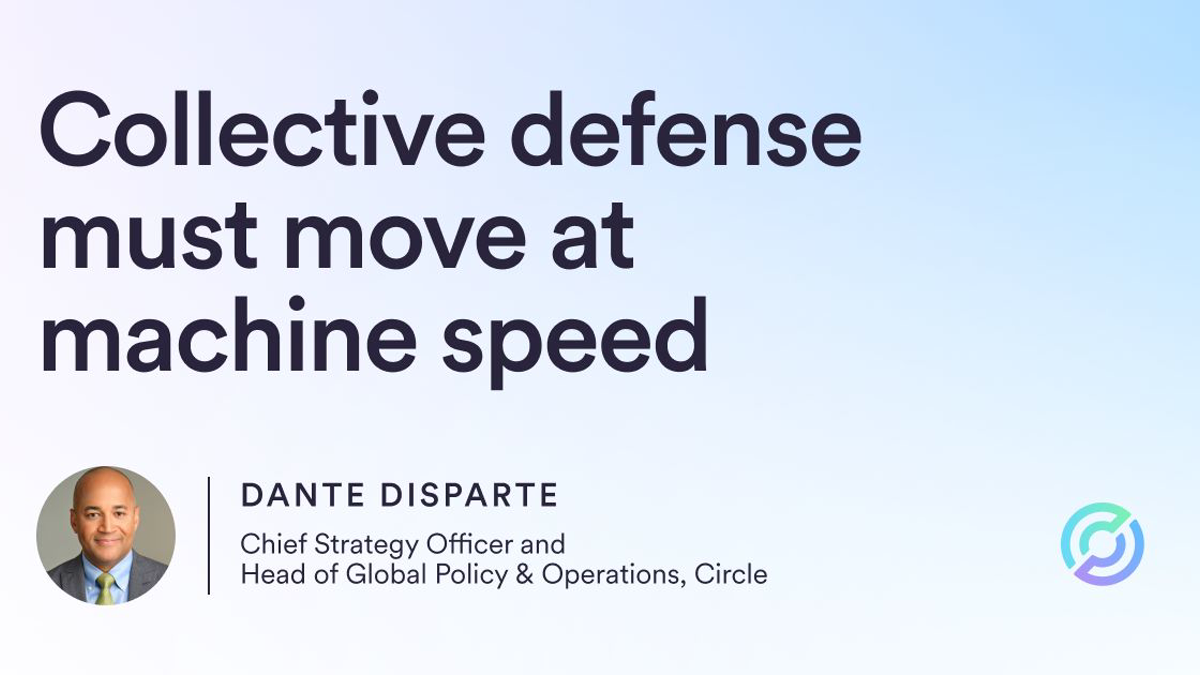
Circle summarized the experience of this incident as "collective defense must operate at machine speed." Attackers can automate the splitting of funds, switching of chains, and trading venues; if defenders still rely on emails and manual processes to coordinate each transaction individually, they will lose the opportunity before the program even has a chance to start. Issuers, exchanges, on-chain analysis companies, custodian institutions, and law enforcement departments need to quickly share addresses, verify information, and take actions within their respective authorities.
The faster the speed, the more important the boundaries of the program become.
Rapid response does not mean that the issuer can dispose of addresses at will based on their own judgment. Circle clearly distinguishes between freezing and confiscation, stating that address freezing is only carried out when a valid court order is obtained from law enforcement authorities. The significance of this distinction is that while technology can halt assets, it is still the law that determines why they should be halted, for how long, and who they ultimately belong to.
For market participants, this structure brings both protection and dependence. In the event of large-scale theft, the freezing capability may preserve the opportunity to recover stolen assets; normal users must also accept that what they hold is not an unlicensed asset completely detached from the issuer and the judicial system. The liquidity of USDC comes from the blockchain, while the redemption and compliance capabilities come from the issuing institution. The larger the incident, the harder it is to ignore these two layers of relationship.
Public materials do not provide a list of all frozen addresses, judicial jurisdictions, or a timeline for subsequent actions, and the facts of the investigation may still be updated. Therefore, what can be confirmed at this time is the scale of the freeze and the execution logic as reported by Circle. It cannot be inferred from this that all stolen funds have been controlled, nor can it prove the ultimate ownership of each related address.
This incident also raises operational issues for other stablecoin issuers and trading platforms: in what format does address information flow, how can urgent requests be verified, and who is responsible for correcting false reports? If speed relies on vague authorization, it may affect unrelated addresses; if the process is too slow, opportunities for cross-chain fund transfers will be missed. Ultimately, so-called machine speed still depends on clear human authorization and audit records.
This freeze has made the “programmability” of stablecoins more than just a promotional slogan for payment efficiency. Programs can not only move funds at high speeds but also stop their movement under specific legal conditions. Who can trigger this stop, what evidence is required, and who will review it? These have become institutional issues as important as throughput. With about $1.1 billion remaining on the blockchain, what truly begins to operate is cross-institutional legal and technical collaboration, rather than a one-click conclusion to asset recovery.
For users, when judging a stablecoin, it is not enough to just look at whether its price is anchored; they also need to consider what kind of freezing policies, appeal channels, and transparency reports the issuer makes public. The ability to respond in times of crisis also needs to be subject to supervision on a regular basis.