

ZEC has fallen by approximately 41% from its historical high of $1,695 and is currently testing its 20-week EMA level.
In November, Zcash ETF recorded a net outflow of $29.78 million, and its asset size decreased to $562.16 million.
Despite the overall contraction of the industry, the number of active developers for Zcash has approximately doubled within two years.
After breaking below $1,000 in November, ZEC is once again facing an uneasy test. The latest round of declines has raised concerns in the market: whether Zcash will be able to maintain its broader bullish trend, especially as the token retests its 20-week EMA level. Interestingly, this is not the first time ZEC has experienced a sharp correction after hitting new highs. Its history indicates that investors should not easily overlook the possibility of another 75% pullback.
ZEC The price history shows a familiar 75% pattern.
The previous market structure presented some concerning contrasts. Since 2021, ZEC has been trading within a descending triangle, testing the support range of $95 to $100 several times. In the first half of 2022, expectations for a breakout increased, but ultimately the structure broke down to the lower side.
What followed was an exceptionally long period of consolidation, which lasted from the second half of 2022 until the first half of 2025.
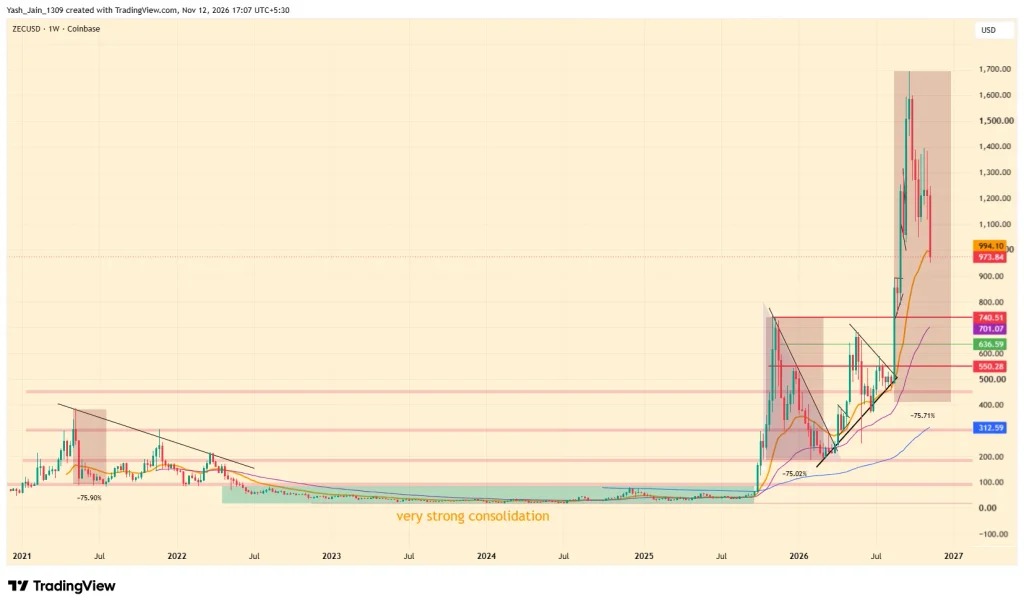
After that, the market trend reversed. ZEC reached a historical high of $740 in the second half of 2025, and then a profit-taking move led to a correction of over 75%, with the price eventually falling back to around $200.
In the first quarter of 2026, another descending triangle pattern appeared. This time, it managed to break through upwards successfully. By the end of the third quarter of 2026, ZEC reached a new historical high of $1,695. However, the decline in November has once again pushed the token back below $1,000.
ZEC Will it repeat the previous market correction?
However, historical comparisons are not optimistic. ZEC has previously fallen from $380 to $95 in 2021, and also from $740 to $200 in 2025. Both corrections were close to 75%.
If the selling pressure continues, $740 and $550 could become potential support levels. A further breakdown could expose the range of $400 to $440, which would mean another significant pullback from the latest high. The above are just potential downside scenarios and not confirmed price targets.
Zcash ETF faces increased pressure due to capital outflows in November
Institutional capital flows have not been conducive to the short-term trend. According to SoSoValue data, US spot Zcash ETF experienced a net outflow of $14.61 million on November 11, which is the largest single-day withdrawal since October 15.
These funds experienced capital outflows on 6 of the last 9 trading days. As a result, the net outflow in November totaled 29.78 million US dollars, and the total net assets dropped to 562.16 million US dollars, reaching the lowest level since September 4th.
This reversal is noteworthy, as in late October there was the strongest weekly inflow of funds since mid-September.
Developers' growth provides an important counterargument.
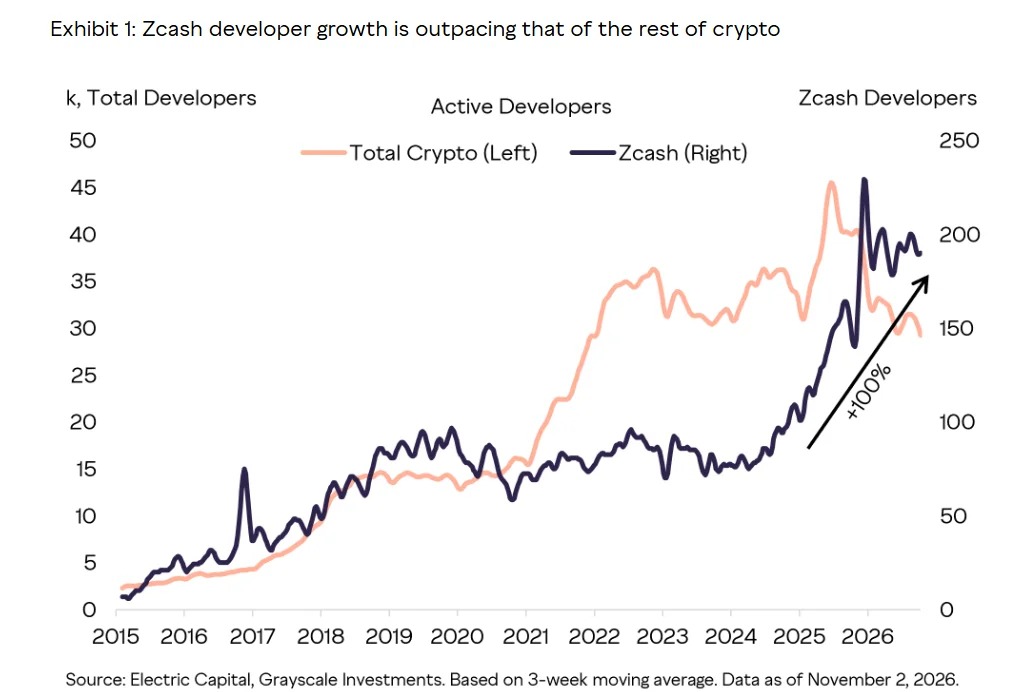
There are also aspects worth paying attention to in the bearish price trend. Research by Grayscale shows that although the overall number of cryptocurrency developers is declining, the number of monthly active developers for Zcash has approximately doubled over the past two years.
Approximately 70% of active Zcash developers have more than one year of experience in the crypto industry, while this proportion is 58% for the entire industry.
Grayscale believes that this development momentum may ultimately support the valuation of ZEC. However, the market has not yet rewarded it accordingly at present.
For now, the price of ZEC is facing conflicting signals: a weakening capital outflow for ETF, a significant price correction, and an improvement in developer participation. Whether the 20-week EMA level can be held may become particularly important. If selling pressure accelerates, the historical 75% correction pattern suggests that levels of 740 dollars, 550 dollars, and possibly the range between 400 to 440 dollars deserve attention.