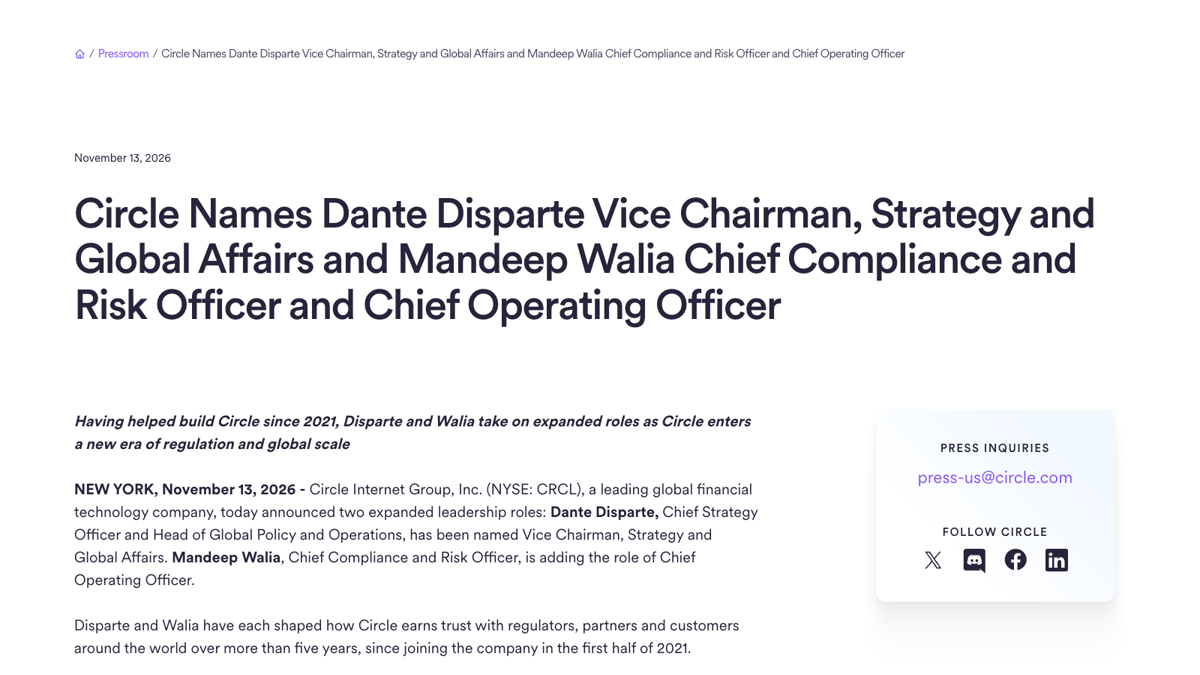


When stablecoin companies expand, product development speed and regulatory compliance often compete for the same set of management resources. On November 13th, Circle announced two senior management changes: Dante Disparte was appointed as Vice Chairman of Strategy and Global Affairs, while Mandeep Walia continued to hold the position of Head of Compliance and Risk Management and also took on the role of Chief Operating Officer.
Both joined Circle in the first half of 2021. The company described this adjustment as a reconfiguration of leadership for a larger scale and higher responsibilities, rather than a mass departure of personnel or a reduction in organization. The change in job titles does not automatically alter the rules of USDC; what is truly worth observing is how the division of labor and checks and balances among policies, compliance, risk management, and daily operations are carried out.
Global affairs have been elevated to the level of vice-chairman.
Disparte previously served as Chief Strategy Officer and was responsible for global policy and operations. Circle stated that he played a role in promoting the federal framework for stablecoins in the United States and led the company in communicating with regulators in various regions. The new position elevates strategy and global affairs to the level of Vice Chairman, indicating that the policy environment is considered a core variable for the company's growth, rather than a secondary matter after the product is launched.
Stablecoin businesses encompass issuance, reserves, redemption, payment, and blockchain networks, and different jurisdictions have varying requirements for licenses, disclosure, and customer protection. Centralized coordination at the senior level can reduce discrepancies in how market teams interpret these rules, and it may also enable companies to more quickly adapt regulatory changes into product and regional priorities.
However, "participating in shaping the rules" is not the same as "complying with all rules." Regulatory frameworks will continue to be updated, and specific businesses still need to meet licensing requirements, undergo audits, disclose reserves, and face enforcement inspections. The position of vice chairman has increased the organizational weight of policy issues, but it cannot replace external supervision and individual compliance certifications.
The compliance officer also serving as the operations manager presents a dual challenge
Walia will continue to serve as the Chief Compliance and Risk Officer, while also taking on additional responsibilities as the Chief Operating Officer. Circle stated that he will build the foundation for the company's operations in the next phase, covering areas such as payments, partner support, anti-fraud, and privacy. Bringing these processes under the same senior management's oversight is conducive to considering risk control at an earlier stage during product delivery.
The potential contradictions are also clear: operational departments usually pursue speed, scale, and efficiency, while compliance departments must reject business when necessary. If the same executive is responsible for both sets of goals, the organization needs clearer mechanisms for escalation and avoidance. Circle emphasized in the announcement that compliance and risk management remain independent and report directly to the board of directors, subject to the supervision of governance mechanisms.
This commitment needs to be verified by systems rather than slogans. External observers can pay attention to whether the board of directors' risk committee, compliance budget, disclosure of major events, and internal audits have independent channels. The real stress test lies in whether the compliance team can pause new initiatives when operational indicators deteriorate or business opportunities become urgent.
Executive adjustments will not immediately change token attributes.
What USDC holders are most concerned about are reserves, redemption, and network availability. Changes in executive positions will not directly alter the token contract, reserve assets, or exchange terms, nor do they indicate that a new market has been approved. Any specific product changes should still be based on official terms, on-chain contracts, audit, and regulatory documents.
However, closer integration of operations and compliance may affect the handling of abnormal transactions, the onboarding of partners, and customer support. If processes are properly integrated, identity verification, account freezing, refunds, and risk escalation can be streamlined, reducing wait times across departments; on the other hand, unclear responsibilities can also lead to issues being concentrated in a single management chain. It is necessary to maintain both efficiency improvements and independent decision-making.
For institutional clients, the governance structure itself is subject to due diligence. Clients not only consider the market value and transaction speed of stablecoins but also ask who approves new businesses, who can veto high-risk collaborations, and who reports to the board of directors in the event of incidents. This adjustment provides a new list of responsible persons, but continuous disclosure is still required to prove the actual operation of the mechanism.
The scaling phase tests the auditable responsibility even more.
Circle states that two senior executives have helped to establish a foundation for regulation, policy, and compliance over the past five years. As stablecoins enter more payment and institutional scenarios, the risks have expanded from mere technical failures to include customer funds, privacy, sanctions, and cross-border operations. The larger the organization, the more difficult it becomes to rely solely on direct decisions by the founders; clear responsibilities and evidence chains become even more important.
To determine whether this adjustment is effective, several indicators can be considered: whether new market approvals are synchronized with licensing, whether the time taken to resolve issues with partners has been reduced, whether compliance exceptions are recorded, and whether the board of directors can independently receive risk reports. If only the job titles have changed while the processes remain unverifiable, then the improvement in governance will be difficult to verify externally.
The signal sent by this personnel arrangement is that Circle has placed global rules and operational execution under a higher level of management. This may help the company to unify its policies during expansion, but it also raises new questions about how to maintain compliance independence. Whether the governance of stablecoins has truly changed does not depend on the new titles mentioned in the press release; rather, it depends on whether the risk management team can still make clear, auditable, and vetoable decisions under the pressure of high growth.