Broadcom (NASDAQ : AVGO)'s stock price rose by 18.16% during the trading week from November 9th to 13th, as investors turned to other artificial intelligence chip manufacturers amid the leadership crisis at NVIDIA, further exacerbating the differentiation within the semiconductor sector.
AVGO's stock price rose from $293.69 on November 6 to $347.01 on Friday, outperforming the S&P 500 index by 2.51%. During the same period, AMD increased by 18.93%, while NVIDIA fell by 12.75%, indicating that investors are re-evaluating their exposure to competitive AI hardware suppliers.
This differentiation continued the previous upward trend of AMD and Broadcom. On November 12th, these two chip manufacturers rose by approximately 5.4% and 5.5%, respectively.
As NVIDIA faces leadership uncertainty, Broadcom's stock price rises by 18%
After NVIDIA confirmed that CEO Jensen Huang had resigned, the rotation in the semiconductor sector intensified further. Jensen Huang concluded his tenure as leader of the company he co-founded over thirty years ago.
According to an official announcement from NVIDIA, Colette Kress, who has long served as the Chief Financial Officer, has been appointed as the interim CEO, and the board of directors has simultaneously begun the process of finding a permanent successor.
As a result, investors have turned to favor several competitors, including AMD and Broadcom. However, there is currently no conclusive evidence that NVIDIA's main customers have cancelled orders or switched to other suppliers after this transition.
However, on Friday, the market trend reversed significantly. AVGO fell by 4.76% to $347.01 that day, indicating that this round of gains is still susceptible to new selling pressure.
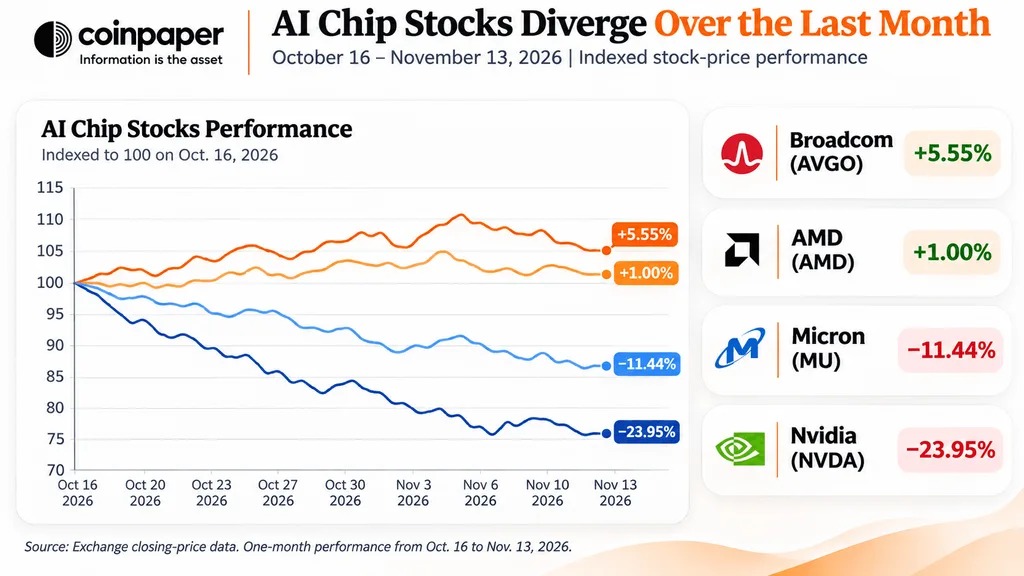
This comparison continues the previous trend of Wall Street rotating its focus towards the competitors of AI, and also further distinguishes NVIDIA's corporate-level risks from the broader semiconductor demand.
Broadcom AI chip revenue expectations support investors' optimistic sentiment
Broadcom's investment attractiveness does not stem solely from the uncertainty of NVIDIA's leadership.
In its financial report for the third quarter of July, the company reported revenue of $29.6 billion, a year-on-year increase of 86%.
AI Semiconductor revenue reached $16.7 billion, with a year-on-year growth of 221% and a quarter-on-quarter growth of 54%. Management expects that in the fourth fiscal quarter, AI chip revenue will reach $21.7 billion.
Unlike NVIDIA's general GPU strategy, Broadcom focuses on designing custom accelerators and network hardware for large cloud customers and AI customers.
Its growth reflects an increasing interest in application-specific chips in the market, however, custom processors may not necessarily replace NVIDIA GPU in all workloads.
This performance follows a previous analysis article on Broadcom's financial report, which discussed aggressive revenue expectations for AI and Wall Street's concerns regarding valuation.
Despite rising stock prices, Broadcom still faces a $63 billion AI financing challenge
The company's increasingly deep involvement in the infrastructure financing of AI also brings another layer of risk.
A financing announcement on October 26 disclosed a structural arrangement totaling $63 billion, involving Bank of America, Blackstone, Citibank, and Morgan Stanley, aimed at supporting Anthropic in using Broadcom technology to expand the computing power of AI.
This arrangement indicates that semiconductor revenue is increasingly linked to the customers' ability to finance expensive computing infrastructure.
Coinpaper Previously, an analysis was conducted on Broadcom's AI financing exposure, which has made the already strong semiconductor growth story even more complex.
On Friday, investors' cautious sentiment once again intensified. It was reported that Rothschild and Co Redburn downgraded Broadcom's rating from 'Buy' to 'Neutral' and reduced the target price from $595 to $398.
This downgrade occurred simultaneously with the decline of AVGO on that day, despite the fact that the stock still recorded a considerable increase this week.
Looking ahead to the future market, NVIDIA will release its financial report on November 17th, which will provide another important test for semiconductor sentiment. Broadcom's next financial report is scheduled to be released on December 9th.
Ethan Mercer
Ethan Mercer is a financial journalist who covers cryptocurrency, stocks, and the global economy. He studied economics and finance before turning to market reporting, with a particular focus on Bitcoin, stocks, monetary policy, and investor sentiment. His work primarily explains daily market fluctuations and the broader trends behind them.