

Baidu releases its financial report for the third quarter of 2026, with total revenue of 30.8 billion yuan, which is basically in line with market expectations.
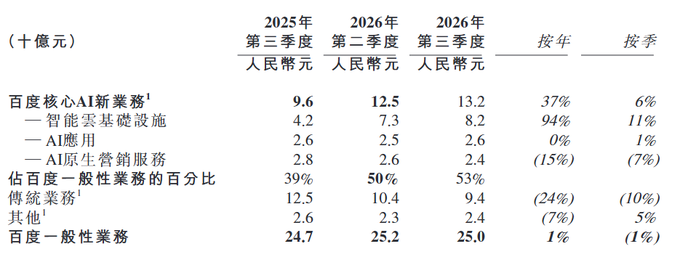
Despite the ongoing pressure on online marketing operations, the implementation of the AI strategy is reshaping Baidu's revenue structure. This quarter, Baidu's core AI new business revenue reached 13.2 billion yuan, accounting for 53% of Baidu's general business revenue for the first time, surpassing half for the first time. This marks an important milestone in the company's transformation from a search engine provider to a AI company.
CEO Li Yanhong stated in the financial report that the long-term investment in full-stack AI is transforming into scalable and substantial growth, and the role of AI in shaping Baidu's future is becoming increasingly important. CFO He Haijian emphasized that the company will adhere to a prudent capital allocation strategy, with a clear focus on return on investment. The operating cash flow amounted to 2.8 billion yuan, and the total cash and investments reached 276.6 billion yuan, providing sufficient funds for continued AI investments.
Intelligent Cloud Infrastructure: A New Growth Engine Is Fully Launched
The most impressive figure of this quarter comes from the intelligent cloud infrastructure segment – revenue reached 8.2 billion yuan, a year-on-year surge of 94% and a month-on-month increase of 11%. Among them, the cloud revenue of GPU increased by 191% year-on-year and 43% month-on-month, reflecting the strong market demand for public cloud AI computing power.
What is more telling is the revenue from Token on Baidu's Qianfan MaaS platform, which increased by a staggering 1159% year-on-year this quarter. This figure directly reflects the acceleration of the commercialization of large models. On the customer side, there are positive signs this quarter, such as an increase in advance payments from customers and a shift towards longer-term contracts, indicating that corporate customers are becoming more dependent on and confident in Baidu's AI infrastructure.
At the hardware level, Baidu's Kunlun Core M100 chip made its debut at the World Artificial Intelligence Conference, positioned for large-scale AI inference optimization, with mass production expected by the end of 2026. This is an important move by Baidu to improve its self-developed chip ecosystem and reduce its dependence on external computing power.
Online Marketing: Structural Pressures Are Inevitable
Traditional online marketing services generated revenue of 11.9 billion yuan, a year-on-year decrease of 22% and a month-on-month decrease of 9%. The proportion of these services in Baidu's general business revenue has dropped from 62% a year ago to 48%, falling below 50% for the first time.
Baidu's management attributed this decline to three main pressures: a weak macroeconomic environment, a continuously evolving competitive landscape, and the company's choice to prioritize enhancing user experience over short-term monetization during its transformation in AI search. This statement implies that some loss of marketing revenue was a deliberate strategic sacrifice, rather than a simple loss of market share. In September, Baidu had 604 million active users in APP, indicating that its overall user base is still intact. However, how to effectively convert user traffic into marketing value in the AI era remains a core challenge for the company.
AI Applications vs. AI Native Marketing: Clear Differentiation in Growth
The revenue from the application segment reached 2.6 billion yuan, remaining relatively stable year-on-year and showing a slight increase of 1% month-on-month. This quarter, Baidu integrated its internal office AI intelligent agents, AI coding assistant Wenxin KuaiMa, and the no-code programming platform into a unified work intelligent agent called “Baidu Dazi”. The aim is to cover a wider range of enterprise scenarios through a single entry point. The penetration rate of daily active users for Baidu Wenku and Baidu Netdisk AI increased by 60.7% year-on-year, indicating that the acceptance of these AI functions on the To C platform is on the rise, but monetization still requires time.
AI's native marketing service revenue amounted to 2.4 billion yuan, a year-on-year decrease of 15% and a month-on-month decrease of 7%. It is the only segment among AI's new businesses that has seen a year-on-year decline, directly affected by the weakness in the overall marketing market. In November, Baidu launched "CiYuanSo" – a trading platform that connects AI model service providers with customers, which may represent a new attempt by the company in building its AI marketing ecosystem.
Radish Run: The Autonomous Driving Landscape Expanding from China to the World
Robotaxi Business "Rouba Kuai Pao" continues to expand this quarter. As of October 2026, the number of cities with operations has grown to 30 globally, with autonomous driving mileage in the third quarter reaching approximately 34 million kilometers, and the cumulative mileage exceeding 390 million kilometers.
Regional expansion is a highlight of this season: in Shenzhen, the volume of fully autonomous driving orders increased by about 170% month-on-month; in Dubai, Luobo Kuai Pao expanded its fully autonomous driving commercial operations and doubled the size of its fleet; in London, continued cooperation with Uber and Lyft for open-road testing; in Hong Kong, fully autonomous driving tests were advanced on the Airport Island. Luobo Kuai Pao's internationalization path is becoming increasingly clear, and it has won the British Autonomous Driving Industry Award for Consumer Service, which adds credibility to its global reputation.
Cost Pressure and Capital Expenditure: The Price of a Heavy Investment Cycle
While revenue is under pressure, there has been a noticeable expansion on the cost side. Sales costs amounted to 19.9 billion yuan, a year-on-year increase of 9%, mainly driven by rising costs related to cloud services and traffic acquisition. In terms of capital expenditure, this quarter reached 7.3 billion yuan, which is a decrease from the previous quarter's 11.4 billion yuan, but free cash flow remains negative (-4.571 billion yuan), indicating that the company is still in a phase of heavy investment.
R&D expenses amounted to 4.8 billion yuan, a year-on-year decrease of 7%, but there was a slight increase from the previous quarter, indicating that while the company continues to maintain its R&D investment in AI, it is also making efforts to optimize efficiency to some extent. Sales and administrative expenses totaled 5.5 billion yuan, showing a significant year-on-year decline of 17%, mainly due to reduced expected credit losses and channel expenditures, which to some extent supported the profit performance exceeding expectations.
Shareholder returns and iQiyi: two parallel lines
In terms of capital returns, since the beginning of the first quarter of 2026, Baidu has returned $373 million to shareholders through share repurchases and expects to distribute dividends for the first time by the end of 2026, subject to market conditions and board approval. This signal indicates that while maintaining high-intensity investment in AI, Baidu is also gradually increasing its direct returns to shareholders.
iQiyi's performance continues to drag down overall results — this quarter's revenue was 6 billion yuan, a year-on-year decrease of 10%, lower than the market estimate of 6.29 billion yuan, and it is still operating at a loss. The reduction in content costs has offset some of the pressure from declining revenue, but the gap between iQiyi's strategic value as a streaming media asset under Baidu and its financial contribution remains a focal point of concern for investors in the long term.