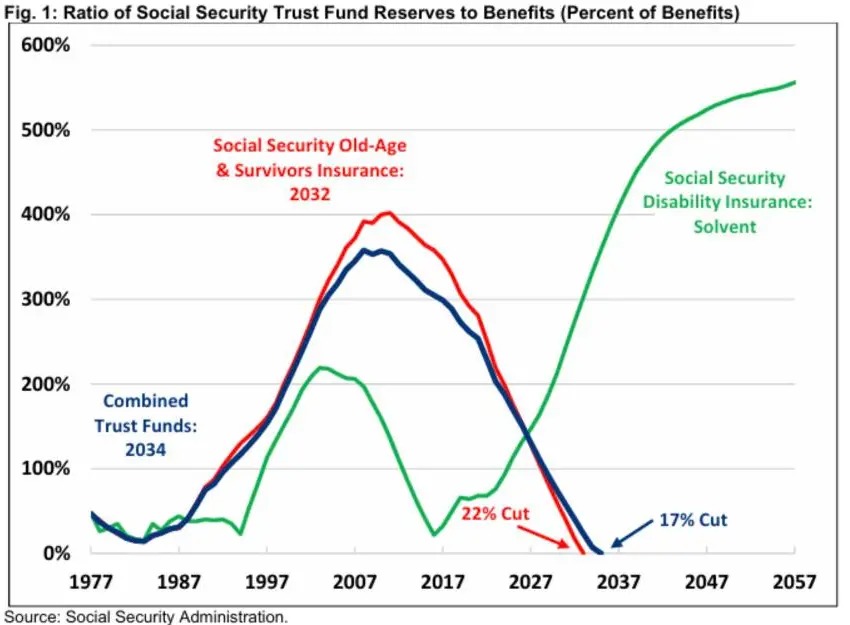
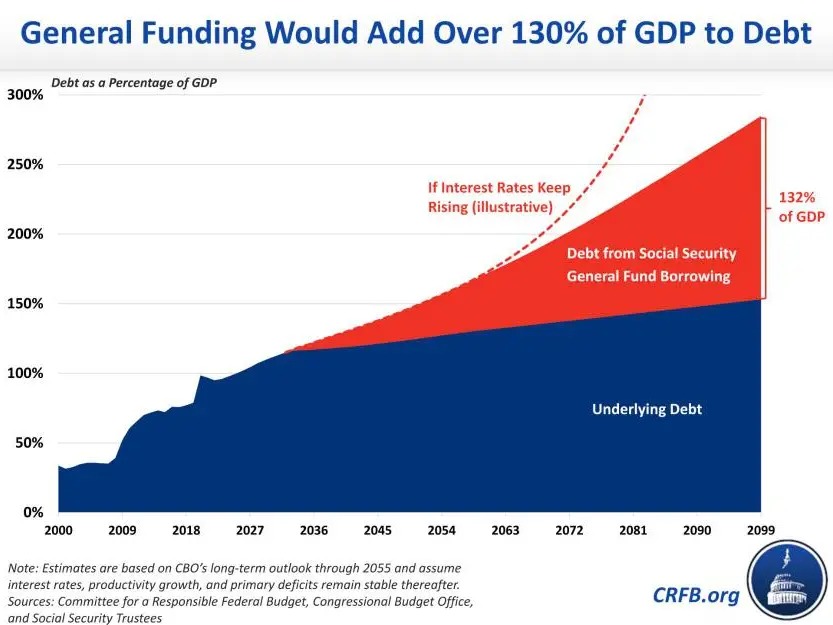
On November 18th, this Republican from Wisconsin proposed a bill which the Responsible Federal Budget Committee of the United States referred to as the "Don't Scare the Elderly Act" ( Stop Scaring Seniors Act ). This proposal would allow the Secretary of the Treasury to transfer funds from the general government fund into the retirement trust fund after its reserves are depleted, thereby enabling beneficiaries to continue receiving their full benefits. CRFB estimates that this would result in an increase of $190 trillion in U.S. national debt over 75 years, when adjusted for inflation, which is approximately 165% of GDP.
For about 70 million people who receive social security benefits, this proposed cut is a real loss of money: according to CRFB data, each beneficiary loses approximately $500 per month on average. The question is, who will foot the bill for it.
The bill will move towards the bond market.
CRFB is a non-partisan fiscal hawk organization that believes that the greater risks lie not after 75 years.
"Even if it's just this legislation, it could be enough to shock the bond market and trigger financial turmoil," said MacGuineas, adding that such borrowing "is almost certainly going to lead to a crisis."
The organization has previously conducted similar calculations. In an analysis last November, CRFB estimated that if general fiscal revenue were used to fund social security instead of maintaining the integrity of the trust fund, interest rates would be about 2.6 percentage points higher than under the current situation. This would push the yield on 10-year U.S. Treasury bonds from 4% to 6.6% and raise the mortgage loan rate for 30-year bonds from 6.3% to 8.9%. In the view of CRFB, the trust fund would no longer be a budget rule and would become "more like any other government project."
Johnson's statement
According to National News Desk, Johnson stated: "Your money has already been used to pay the current beneficiaries or to fund other government projects." Future benefits will be paid for by the money of 'your sons and daughters who are working at that time', in addition to loans.
Johnson has also recently begun to turn his criticism towards his own camp. After the Republican Party's defeat in the midterms, in an interview with Fox News on November 7th, he stated that there was corruption within the government, and "regrettably, the same is true within the Trump administration," referring to claims by former White House health advisor Calley Means that senior aides catered to special interest groups.
"Our supporters originally expected us to clear the swamp, but it seems the swamp has won," he said. He then clarified that he was referring to "the deep state figures within each administration" and that he had been pushing to delay the Republican leadership elections in the Senate in order to conduct what he called "exhausting discussions."
Scaring the elderly
Johnson has previously used the same title for this bill. In July 2011, he and 12 other newly elected Republican senators wrote to then-President Barack Obama, accusing him of trying to “scare the elderly” by warning that Social Security checks could be at risk if Congress did not raise the debt ceiling.
The debt ceiling issue is back again. TD Securities predicts that the current ceiling of $41.1 trillion will come into effect in January, and the government will likely run out of room for maneuver around September 2027. This is five years earlier than the trust funds will be depleted, and Johnson's bill will also rely on the same borrowed funds to support social security.
This article utilized generative AI in its research assistance and/or transcription processes. The journalist independently reported on and verified the factual statements contained within the article, which were also reviewed by human editors before publication.