









Tesla also claims that its "ability to handle critical safety scenarios" has increased by 25 times, and they have added a rather impressive real-time visualization interface. If the improvements in driving performance are as realistic as these visual effects, then this will be a major update.
FSD v15 What content does it have?
Tesla announced the start of rolling out the update on Thursday afternoon via X, followed by a detailed update explanation posted on their Tesla Super Intelligence account. The company did not specify which models would receive the update first, but they had previously informed investors that their AI4 ( HW4 ) computers are capable of running v15.
The following are the update notes released by Tesla for FSD and v15.
Every part of the end-to-end driving network has been upgraded. This includes: introducing Tesla Augmented Reality, replacing all explicit model signals with a single end-to-end visualization to reduce the total amount of computation; improving parking spot selection by utilizing personalized parking history, with maps now displaying multiple parking options at the destination; enhancing the recognition of hats and sunglasses in driver monitoring by increasing the availability of visual-based attention monitoring in driving configurations at higher speeds and lowering the strictness of detection; improving the detection of road signs, small animals, road debris, and chains; enhancing the detection of potholes, road details, and avoidance of deep puddles; and improving speed handling in various driving configurations, school zones, speed limits, as well as in adverse weather conditions; and also improving the functionality of Autoshift by unifying it with gear prediction based on FSD.
Tesla's main announcement also stated that FSD can now slow down in front of speed cameras, and a new feature Bike Rack Mode has been added, allowing FSD to be used when installing bicycle racks or similar trailer mounting accessories. Navigation learning currently only covers the starting and ending points of a journey; Tesla mentioned that future versions of v15 will expand this feature to cover the entire route.
Reality View looks great.
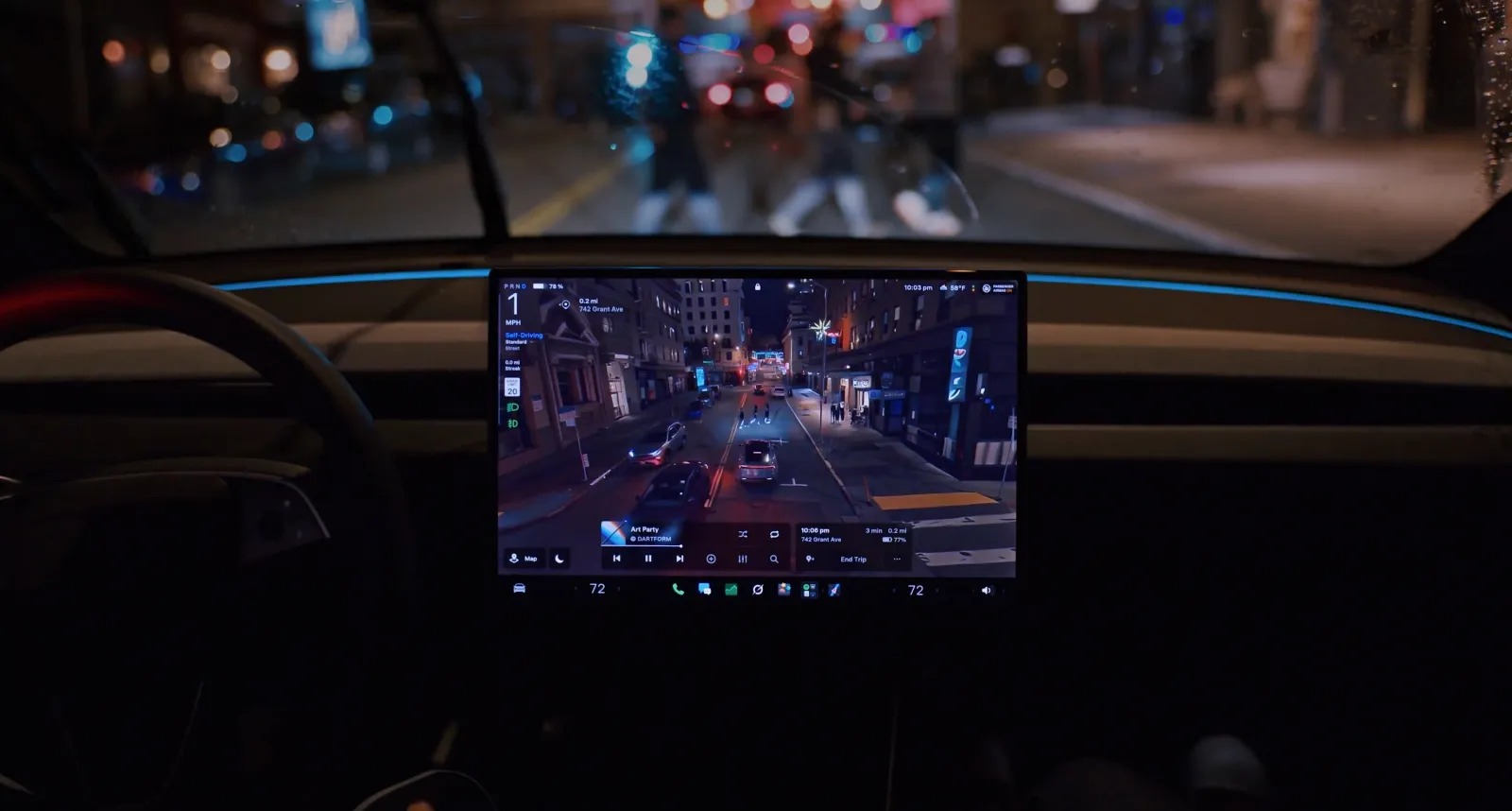
In its announcement, Tesla referred to it as “Reality View”, while in the update notes it is called “Tesla Augmented Reality”. The notes state that it replaces all independent model signals with a single end-to-end visualization, reducing the amount of computation; Tesla claims that this allows drivers to “see and control what FSD plans to do”. If this is indeed true as advertised, then the monitoring system will be much easier to use.
v15 Directly exposes the biggest weak point of FSD
What is more noteworthy is the focus of Tesla's efforts. Almost every driving improvement mentioned in the update notes targets the areas where FSD currently performs poorly.
Traffic signs are a big issue. In a test conducted in September by the Belgian non-profit organization Johanna.be, FSD was found to be speeding in 55% of the areas with a speed limit of 30 kilometers per hour, with an average speed of 44 kilometers per hour. In most of these areas, the speed limit displayed on the vehicle screens was 50 kilometers per hour. It seems that the system did not correctly interpret the signs.
Potholes are also a problem. In August, Musk stated that avoiding potholes “would come soon,” and he had made similar promises as early as 2019. Today, however, FSD still drives straight over them.
School areas are also on the list. The National Highway Traffic Safety Administration (NHTSA) is reviewing a petition claiming that Tesla drivers speed in school areas that are still in use; meanwhile, NHTSA is also investigating another case regarding traffic violations, such as running red lights, that was initiated in October 2025. Slowing down in front of speed cameras fits into this context as well, but it also implies that Tesla believes it is okay to speed as long as there are no cameras present.
Therefore, if v15 truly fixes these issues, then it would be a very good update. The question is, just how significant are the improvements?
One change, however, is in the opposite direction. Tesla stated that in higher-speed driving modes, it will “reduce” the strictness of driver monitoring; at the same time, there are continuous reports in the news about FSD drivers who are asleep, and Tesla is also tightening monitoring requirements in Europe as per regulatory authorities.
"25 times" refers to the key takeover rate.
Update note clarifies what "25 times" specifically refers to: Tesla claims that the new visual encoder has increased the key takeover rate by 25 times. This is an important indicator of progress towards autonomous driving without human supervision. However, Tesla has not yet disclosed the actual numerical value, only providing the multiple.
This calculation quickly became interesting. Data from earlier this year indicates that FSD v14 may only experience a critical takeover every few thousand miles. If we increase this by 25 times, then the interval between critical takeovers for v15 would reach about 50,000 miles, which is much higher than the approximately 10,000 miles we previously thought was required for Tesla to achieve limited unsupervised driving. If this performance holds true across the entire fleet, we might see one of the most significant advancements in autonomous driving from Tesla in a long time.
Moreover, v15 has already come with a lot of publicity. In April, Elon Musk wrote that v15 “will far exceed human safety levels, even in completely unmonitored and complex situations.” At that time, we pointed out that he had said similar things about v12 and v14. In August, Tesla told JPMorgan Chase that v15 is a “leapfrog” upgrade based on seven “core technologies,” about 40% of which are already in use with the Robotaxi fleet in Austin.
Take two steps forward, then one step back.
The improvements of FSD have never been linear. Each major version brings real progress, but at the same time, it also introduces new problems, while minor version updates often lead to regressions.
In October 2025, when v14 was launched, it came with issues such as hallucinations, sudden hard brakes, and excessive speeding. Early crowdsourcing data showed that the critical separation distance was about 732 miles, which was lower than our expectations. Subsequently, there were indeed significant improvements. However, subsequent updates to v14.2 led to a regressive trend, while Musk described v14.3 as the version where "the last crucial piece of the puzzle finally fell into place."
After seven months and a long string of minor version updates, car owners still need to keep a close eye on the situation, while Tesla now needs v15 to achieve the goals that were originally supposed to be fulfilled by v14.3.
Views of Electrek
These visual effects are truly stunning. Just from watching the videos, we can already make such a judgment, and Reality View might make FSD easier to understand and monitor.
Judging the performance at the driving level is even more difficult. Tesla is directly addressing the weakest points that car owners and regulatory agencies often complain about: incorrect speed limit recognition, potholes, school zones, and road debris. If v15 brings substantial improvements in these areas, then it indeed represents a very good update.
However, "improved detection" does not specify by how much it has actually improved; without underlying data, it is difficult to verify a factor of 25. The history of FSD has been one of making progress only to take steps back, with minor version updates often causing problems that previous versions could handle just fine. Yet Tesla still refuses to release the control data to settle the matter once and for all.
If you're considering buying an electric vehicle, using home solar power can bring the cost of fuel down close to zero. With electricity prices rising by nearly 10% last year and expected to continue to increase, installing solar panels is one of the best ways to counter these rising costs. Through leasing and the PPA program, you can even start with no down payment and start saving money immediately. If you want to find the best option, take a look at EnergySage. This is a free service where hundreds of pre-approved installers will compete for your order, so you can save 20% to 30% compared to searching on your own. There will be no sales calls before you choose an installer. Click here to get a free quote.
FTC: We use automated affiliate links that can generate income. For more information.