













Views: Founders of Michael Egorov, Curve Finance, and Yield Basis
On-chain foreign exchange (FX) does not need to first rebuild a trillion-dollar-level institutional market to become useful. Real needs can be met by allowing smaller-scale markets to operate first.
For a long time, the most intuitive way people have thought about on-chain foreign exchange has been to start from the top: banks tokenize currencies, large financial institutions migrate their foreign exchange operations onto the blockchain, and institutional liquidity naturally follows.
The ultimate outcome will be that the blockchain-based foreign exchange market will grow to a size similar to that of the traditional foreign exchange market. However, things may not necessarily develop in that way.
In fact, there are increasingly many signs indicating that the development path of on-chain foreign exchange may be just the opposite – from bottom to top.
Stablecoins like EURe (similar to BRZ or Monerium) can be quickly redeemed on the blockchain and easily transferred from digital wallets to bank accounts. When users of decentralized finance (DeFi) exchange them within the pools of decentralized exchanges (DEX), it generates healthy transaction activity.
In such a market, it will ultimately develop in real-time around a practical user need: namely, the direct transfer of funds between digital currencies and fiat money.
This is still just an early example, but this use case and requirement are already quite realistic. Data from Keyrock shows that for transactions of on-chain stablecoins pegged to emerging market currencies, most individual transactions fall within the range of $1,000 to $10,000 – which is not large on a institutional scale – but that is precisely what illustrates the point.
This indicates that the market is moving in the overall direction of on-chain foreign exchange, in order to meet actual payment needs, rather than just serving large traders.
“Small” does not equal “useless”.
Both individuals and businesses need to transfer funds between different currencies, and obviously, they are not willing to keep waiting for large traditional financial (TradFi) institutions to migrate their foreign exchange services onto the blockchain.
Regarding on-chain foreign exchange, there is a rather common assumption: the market must first possess a huge level of liquidity before it can be truly useful. However, in practice, this is not entirely correct.
If there are indeed people in need of converting US dollars into euros, Swiss francs, or other currencies, then even smaller pools of funds can handle such transactions and serve real economic purposes.
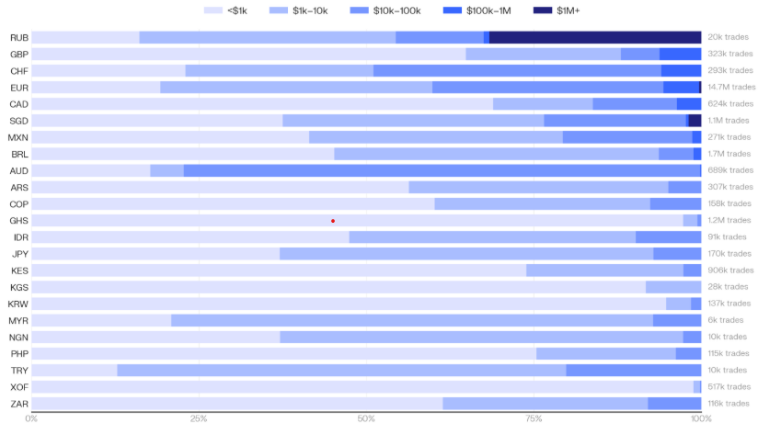
Stablecoin DEX trading volume. Source: Keyrock Research
On-chain foreign exchange doesn't need to become large first to be useful; on the contrary, it can grow precisely because people are actually using it.
In fact, that is roughly the development of stablecoins. They were initially only for relatively niche, crypto-native use cases, but today we know that they have become part of a broader financial infrastructure.
Users don't care how big the market is.
This is actually the most practical aspect of this issue. Clearly, on-chain foreign exchange cannot compete with the global foreign exchange market in the short term; that will only happen after many years. However, what is more interesting is what benefits it can provide for those who have already placed their funds on the blockchain.
Today, you can exchange one type of US dollar-stabilized coin for another type of euro-stabilized coin (or other alternative options) on the blockchain, and use this money for payments relatively easily. In fact, doing so is often faster and cheaper than traditional international bank transfers.
The same logic also applies to on-chain foreign exchange. Financial technology companies or cryptocurrency card companies do not need to rebuild the entire institutional market; what they really need is the ability to transfer customer funds efficiently between different currencies.
When someone attempts to pay in another currency, currency conversion incurs additional operational costs, as this usually involves Visa or Mastercard, which charge a processing fee of around 1%.
Here, on-chain exchange is a better option. If the user's funds are already on the blockchain, then converting US dollar stablecoins directly into euro stablecoins eliminates the need for additional intermediaries, making the process faster and less costly.
In scenarios where digital currencies need to interact with the real world, banks are likely to remain important gateways. Banks will play a leading role in issuing and redeeming local currencies, accessing bank accounts, and handling compliance matters.
But when the funds are actually on the blockchain, many traditional “intermediary links” can be eliminated, thereby improving efficiency.
For a user who simply wants to complete a transfer with as little hassle as possible, this is clearly a very positive improvement. In this case, whether the overall market is large or small is not so important.
The requirement only solves half of the problem.
Of course, there is also a prerequisite involved here.
Real needs are certainly crucial, but they cannot miraculously solve the issue of liquidity. The challenge is not just about establishing a EUR / USD or CHF / USD fund pool; it is also about how to make them economically sustainable.
This is precisely where automated market makers can play a role. Traditional market-making firms may not find it attractive to provide liquidity for a small foreign exchange market; the trading volume may simply not be sufficient to cover their operating costs.
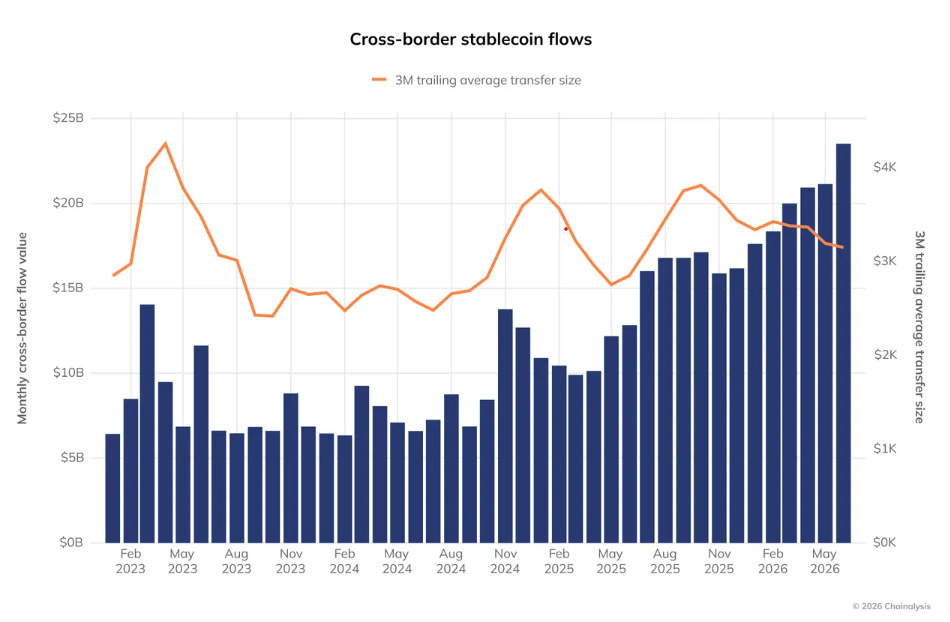
Cross-border stablecoin flows. Source: Chainalysys
Automated liquidity has changed this equation, as software can continuously provide liquidity without the need for market-making companies to manually manage each transaction.
Imagine two US dollar stablecoins: USDC ( USDC ) and Tether ( USDT ). From the perspective of traditional exchanges, exchanging one US dollar stablecoin for another might be a rather dull business. Both assets are theoretically supposed to be worth approximately 1 US dollar, so there is hardly any price fluctuation available for trading.
But if there is indeed a real need for people to switch between such stablecoins, then automated market makers can establish a fund pool that allows users to complete exchanges directly. Each transaction will bring a small fee to the providers of liquidity; and when enough people need the same conversion, such a market can still exist, even if it is not particularly attractive in the eyes of traditional market makers.
This approach certainly cannot be called explosive growth, but slow, natural growth in itself is not a problem. Sometimes, a new market only requires a small group of people who happen to face a problem that the existing infrastructure cannot solve well. If these users can make the market economically viable, liquidity can then continue to grow from there.
About the Author
Michael Egorov is the founder of Curve Finance and Yield Basis. He is also a physicist, entrepreneur, and a proponent of minimalism in cryptography. Michael transitioned from the scientific field to the cryptocurrency industry, has won a bronze medal in the International Physics Olympiad, and holds a doctorate in the field of ultra-cold atoms.