Bloomberg journalist Mark Gurman released the latest Power On newsletter last night, analyzing Apple's position in the AI Agent competition and disclosing some of Apple's new product plans for the first half of 2027.
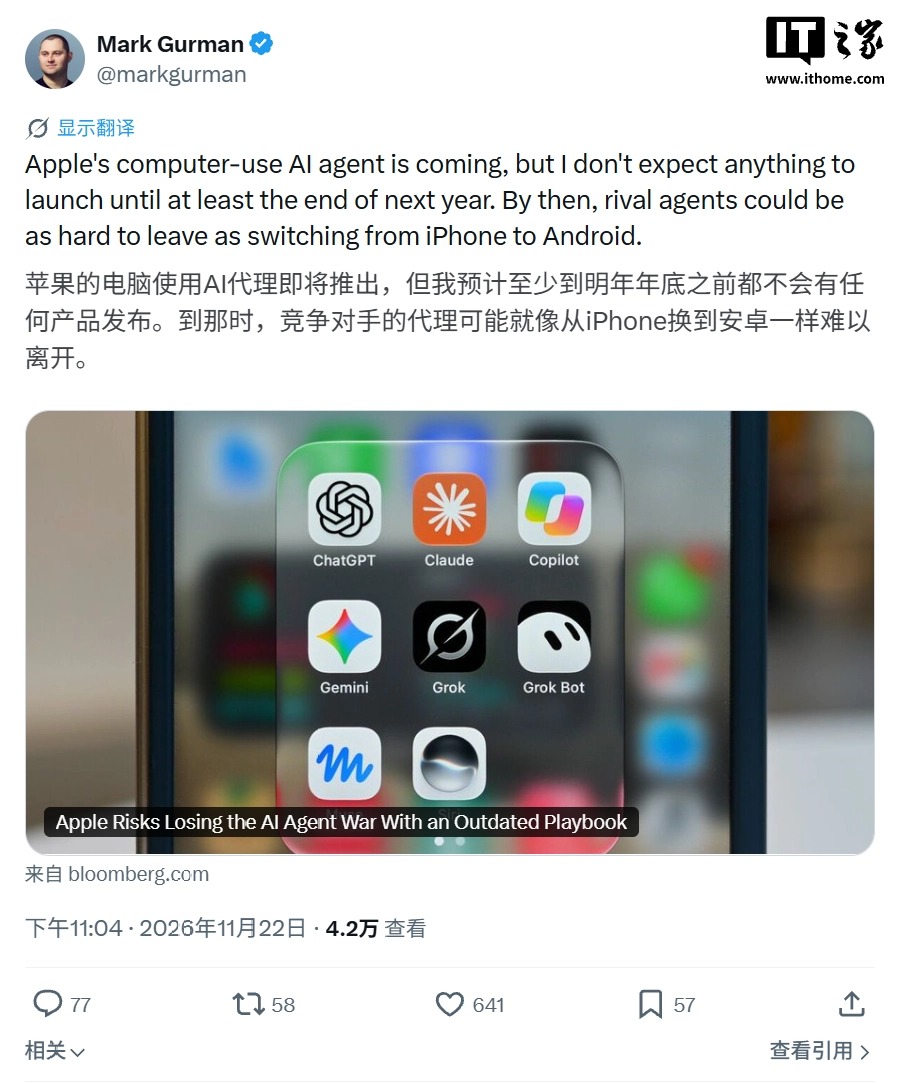
As previously reported by IT, Apple is recruiting senior engineering managers for the Agentic AI project, with the job description covering skills in cross-application operations, web browsing, command execution, as well as code writing and debugging.
Gurman believes that the main issue Apple faces in the AI Agent competition is not a lack of funds or technical resources, but rather that the traditional software and hardware development model can no longer keep up with the rapid iteration pace of the AI industry.
He pointed out that in the past, Apple built a competitive advantage by relying on its ecosystem. Users store their emails, contacts, photos, and videos within the Apple ecosystem, and also manage their health data, passwords, bank cards, and smart home devices through Apple's services. Products such as AirPods, Apple Watch, HomePod, and Apple TV are also deeply integrated with Apple's ecosystem. These factors make it costly for users to switch platforms, which has helped Apple maintain its competitiveness over the long term.
However, Gorman believes that AI Agent is becoming the core of the next phase of competition in the tech industry ecosystem. Companies such as OpenAI, Anthropic, Google, and Meta are continuously launching new AI models and agent services that can connect users' calendars, emails, travel plans, shopping habits, and office tools, and are capable of autonomously performing multi-step tasks.
In contrast, Apple's software development process is still relatively traditional. Gulman stated that Apple's software engineering team uses an internal version release cycle from A to G, and the roadmap for major operating system versions and their features are usually determined at the end of summer or the beginning of autumn of the previous year. This means that Apple often takes about a year to implement its planned updates, making it difficult for them to respond in a timely manner to new features launched by competitors during their development cycles. For example, the Apple Intelligence that Apple announced in 2024 was not released until more than a year later. Gulman believes that Apple has already shown the limitations of this development model in the area of AI. In comparison, some AI competitors release new models and features every week, while Apple used to focus its major software updates on autumn, with only one major system upgrade per year.
Apple is trying to change this situation. Gourman said that Apple plans to accelerate product iteration by increasing spring software updates and dispersing the release cycles of hardware products. However, Apple's internal employees have not yet noticed any significant changes in the company's overall operations.
He pointed out that Apple's current Siri AI still lags behind its competitors in terms of response speed, integration with third-party applications, and the reliability of task execution. The screen perception and personal context capabilities that Apple previously promoted heavily also failed to meet expectations consistently. He gave an example: during a text conversation with a friend, he saw the location and time of a gathering and asked Siri to add it to his calendar, but Siri still required him to provide the date, time, and event name again, and even failed to recognize the location information on the screen.
Apple is continuing to add cross-app functionality to Siri. According to Gurman, the relevant features are expected to be supported within Apple's own apps in December and will be extended to third-party apps in 2027. By then, users will be able to use a voice command to ask Siri to find photos, crop and rotate them, and then send them to friends via email. They will also be able to ask it to book Uber or place orders through Resy.
However, Gullman believes that there is still a gap between this and the ability to actively understand user needs and autonomously complete tasks. More and more users have begun to integrate AI Agent with their travel accounts, ride-hailing services, bank accounts, credit cards, email, and office tools. The number of applications and services currently provided by relevant platforms has reached several thousand.
This could also change the way users use software. Gorman believes that in the future, users may no longer need to frequently open separate applications installed on their devices, but instead complete various tasks directly through the AI platform. This change will weaken the existing influence of Apple's App Store ecosystem.
Gurman believes that, according to Apple's current organizational and development processes, its own AI Agent product is not likely to be launched until at least the end of 2027. He is concerned that if competitors take the lead in integrating AI Agent deeply into users' daily lives, accumulating users' personal data, financial information, usage preferences, and account permissions, it will become increasingly difficult for users to switch to AI in the future.
However, Apple still possesses some competitive advantages, including a long-established reputation for privacy protection, a vast ecosystem of App Store applications, and control over its own operating system and hardware. Gullman also noted that Apple is raising the barriers for third-party AI Agent applications to operate on Mac. For example, configuring ChatGPT on a computer running macOS 27.3 requires users to complete 14 separate steps. If Apple can in the future provide a simpler user experience for its own AI Agent, as well as more extensive access to iMessage and iOS functions, it still has the opportunity to build a competitive advantage.
Gurman also believes that even if Apple ultimately fails to gain a leading position in the AI Agent software field, iPhone may still continue to maintain an important position. Users can continue to purchase Apple hardware, but they will entrust their daily tasks to the AI assistants of other companies. However, if the AI platform becomes the main entry point for users to interact with their devices, it may also become less difficult for users to switch to the hardware owned by AI service providers in the future.
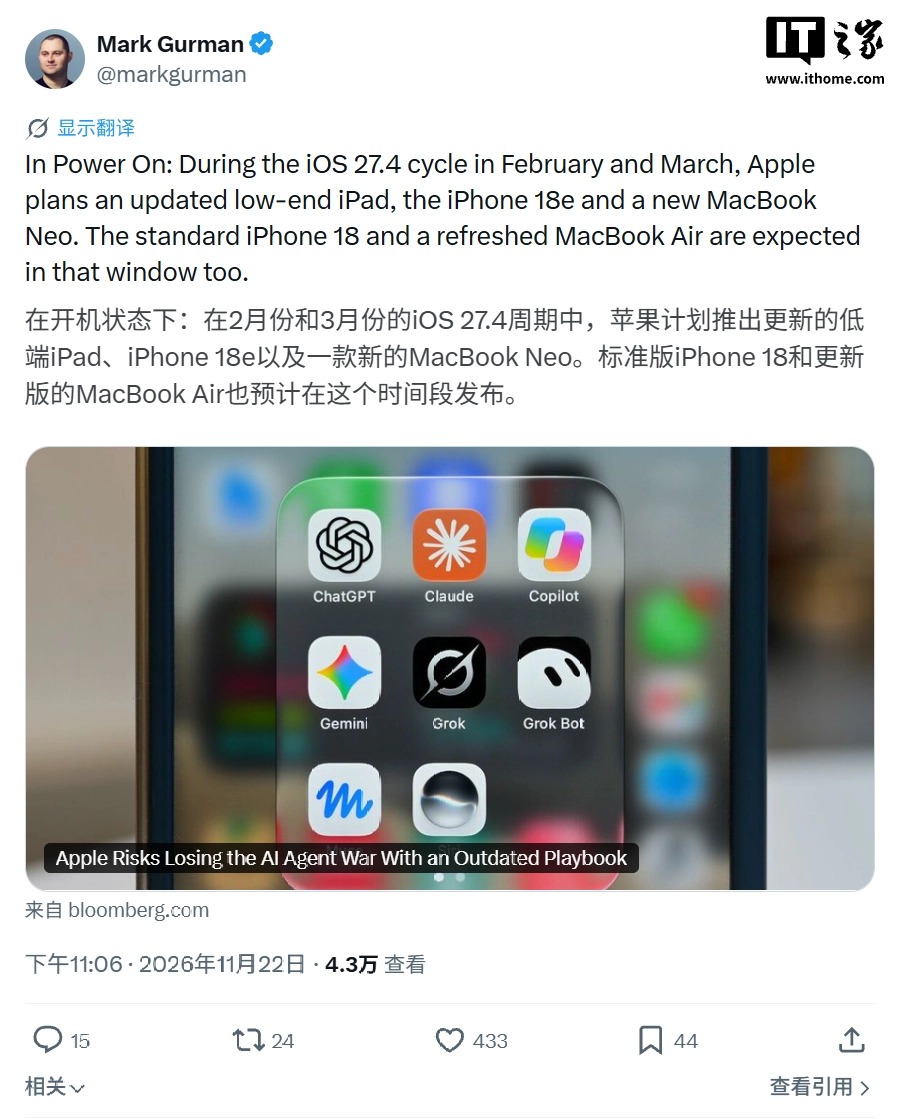
It has been revealed that during the iOS 27.4-week period from February to March 2027, Apple plans to launch new entry-level iPad, iPhone 18e, and the new MacBook Neo. Additionally, the iPhone 18 standard version and the new MacBook Air are also expected to make their debut during this time frame.
Apple also plans to launch more products in the first half of 2027, including the OLED model, the iPad model, the Air model, the new iPad model, the Pro model, and the iPhone model, as well as the Air model 2. However, the manufacturing schedules for these products are slightly later than those of the aforementioned entry-level and mid-range models.
Gurman expects that Apple may release these new products over multiple dates, rather than all at once during a single press conference. This move also aligns with the new CEO John Ternus' desire to schedule more product releases throughout different periods of the year.
In the second half of 2027, Apple is also expected to launch new models of Apple Watch, iPhone, smart glasses, as well as AirPods equipped with cameras.
Regarding MacBook Neo, Gorman further revealed during the Q&A session that Apple plans to adopt an "annual update" cycle for this laptop in order to continuously compete in the entry-level Windows PC and Chromebook markets.
According to the introduction, the new MacBook Neo has an internal code name of J701 and is expected to be launched in the spring of 2027. The main upgrades will focus on the chip. The currently available models are equipped with the A18 Pro chip, while the new model is expected to be upgraded to the A19 Pro chip, and the memory capacity will be increased to 12GB, resulting in faster processing speeds and better graphics performance. In addition, Apple also plans to update the color options of the MacBook Neo body more frequently.
In addition, Apple has recently laid off some employees from the Siri team, with the main impact on those responsible for the older infrastructure, rather than the employees working on the new generation of AI technical architecture. Gullman believes that this reflects Apple's efforts to adjust its Siri organizational structure, but whether these changes will translate into more competitive products remains to be seen.
In addition, Gurman also revealed that Apple has appointed Corey Fugman ( Corey Fugman ), who has worked at the company for 26 years, to be in charge of Pay , Card , and Wallet services. He began his career in Apple's retail business department.
In terms of other organizational adjustments, the head of software engineering for core applications such as the camera and photos at Apple has retired, and the company has not yet appointed a new vice president to take over. Gorman also mentioned that Apple recently encountered issues with a software update, which led to a widespread disruption of its internal systems, preventing employees from working normally for several hours and affecting businesses such as retail stores, App Store, and iCloud.
Regarding the commercialization of Siri AI, Gorman stated that Apple plans to bind more AI usage quotas to iCloud plus subscription packages, rather than selling the Siri AI subscription service separately. Different storage packages will correspond to different AI usage quotas; for example, the usage quota for the 200GB package will double, and the 12TB package will increase to 20 times the original amount.
Gurman believes that this approach can enhance the attractiveness of the existing iCloud + package, but the main competitive advantages of Apple's AI service remain the degree of system integration and price, rather than the model capabilities themselves.