













The storage market is expected to move from an extreme shortage in 2027 towards a rebalancing of supply and demand in 2028.
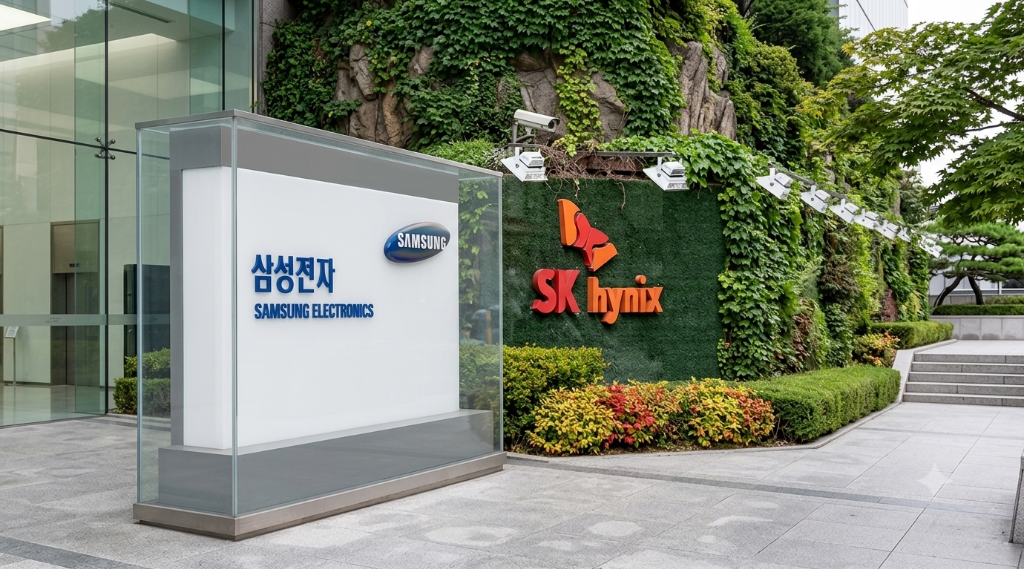
According to Zuifeng Trading Desk, Goldman Sachs has significantly lowered its target prices for Samsung Electronics and SK Hynix. The core logic behind this is not to deny their current profitability, but rather to reprice the supply and demand dynamics in the storage market for 2028.
It is estimated that in 2028, the price of Samsung's traditional DRAM may fall by 20%, the price of Hynix' NAND is expected to drop by 21%, and the price of HBM products with the same specifications is expected to decline by 20% year-on-year. Although the demand for AI remains strong, the expansion of supply and weak consumer demand are changing the industry landscape.
In a research report released on November 23, Goldman Sachs lowered its target price for Samsung Electronics from 500,000 Korean won to 350,000 Korean won, a decrease of 30%; it also reduced its target price for SK Hynix from 3.5 million Korean won to 2 million Korean won, a decrease of over 42%. The ratings for both companies remain 'buy'. The main reason for the lower target prices is the revision of price and profit assumptions for 2028, rather than a deterioration in the fundamentals for 2027.
Goldman Sachs conducted stress tests on three key issues simultaneously, and the conclusions pointed in the same direction: The current stock prices of both companies seem to have already reflected the extreme scenario where capital expenditures will be zero in 2028 (reflected by AI), and the average storage price will fall another 40% compared to the baseline scenario. It is very likely that the significant downside risks have been sufficiently priced into the stock prices, with the risks being more reflected in the time dimension rather than the magnitude.
Supply shortage reaches its worst in 15 years in 2027, with the gap narrowing sharply in 2028
The report states that Goldman Sachs' updated DRAM supply and demand model shows that in 2026, 2027, and 2028, supply will fall short of demand by 4.1%, 5.1%, and 1.2%, respectively, compared to previous forecasts of 5.0%, 5.9%, and 3.9%. The supply shortage in 2027 is described as the most severe in over 15 years, but the gap for 2028 has significantly narrowed from the original forecast of 3.9% to 1.2%, and this change constitutes the core logic behind the reduction in the target price this time.
There is a clear differentiation on the demand side. Goldman Sachs has raised its forecasts for industry DRAM demand growth for 2026, 2027, and 2028 to 33%, 24%, and 17% respectively (previously 28%, 20%, and 19%). The main driving force behind this upward revision comes from the server side: server DRAM (excluding HBM) demand growth is projected to rise to 32% and 21% in 2027 and 2028, respectively, with NVIDIA Vera CPU driving SOCAMM demand to grow by 75% and 58% in those same years. However, the consumer side has become a drag – increased storage costs have suppressed the growth in PC and smartphone shipments as well as the capacity per device. PC DRAM demand is expected to decline by 2% in 2027, while smartphone DRAM growth is only expected to be 8%.
The growth rate on the supply side has also been raised accordingly. Goldman Sachs expects that in 2026, 2027, and 2028, the industry's DRAM supply will increase by 29%, 23%, and 22% year-on-year respectively (previously estimated at 23%/19%/21%). Among these, the assumed annual growth rates for ChangXin Memory's bit supply over the three years are 48%, 36%, and 32%. China's capacity expansion will be an important factor in catching up with supply in 2028. In addition, since the conversion ratio of traditional DRAM to HBM exceeds 3:1, the expansion of HBM production capacity will, to some extent, limit the excessive growth of traditional DRAM supply, providing a form of offset.
In terms of NAND, Goldman Sachs expects shortages of 3.3%, 2.2%, and 0.3% in 2026, 2027, and 2028 respectively (previously 4.4%, 4.6%, and 3.0%), with supply and demand expected to be nearly balanced in 2028. The increased demand for enterprise-level SSD (growing by 48% and 25% in 2027 and 2028 respectively) is not sufficient to offset the weakening demand for smartphones and PC NAND. Coupled with upward forecasts for supply from Samsung, Micron, and Chinese manufacturers, the NAND market is also expected to show a slowdown in 2028.
In 2028, price assumptions are expected to be significantly revised downward; the increase in volume and decrease in price of HBM will partially offset this.
The reduction in the target price this time pertains to the assumptions regarding prices and profits for 2028; the assessment for 2027 remains largely unchanged.
In terms of traditional DRAM, Goldman Sachs has adjusted its year-over-year price forecasts for Hynix for 2027/2028 to a 32% increase/19% decrease (previously it was a 32% increase/5% decrease), and the price forecast for 2028 has been lowered by about 14% to 15%. After the revision, Hynix's average price for 2028 is expected to be $1.76 per Gb (previously $2.05), which falls between the prices of the second and third quarters of 2026 – Goldman Sachs believes that most long-term agreements are based on the prices of these two quarters. Samsung's corresponding price forecast is a year-over-year increase of 31%/decrease of 20%.
Regarding NAND, Hynix's price forecast for 2027/2028 has been adjusted to a 20% increase and a 21% decrease (previously it was a 30% increase and a 14% decrease). In 2028, the average price per 16Gb will be lowered from $0.65 to $0.55, also falling within the price range of the second and third quarters of 2026.
The HBM sector exhibits a structural change of increasing volume and declining prices. Goldman Sachs has raised its estimates for the potential market size of HBM in 2026, 2027, and 2028 to $60 billion, $200 billion, and $237 billion respectively (previously $56 billion, $116 billion, and $168 billion), mainly reflecting a stronger ASIC demand and a significant increase in average price assumptions, with 2027 being particularly notable – the average price is expected to rise by over 100% year-on-year in 2027.
Meanwhile, in 2028, the supply-demand gap for HBM narrowed from the original forecast of 4.3% to 2.3%, and the price of HBM of the same specification is expected to fall by more than 20% year-on-year. The share of ASIC in the demand for HBM is expected to rise from 39% in 2026 to 44% in 2028, with Samsung benefiting from its favorable position among customers of ASIC (especially Google TPU). The volume of HBM has been increased, while the price has been lowered, and the effects of these two factors on profits partially offset each other.
In terms of profit forecasts, Goldman Sachs has lowered Samsung's earnings per share for 2027 and 2028 by 5% and 17%, respectively, and has also reduced Hynix's earnings per share for those same years by 7% and 22%, respectively. Samsung's forecast for operating profit in 2028 has been lowered by 26%, now expected to decline by 11% year-on-year; Hynix's forecast for operating profit in 2028 has been reduced by 23%, also expected to decline by 11% year-on-year. Considering that both companies plan to carry out significant share repurchases and cancellations, Samsung's earnings per share in 2028 are expected to remain relatively flat year-on-year, while Hynix's earnings per share are expected to decline by only 2% year-on-year.
Stress Test: Stock Prices Have Absorbed Extreme Scenarios, and the Threshold for Long-Term Contract Violations is Relatively High
Goldman Sachs conducted quantitative stress tests on three key risk points.
First, the pricing of stock prices regarding AI's capital expenditures. Goldman Sachs estimates that storage will account for about 40% of the capital expenditures of hyperscale cloud vendors in 2028. If AI's capital expenditures remain flat, decrease by 10%, or decrease by 20% year-over-year in 2028, storage expenditures will be reduced by $55 billion, $99 billion, or $144 billion respectively. After converting the profit declines under each scenario into implied equity value, sensitivity analysis indicates that Samsung's stock price could fall by 31% to 51%, and Hynix' by 28% to 50%. Considering the current stock prices, it seems that the stock prices of both companies have already reflected a scenario where AI's capital expenditures grow by zero in 2028, and the average storage price falls by another 40% compared to the baseline scenario.
Secondly, there is the risk of breach of long-term agreements. Goldman Sachs estimates that for Samsung's traditional DRAM prices to trigger a meaningful economic incentive for breach, they would need to fall by more than 32% to 51% compared to baseline forecasts; for Hynix, the corresponding threshold is a 38% to 54% decline. Even in an extreme scenario where prices fall by 60% below the baseline, assuming 50% of the agreement customers breach their obligations, Samsung's revenue losses in 2027 and 2028 would still be only about 4% and 10% compared to a scenario where all agreements are fully fulfilled. Moreover, revenue after breach would still be 25% and 55% higher than in a situation without any long-term agreements at all. For Hynix, the corresponding figures are 3% and 8% loss, with post-breach revenue still 22% and 49% higher. Long-term agreements can still provide significant protection against downward trends even under severe price adjustments.
Thirdly, the impact of historic price declines on profitability. If the price drops of DRAM and NAND are similar to those during the downward cycles in 2019 and 2023 (both falling by 50%), Samsung's revenue, operating profit, and net profit in 2028 would be 29%, 54%, and 48% lower than the baseline forecasts, respectively. However, the operating margin would still be 35%. Based on this stress scenario for profitability, the price-earnings ratio (P/E) and price-to-book ratio (P/B) would be 4.7 times and 1.0 times, respectively. Under the same scenario, Hynix' revenue, operating profit, and net profit would decline by 39%, 55%, and 52%, respectively, but the absolute profits would still be considerable.
~~~~~~~~~~~~~~~~~~~~~~~
The above wonderful content is from the Chuifeng Trading Platform.
For more detailed interpretations, including real-time analysis and frontline research, please join [Chui Feng Trading Desk ▪ Annual Membership].