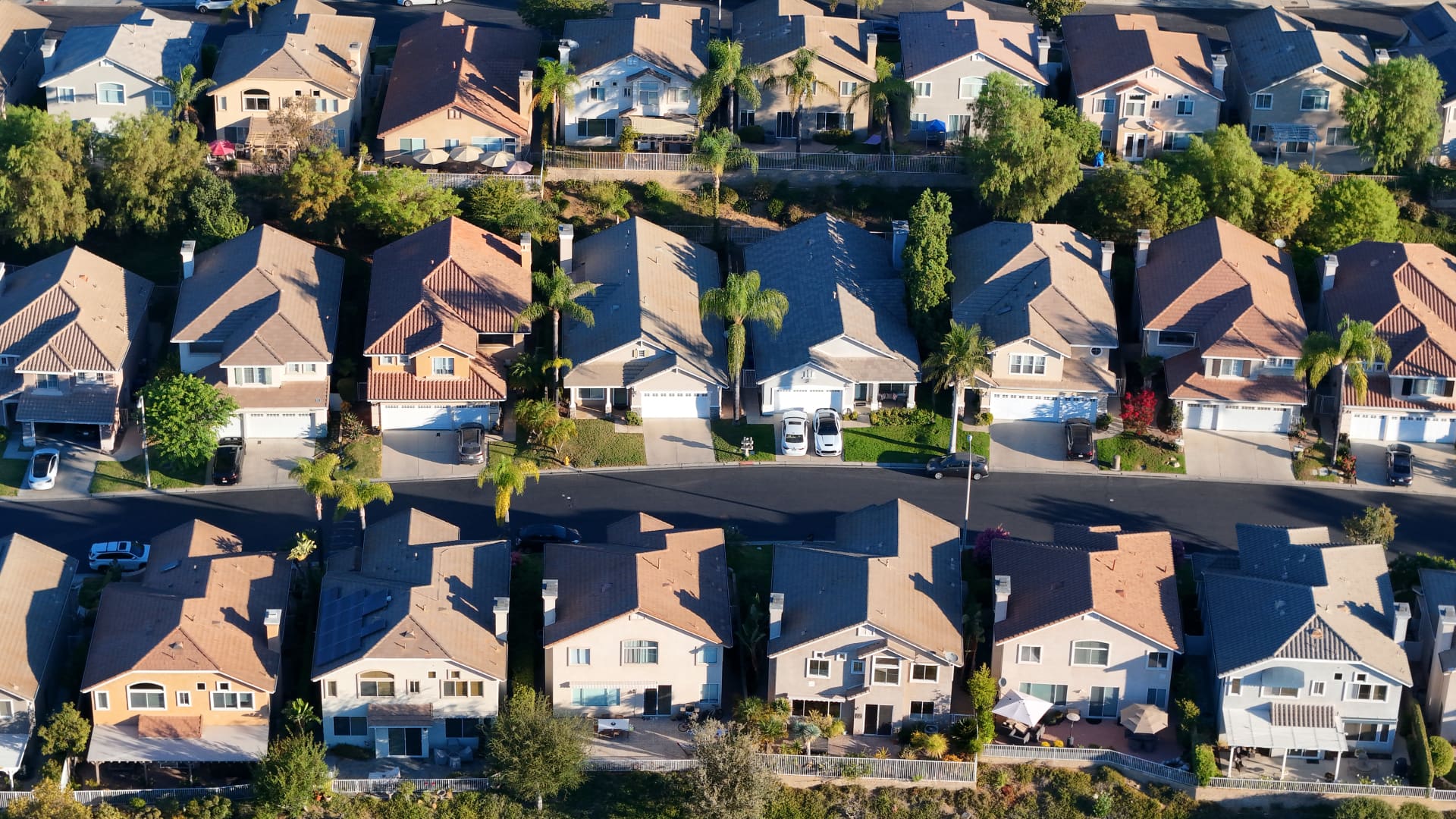
Autumn is usually a busy season for the housing market, but not this year. The sharp rise in mortgage loan rates in September has pushed the already sluggish real estate industry into a deep freeze.
Both buyers and sellers are waiting and watching, leaving people in the real estate industry with hardly any business to do.
It seems like everyone is trapped.
According to Mortgage News Daily data, the average interest rate for popular 30-year fixed mortgages hovered around 6.60% in July. By early October, this rate had risen to 7.61%, an increase of one full percentage point.
Zillow CEO Jeremy Wacksman stated on CNBC: "That surge, that 100-basis-point increase, was one of the fastest three-month gains we have seen in decades."
Although the surge in interest rates has exacerbated the problem, the slowdown in the housing market has actually been brewing for years. Rising housing prices have made it increasingly difficult for Americans to realize their dream of buying a home. Redfin Data shows that the number of active buyers across the United States has been declining for six consecutive months and dropped to its lowest level since the financial crisis in October.
The supply of homes for sale is also low. Developers are now facing pressures from rising costs of land, labor, materials, and energy. They simply cannot afford to build the cheaper housing that the current market needs most. Data from the U.S. Census Bureau shows that permits for single-family residential construction, which serve as an indicator of future construction activity, decreased by 13% in October compared to the same period last year. Developer confidence also fell to its lowest level since 2012 in November.
The slowdown of the entire housing ecosystem is affecting every aspect of Americans' lives and livelihoods.
Redfin Chief Economist Chen Zhao said, "Where you live determines many things. It determines which school your children go to, which jobs you can access, right? It also determines whether you can be closer to your family. Over the past four years, we've seen a housing market situation where, with such historically low turnover rates, many people are truly trapped in their own homes."
Data from the National Association of Real Estate Brokers (NAREB) in the United States shows that the volume of existing home sales in October dropped to its lowest level in 16 years. The number of pending sales, which serve as an indicator for future transactions, also reached a record low on the index, which has been in use by this association for 25 years.
Although the pace of housing price increases has slowed down recently, prices are still more than 50% higher than before the pandemic. Part of the reason is that housing construction has slowed down to almost a standstill.
"The scariest part"
All of this made Ryan Deighan, who wants to buy a house, start to doubt whether they can really afford to buy one.
“I really don’t know, and that’s the scariest part,” he said.
Deighan and his wife have been renting a house in Boston for six years. He is a chiropractor, and his wife works in the private equity industry. Even though their combined annual salary exceeds $200,000, he still feels that they are trapped.
Deighan said, "Judging by my wife's and my income, on paper it seems we're doing well, but I still feel like we're struggling hard to save enough for a down payment on a house."
He said that being unable to afford a house is changing the “list” of the future he once envisioned.
"You graduate from college, find someone to marry, move into a house with white fences and dogs, and then have children," he said, "For us, it doesn't quite look like that anymore."
The seller is also trapped.
These numbers affect not only potential buyers but also impact sellers.
Robin Welch has lived in a house in the Cleveland area of Ohio for over 20 years. Her children have now grown up and moved out on their own. She wants to reduce the size of her living space and move into an apartment, but the math doesn't add up for her; part of the reason is that her current mortgage interest rate is much lower than any new mortgage rates. This phenomenon is known as the "mortgage lock-in effect."
Welch said, "In fact, buying a smaller house actually costs more money. I also have to pay the homeowners' association fees, which is another monthly expense in addition to the higher property taxes and higher interest rates."
Over the years, she has also made upgrades to her own house and doesn't want to start all that investment over again with another property.
Welch is also one of the reasons for the decline in housing turnover rates. Cotality Data shows that the housing turnover rate, which refers to the frequency at which homes change owners, has now dropped to just 3.8% per year, far below the 5% level seen in the decade following the major financial crisis.
In addition, the national mobility rate, which refers to the frequency at which people move between different regions, has been declining for two consecutive years. According to statistics from the Joint Center for Housing Studies at Harvard University using data from the U.S. Census Bureau, this rate is currently at 8.3%, which is lower than the 11.1% level from ten years ago. At the end of the 1980s, the mobility rate approached a high of 18%.
A senior research analyst at Harvard University JCHS Riordan Frost said, "This is mainly due to the interest rate lock-in effect, but also because housing prices are simply too high. The combination of these factors makes it difficult for current homeowners to move, and also makes it harder for people to enter the housing market."
According to Cotality, Americans have nearly $35 trillion in wealth locked up in their homes, a record high. However, Frost states that a slowdown in the housing market will affect the accumulation, transfer, and utilization of this wealth, as well as the labor market.
"Any potential job opportunity must truly be sufficient to offset the costs of taking on a mortgage with a higher interest rate, or the costs of moving, or the costs of moving into a property with higher rent," said Frost.
The wealth gap between homeowners and tenants is now astonishingly large. The latest round of consumer finance surveys conducted by the Federal Reserve last year revealed that the median wealth of homeowners is approximately 43 times that of tenants.
Zhao said, "This will have a chain reaction on other parts of the economy. It will affect the labor market, impacting our ability to better match employees with employers. It will also affect education and the growth of GDP."
Buyer exits
When houses can't be sold and people don't move, those in this industry are also trapped. The entire housing ecosystem is functioning much more slowly, and a sudden spike in mortgage loan rates is causing transactions to fall apart.
A real estate agent in the suburbs of Boston, Dana Bull, said, "Not long after Labor Day, we launched a batch of properties for sale. All of them were sold at prices higher than the asking price." However, interest rates then soared shortly thereafter.
She said, "This was a shock to the system. I think they all ended up returning to the market in the end. We weren't able to fulfill the contract." When asked if she saw her competitors leaving the market, she replied, "Everyone is considering their options. It's very difficult."
Data from the U.S. Bureau of Labor Statistics shows that in the past year, there has been a reduction of nearly 2,000 jobs in the real estate and leasing industries, and 4,400 jobs in the residential construction industry.
The Mortgage Bankers Association of America stated that since June, employment in the mortgage industry has been on the decline, with a reduction of 38% compared to the previous high in the second quarter of 2021. At that time, mortgage loan rates were less than half of what they are now.
BJW_KEEP_00002__, the company ranked first in the US by loan issuance size, said its business has declined by about 30% in the past year.
"Whenever change comes quickly, a slowdown follows," says Banosian, who has 23 years of experience in the industry. "This requires us to go out more to provide advice, education, and guidance. Therefore, my experience is that I need to spend more time on marketing, brand building, and relationship maintenance. Because people want more information to navigate this market, conversations also tend to be longer."
Bull also expressed agreement. She said that her work has also become more difficult.
"This year we've done twice the amount of work. After signing the contract for the house, it fell out of the agreement again, and then we had to sign it back on. But the negotiations were definitely more intense this time," she said. "This is also my request to both buyers and sellers: we need to return to a situation where everyone is willing to negotiate."