















XRP is currently trading around $0.93, and after a continuous decline in November, it is still difficult to regain the psychological barrier of $1.
On November 23, the US spot XRP ETF once again recorded a net outflow of $2.49 million, continuing the trend of institutional withdrawals.
After selling off in November, pushing the token price below the psychological barrier of $1, the price of XRP is still struggling to stabilize. XRP is currently hovering around $0.93, near its recent low, with institutional withdrawals and broader market weakness continuing to suppress demand. This decline has also weakened the technical structure of XRP, limiting the room for buyers to drive a sustained rebound.
As the demand range of $0.90 approaches, the question now is whether buyers will be able to hold this support level, or whether the next round of breakdown will extend the correction until December.
XRP ETF Leaks Intensify Market Pressure
As there continues to be a withdrawal of funds from US spot XRP ETF, institutional demand remains a concern for the market. These funds recorded a net outflow of approximately $2.49 million on November 23, with Canary XRP ETF accounting for the entire outflow on that day.
Earlier on, as of November 20th, the cumulative outflow for the month of November had reached approximately 30.76 million US dollars, ending a streak of seven consecutive months of monthly net inflows. ETF's total assets also saw a significant decline compared to the level of October.
Although the cumulative net inflow since the launch of these funds has been considerable, the recent reversal indicates that as it becomes increasingly difficult for XRP to recover, investors have become more cautious. If capital continues to flow out, it will be even more challenging for the tokens to attract new buying interest during the current correction period.
XRP Price Analysis: The $0.90 demand range becomes crucial
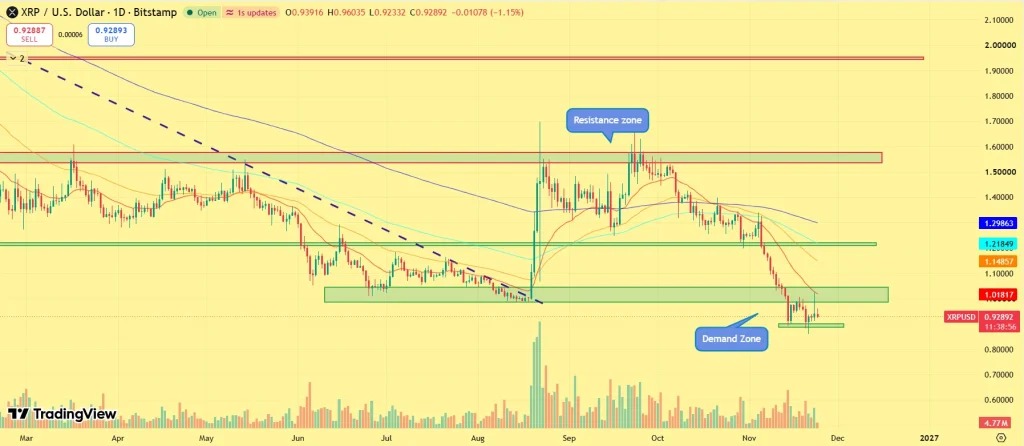
The XRP daily chart shows a clear bearish structure, with the token trading price below the main moving averages. The current focus is on the demand range between $0.90 and $0.92, where buyers are attempting to establish a bottom after recent declines.
The price trend also shows that there is resistance around $1.01, with stronger resistance levels at $1.14 to $1.15, $1.21 to $1.22, and $1.29 to $1.30 respectively. If the price can remain above $1.01, it may indicate the first sign of diminishing selling pressure. However, to establish a more solid bullish reversal, it is still necessary to recover above higher moving averages.
If it can continue to hold above $0.90, it may drive the price to rebound in the short term to the range of $1.00 to $1.02. On the contrary, if the daily chart breaks below this support range, XRP could further decline to the $0.85 to $0.87 area.
Why December May Still Be a Challenge for XRP
As we enter December, there are still several challenges that have not been resolved. Capital outflows, weak price momentum, and broader uncertainties in the crypto market may continue to limit demand. The token's recent poor performance also makes it more difficult to see a sustained rebound until new institutions get involved.
Historical seasonality also provides little immediate comfort. In the past 13 years, XRP has seen declines in December on 8 occasions, with a median monthly return of around -4.07%. However, historical performance does not determine future price trends.
If Bitcoin rebounds and the cash flow of ETF turns positive again, the prospects for XRP may improve. Until then, the $0.90 demand range remains the most important short-term technical level.
XRP What will happen next?
XRP The most urgent task at present is to hold above $0.90 and to rebuild buying momentum above $1 again. If the support level is broken, the pullback could deepen; however, if prices can continue to recover above $1.02, that would provide the first meaningful signal of an improvement in market structure.
Currently, the demand for ETF and the support range of $0.90 will still be at the core of the outlook for XRP12 this month. If buyers do not return, it may be difficult for this token to establish a sustained rebound.