On Tuesday, investors in the stock and cryptocurrency markets once again fell into a panic mode, just a day after the NVIDIA CEO Jensen Huang rebound triggered a significant surge in risky assets.
Bitcoin is currently trading at around $59,500, down 2.74% from the opening price of the day; according to CoinMarketCap data, the total market value of cryptocurrencies has fallen by 4.44%, to $2.04 trillion. The Nasdaq and S&P 500 indices are also in a downward trend, giving back some of the gains from Monday.
The Fear & Greed Index of CoinMarketCap – which measures the sentiment of the entire crypto market – is currently at 9 out of 100, unchanged from last Friday and representing the lowest level since February. Just three months ago, this indicator reached a high of 82 points this year, corresponding to “extreme greed”.
On Wall Street, the Fear and Greed Index corresponding to CNN is also in the "extreme fear" range, at 17 points, which is the same as the lowest level since March, recorded last Friday.
Both of these indices measure investor sentiment on a scale of 0 to 100 points, where lower scores indicate greater fear. They use different methods that take into account market momentum, volatility, and trading behavior, rather than simply asking investors about their feelings.
The attractiveness of AI transactions is diminishing.
In the past few years, the artificial intelligence industry has largely contributed to the strong performance of Wall Street, but now it has become the center of selling off.
Last week, the Nasdaq index fell by about 10%, recording its worst single-week performance since 2020 and erasing all of the gains made so far this year. The S&P 500 index entered a correction zone, dropping more than 10% from its October highs.
NVIDIA's leadership crisis has further exacerbated the situation. The market value of this global leading AI chip manufacturer has almost halved since its peak in October, until the company's board of directors reinstated Jensen Huang on Monday, after which the stock price soared by 31.5% at the close of trading.
However, Jensen Huang's return to NVIDIA does not necessarily mean that AI's investments will be more profitable.
Investors are increasingly questioning whether the billions of dollars spent on AI infrastructure will generate sufficient revenue to justify the costs. As previously reported by Decrypt, in a November survey of fund managers conducted by Bank of America, 52% of respondents predicted that at least one major cloud computing company would announce cost cuts within the next six months.
On Tuesday morning, NVIDIA fell by 5.8%, while AI infrastructure providers CoreWeave and IREN fell by 6.9% and 9% respectively. Stocks in healthcare and essential consumer goods performed significantly better, indicating that investors are shifting their funds to businesses that rely less on the AI craze.
The Federal Reserve didn't help either.
Another factor that concerns both markets is that the Federal Reserve of the United States may make borrowing more expensive at a time when the AI industry is in greatest need of funds.
According to CME FedWatch data, traders are currently betting that there is a 98% probability of an interest rate hike in December, and a 66% probability of another hike in January.
Higher interest rates will increase the borrowing costs for companies building data centers and reduce the present value of their future expected profits. At the same time, U.S. Treasury bonds will become more attractive compared to speculative assets such as Bitcoin, which do not generate returns for holders.
For crypto investors, all of this is happening at a particularly bad time.
According to the ETF tracker of Decrypt, despite a brief rebound in Bitcoin prices, US spot Bitcoin ETF still recorded a net outflow of $569.7 million on Monday. Among this, one product from BlackRock's IBIT accounted for $509.3 million of that outflow.
As of now, the cumulative outflow of Bitcoin ETF funds in November has reached $4.71 billion, surpassing the previous monthly record set in June, and there are still 4 trading days left this month.
How much further can Bitcoin fall?
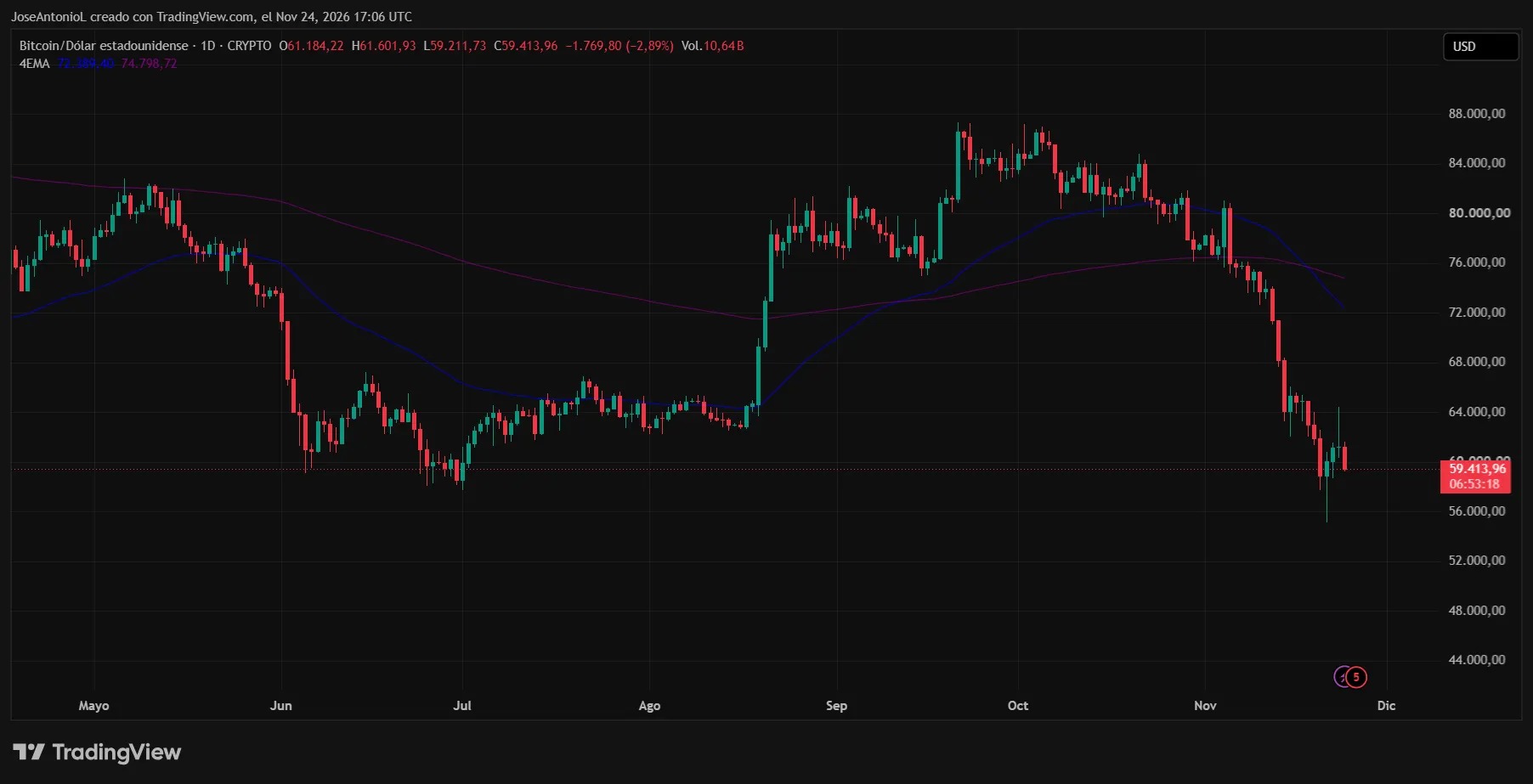
The daily chart of Bitcoin shows that this cryptocurrency is struggling to hold a price range; since 2024, this range has served as a support level on multiple occasions.
BTC has fallen by approximately 53% from its historical high set in October 2025, and the rebound that pushed Bitcoin above $85,000 in September has essentially disappeared.
The $60,000 range is particularly noteworthy, as buying interest has emerged around similar levels in February and June. Last Friday, the price fell to around $55,000, forming another potential support zone, and there has also been historical buying activity around the lower level of around $50,000.
Extremely fearful readings in history have often coincided with some attractive buying opportunities, but they are known for being difficult to accurately identify as bottoms. Bitcoin may remain in a state of oversold for an extended period, especially as institutional investors are withdrawing billions of dollars from the market.
Investors will also face another important economic data point on Wednesday: the United States will release the Personal Consumption Expenditures (PCE) inflation report, which is the inflation indicator favored by the Federal Reserve and also the last major data release before the December monetary policy meeting.