


Wells Fargo has become the largest disclosed institutional holder of spot Bitcoin in the United States ETF. As institutional funds continue to flow in, the bank's related exposure has reached $2.55 billion.
Bloomberg analyst James Seyffart stated that over 2,200 institutions currently hold Bitcoin ETF, and wealth management advisors have driven the largest changes in the holding structure, although the price of Bitcoin is still below $60,000.
Bank of America's bet on Bitcoin exceeds $2.5 billion
According to the 13F filing for the third quarter of 2026, as of September 30, 2,223 institutions held approximately $29.8 billion in US spot Bitcoin ETF, which is equivalent to about 356,072 Bitcoins. Investment advisors are the largest group of holders, with 1,863 filings indicating that they held a scale of $13.4 billion.
But Wells Fargo stands out particularly among them.
Analyst James Seyffart pointed out after merging individual filings and summarizing them that 'Wells Fargo is the new leader.'
After merging the separate filings and the disclosures from Wells Fargo's parent company, the bank's exposure to Bitcoin ETF reached $2.55 billion, which is approximately equivalent to 30,553 Bitcoins.
At the same time, Jane Street holds $1.91 billion, Goldman Sachs holds $1.28 billion, and Millennium Management holds approximately $1.21 billion. This puts Wells Fargo above other major institutional holders.
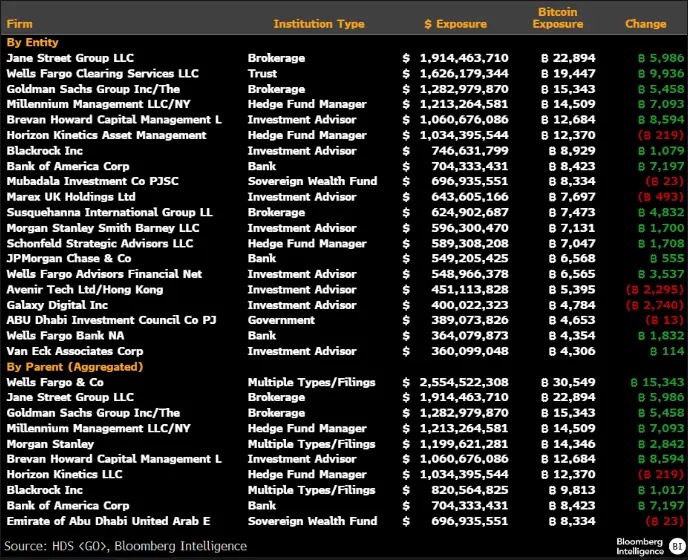
James Seyffart emphasizes the scale of institutional participation and states that there are already “more than 2,200” institutions holding Bitcoin ETF.
BlackRock still holds an advantage in the competition with ETF
Advisors are replacing the early Bitcoin ETF buyers
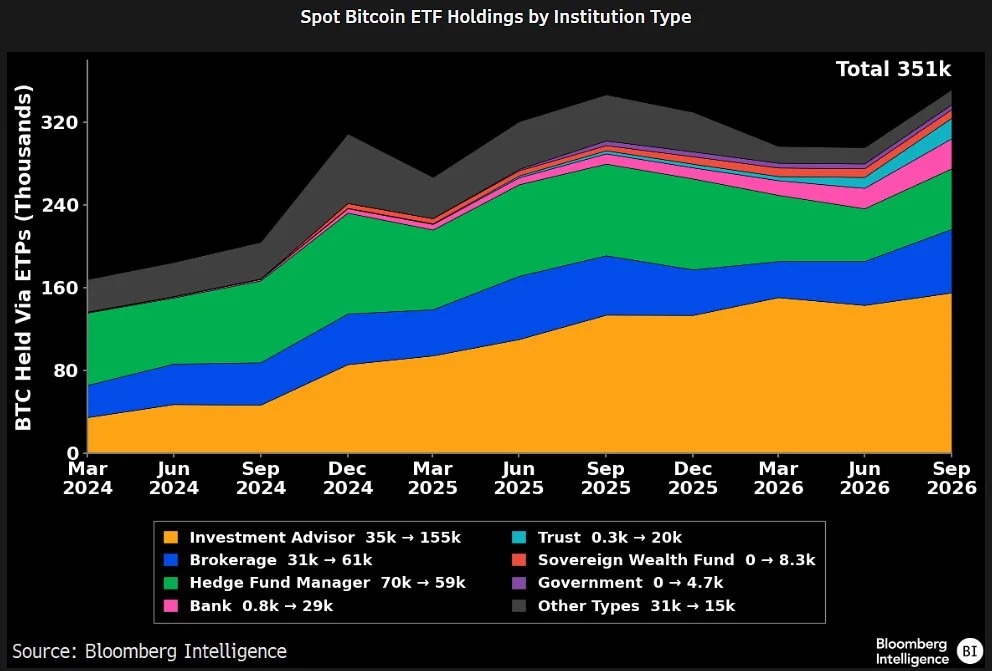
A broader view of positions shows that since the launch of ETF, there have been significant changes in the market structure. The number of bitcoins held by investment advisors has increased from approximately 35,000 in March 2024 to about 155,000 in September 2026.
Therefore, Seyffart indicates that Bitcoin ETF holdings are "led by investment advisors."
Hedge funds, on the other hand, moved in the opposite direction, with their holdings decreasing from about 70,000 bitcoins to 59,000 bitcoins. Bank holdings increased from less than 1,000 bitcoins to nearly 29,000 bitcoins, and sovereign wealth funds and government entities also made their appearance in the institutional holdings landscape.
However, there is an important limitation here. The 13F data as of September 30th predates the significant sell-off of Bitcoin in November and the large-scale outflow of funds related to ETF. On just November 24th alone, a single trading day, ETF recorded a net outflow of $231.4 million.
The next round of filings will show whether such institutional position changes withstood Bitcoin's sharp decline in November.