Key Points
- The UK can issue digital pounds without using XRP.
- Ripple tested synchronous wholesale settlement in 2017.
- The role of XRP in cross-border payments depends on whether its liquidity is competitive.
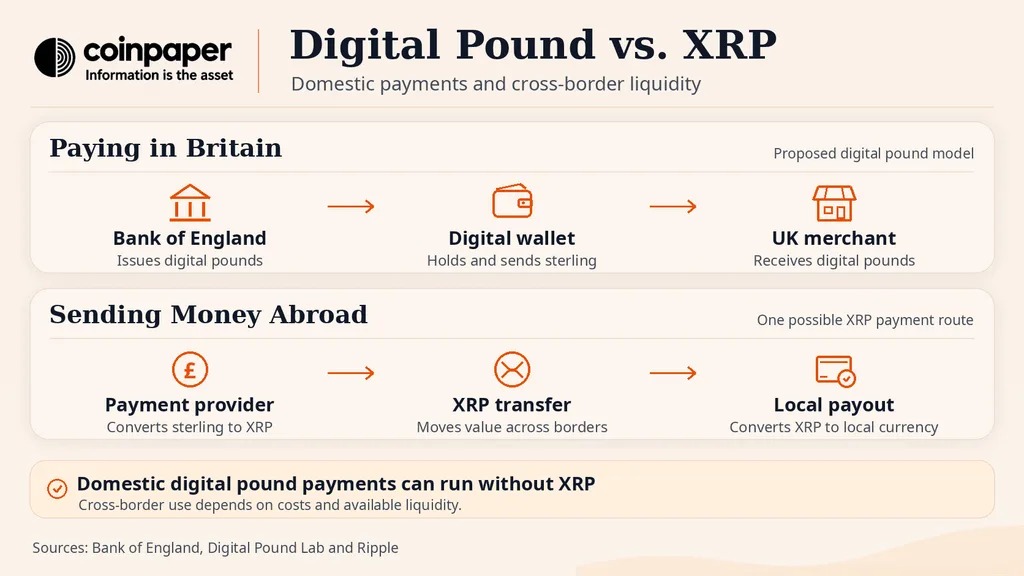
The UK could introduce a digital pound without using XRP. The central bank's proposed digital currency would allow households and businesses to make payments using the digital pounds issued by the central bank.
The potential role of XRP lies elsewhere: it may come into play when payment service providers need to transfer value from one currency to another.
The Bank of England and the UK Treasury are expected to release a blueprint in 2026 and make decisions regarding the next steps to be taken. The regulatory initiative timeline for November indicates that a final decision is still to be made, and before any official launch, relevant legislation must be passed by Parliament.
Why doesn't the digital pound sterling require XRP?
According to the model proposed by the Bank of England, the central bank is responsible for issuing currency, while private enterprises provide wallet services.
A balance of 10 pounds is equivalent to 10 pounds in cash. Therefore, if consumers pay British merchants with digital pounds, there is no reason to convert the pounds into XRP first.
The Digital Pound Laboratory demonstrated over 30 uses in a simulated environment, ranging from offline shopping to settling trade financing transactions.
The key here lies in network selection. XRP is used to cover the transaction fees when payment assets are transferred on XRP Ledger, while the settlement trials related to MasterCard were announced alongside the application of RLUSD, a US dollar stablecoin based on Ripple, on that network. The design for the digital pound announced by the Bank of England does not require the use of this ledger.
XRP Where it may be applicable in the UK payment system
The Bank of England did indeed collaborate with Ripple in 2017. Their proof-of-concept utilized Interledger Protocol to synchronize the transfer of two currencies between simulated wholesale settlement systems.
The released report described it as a technical test, and the Bank of England stated that this collaboration ended once the experiment was completed.
The Bank of England later conducted an experiment to test another method of foreign exchange settlement. In collaboration with the central banks of Singapore and Thailand, the Bank of England coordinated the processes for both parties involved in a currency transaction within a testing system that used central bank currencies for settlement.
Only when the other currency is also ready to be transferred will one of them be transferred.
Service providers can buy XRP in pounds, send it overseas, and then sell it to convert it into local currency. In some payment channels, this approach may be reasonable.
Service providers can also choose bank channels or stablecoins. In the US-Mexico channel, the settlement items for Ripple and Bitso involve the paired use of a stablecoin pegged to the peso with RLUSD, while RLUSD can operate across networks.
Marcus Hale
Marcus Hale is an author who covers cryptocurrency and financial markets, focusing on Bitcoin, Ethereum, digital assets, regulation, ETF, and the adoption by institutions. His reporting focuses on developments that impact the market, investor trends, and the broader forces that shape the crypto economy.