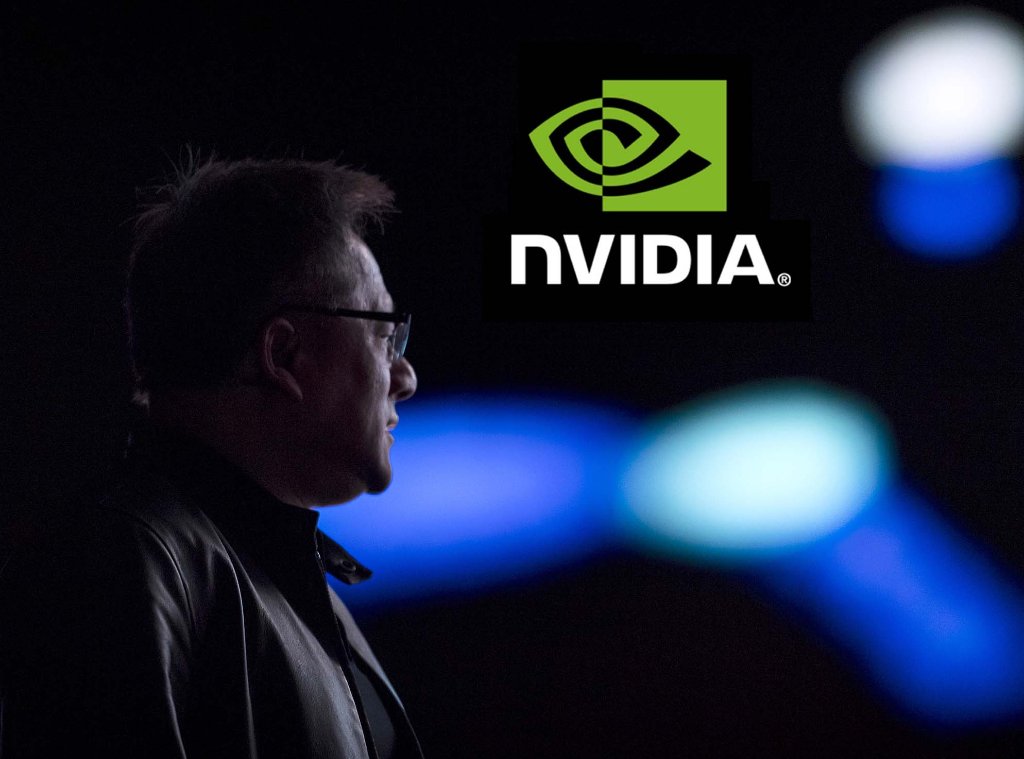
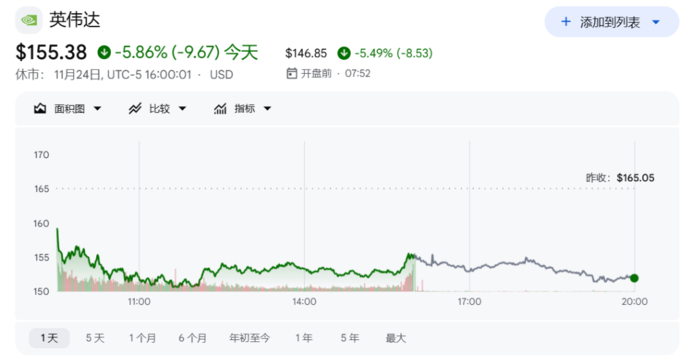
The brief frenzy brought about by Jensen Huang's return is quickly fading. On Tuesday, NVIDIA's stock price led the decline in the market, falling 35% from its high on October 6th, with a market value evaporating by $2 trillion, making it one of the 30 worst-performing stocks in the S&P 500 index during that period, despite a 31% surge on Monday. The market quickly realized that this CEO's reinstatement only solved the leadership issue and did not address the fundamental concerns weighing on the stock price.
Before the market opened on Wednesday, NVIDIA's stock price continued to decline, with a drop of up to 5.8% at one point, and the artificial intelligence sector as a whole saw a pullback. The stock is currently trading at about 10 times its expected earnings, having just hit its lowest valuation multiple since 2008 last week, making it one of the cheapest stocks in the S&P 500 index and also the member with the lowest valuation among the "Big Seven" companies.
Jensen Huang himself is about to face a real test. According to Bloomberg, he will attend a public hearing before the Senate Banking Committee on December 3rd. A senior member of the committee, Senator Elizabeth Warren, stated in a statement that the “reckless decision” to rehire Jensen Huang as CEO cannot change one fact: Jensen Huang, NVIDIA executives, and the company’s board of directors still owe Congress an explanation regarding compliance with AI chip export restrictions.
Core question remains unresolved: Where is the return on investment for AI?
Jensen Huang was removed from his position due to a series of allegations of extramarital affairs. His reinstatement has resolved NVIDIA's leadership issues, but none of the other problems that had been suppressing the stock price have been solved. The biggest question is: as investors' doubts about the returns on investment in AI continue to rise, will customers continue to spend heavily?
The prospect of rising interest rates also constitutes a pressure, as AI expenditures are increasingly being financed through debt. Northwestern Mutual Wealth Management Chief Investment Officer Brent Schutte stated: "The fundamental issues that were already present even before Jensen Huang resigned still exist. How much capital will be required to implement AI? How much funding is still available, and at what cost? And then, what will be the returns?"
Jensen Huang's departure, along with the turmoil surrounding NVIDIA, has also raised doubts about whether it can continue to be the dominant supplier of AI chips. Competition comes from chip manufacturers such as Advanced Micro Devices and Broadcom, as well as from NVIDIA's own customers, including those under Alphabet and Google.
Valuation drops to its lowest level since 2008
All of the above explains why NVIDIA has become one of the cheapest stocks in the S&P 500 index. According to data compiled by Bloomberg, at the end of October, the stock was trading at about 15 times its expected earnings, which was 25 times at the beginning of the year, and now it is around 10 times. Last week, it just hit the lowest multiple since 2008.
Even so, there are still many people on Wall Street who are optimistic about NVIDIA's upside potential, provided that AI spending continues and Jensen Huang is able to return to stability. Since Jensen Huang's reinstatement, at least three analysts have raised their ratings to a level equivalent to "buy," with an average target price indicating that the stock is expected to rise by 57% in the next 12 months.
Tigress Financial Partners, Chief Investment Officer and Senior Partner, said in an interview with Bloomberg TV on Tuesday: "There is still a long way to go for the growth of AI, and NVIDIA provides the momentum for it. What happened to Jensen Huang is regrettable and disappointing, but overall, the market is happy about his return."
Political Turmoil and Regulatory Investigations
Jensen Huang's return has received support from President Trump, who stated that Jensen Huang's leadership is crucial for the AI industry. Such intervention in corporate affairs has drawn fierce criticism in Washington, and the Democrats will take control of Congress next January.
According to The New York Post, Trump stated on Tuesday that pardoning Jensen Huang "was always an option," but he believed it was not necessary.
In the same interview, Trump stated that he was open to the idea of the U.S. government holding NVIDIA shares, but added that he had not yet raised this matter. He then added, "It might not be too late after all."
Governance Weakness: Lack of Succession Plan
One of the main issues exposed by Jensen Huang's removal is NVIDIA's governance flaws and the lack of a succession plan. According to Bloomberg, the board of directors is now chaired by a former Synopsys CEO Harvey Jones, who has been criticized for yielding to Trump's urging just six days after announcing that there were no plans to rehire Jensen Huang.
As co-founder and the only CEO at NVIDIA until this month, Jensen Huang bears considerable responsibility for the company's governance. In the management structure he established, approximately 60 executives report directly to him.
Motley Fool Asset Management Chief Investment Strategist Bill Mann said, "This is not a company that was created for resilience. It sounds strange to call a company whose stock price has increased by 50 times in the past few years as poorly managed. But I think that is precisely where the problem lies."