According to Zuifeng Trading Desk, JPMorgan Chase made clear judgments in two outlook reports for 2027 released on November 25th and 26th: The benchmark target for the CSI 300 index by the end of 2027 is set at 4,800 points, which implies a 21% upside from the closing price of 3,955 points on November 20th; MSCI China's corresponding benchmark target is 77 points, implying a 20% upside. The bank recommends entering 2027 with a “barbell” strategy—allocating funds to policy-supported domestic AI supply chain and healthcare innovation companies on the growth side, and to high-dividend stocks on the defensive side.
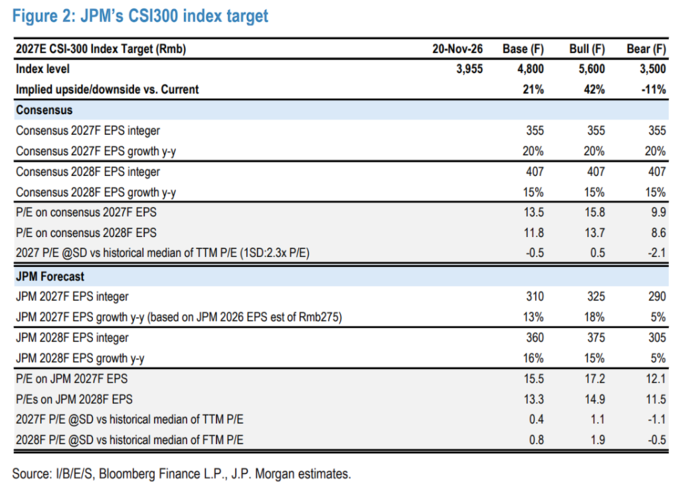
JPMorgan Chase believes that the core supporting this judgment is profitability rather than valuation. JPMorgan Chase predicts that the earnings per share for the CSI 300 index in 2026, 2027, and 2028 will be 275 yuan, 310 yuan, and 360 yuan respectively, representing year-on-year growth of about 12%, 13%, and 16%. During the same period, the growth rate of sales revenue per share will be 7%, 8%, and 9%, with a moderate improvement in net profit margin. The bank clearly states that the premise of this valuation assumption is sufficient interbank liquidity, as well as policy support from the “national team” funds.
JPMorgan Chase believes that the market has already absorbed a considerable portion of these concerns in advance. The bank stated that the sharp decline from the end of June to the end of October was mainly due to the clearing of leverage in the A-share market and the valuation correction of crowded momentum trades, and that "most of this position adjustment has now passed": the balance of financing has dropped to 2.2 trillion yuan, returning to the level of August 2025; domestic public funds have reduced their over-allocations to the technology sector; global hedge funds have recorded a record duration for cutting their net exposures. MSCI China's current forward price-earnings ratio of 8.9 times is only about 4% higher than the low point in September 2024.
Profit: Consistent expectations remain on the high side
JPMorgan Chase remains cautious about the market's consensus expectations. The consensus forecast for earnings per share of the CSI 300 index in 2026 is still around a 20% increase, and the bank expects to continue to lower this forecast during the annual reporting season in March to April 2027. MSCI On the Chinese side, the consensus expectation for earnings per share growth in 2027 is 14%, while the bank predicts it will be 10%.
Looking at the adjustment range from the beginning of 2026 to the present, the consensus forecast for MSCI China's earnings per share in 2027 has been lowered by 6.7%. The reduction ranges from 13% to 30% for industries such as automobiles, retail, food and beverages, medical equipment, semiconductors, software, capital goods, and public utilities; whereas energy, finance, materials, technology hardware, biotechnology, and transportation have seen an increase of 4% to 20%.
JPMorgan Chase stated that signs of structural stabilization have begun to emerge. The bank's "Prism" industry profitability monitoring indicates that profitability revisions and profit margin trends for dairy products, telecommunications, utilities, and medical equipment have started to stabilize or improve selectively. Pharmaceuticals and biotechnology sectors saw consecutive upward revisions to earnings per share in October and November, with net profit margins improving month by month since July; telecommunications' net profit margins have increased month-on-month for 10 out of the past 11 months and have entered a recovery phase; although medical equipment's earnings per share for 2027 were revised down by 21% for the year, the decline in November narrowed from 3.5% in October to 0.8%.
The key test for this year in 2027 is whether the revenue growth rate can stabilize simultaneously with the improvement in profit margins.
AI Mainline: Restricting additional investments actually accelerates domestic substitution
JPMorgan Chase believes that AI infrastructure remains the core driver of growth. The bank estimates that China's capital expenditure on data centers will double from $55 billion to $69 billion in 2026, reaching $95 billion to $151 billion by 2029. Xinhua News Agency reported that during the "14th Five-Year Plan" period, an investment of 4 trillion yuan is expected to be made in computing power networks. The bank forecasts that China's demand for AI computing power will grow at a compound annual rate of about 80% in the coming years, and the localization rate of AI chips will increase from around 40% in 2025 to around 80% by 2028.
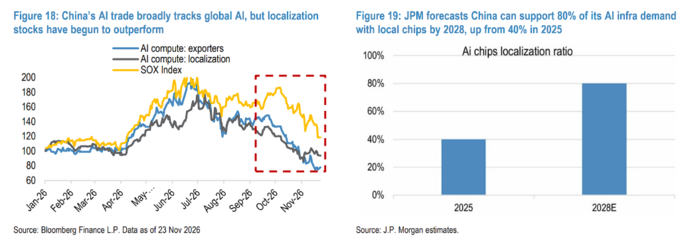
The report indicates that restrictions on overseas computing power supply are not considered by JPMorgan Chase as a reduction to China's AI capital expenditures. The bank's judgment is that these restrictions will not reduce expenditures, but rather change the structure of spending: computing power previously leased overseas must now be established domestically. With the same budget, the expenses shift from monthly rent to costs for data centers, electricity, cooling, and domestic chips, resulting in faster cash consumption and larger individual investments. Since the efficiency of domestic chips is generally lower than that of H200 or GB300, matching the same level of available computing power requires more chips, more racks, and more electricity, which may lead to an increase in nominal capital expenditures as a result.
From the perspective of industrial chain transmission, JPMorgan Chase indicates that as Chinese chip design companies shift orders from overseas foundries back to domestic ones, it will support the capacity utilization and product structure of local foundries. The increasing production capacity of domestic high-bandwidth memory manufacturers such as ChangXin Technology will lead to additional demand for storage capacity and equipment orders. However, the relatively low efficiency of domestic accelerators will boost the demand for advanced packaging, high-speed interconnections, substrates, and testing services. The bank expects that supply conditions will improve in the second half of 2027, at which point the business logic of domestic substitution targets will increasingly focus on domestic orders, capacity expansion, and market share gains.
JPMorgan Chase believes that a notable structural change is that China's localization cycle is decoupling from the global export chain. The bank predicts that in 2027, U.S. capital expenditure will be around $1.7 billion, a year-on-year increase of 87%; in China, it will be about $140 billion. The bank states that this difference in scale means that China is facing supply constraints rather than the risk of overbuilding, and the direct exposure to a slowdown in U.S. capital expenditure is also lower.
Apart from the AI supply chain, healthcare innovation is the second main line of growth. DealForma data shows that in the first half of 2026, Chinese-origin assets accounted for 42% of large transactions with a down payment of over 50 million US dollars and 68% of the total down payment amount; according to CNBC, there were 81 BD transactions in China's biopharmaceutical sector in the first half of the year, totaling approximately 110 billion US dollars, which already constitutes 80% of the entire amount for 2025.
On the defensive side, JPMorgan Chase pointed out that the high-dividend screening criteria are as follows: a market capitalization of over 20 billion yuan, positive free cash flow in the past 12 months, a price-to-book ratio of less than 1.5 times in the most recent quarter, and a dividend yield of over 4% in the past 12 months.
Valuation and Funds: The policy bottom has been reached; the market bottom remains to be tested.
JPMorgan Chase stated that the signals of a policy bottom are now clear. Following two "market stabilization" meetings on November 2, 2026, a report on financial work by the State Council on November 5 proposed to support China Financial Asset Management Corporation (CFCM) in playing a role similar to that of a stabilizing fund. The national team accelerated its purchases in October, with an estimated scale of 528 billion yuan, whereas in the first half of 2026 there was a net sale of 1.5 trillion yuan. The supporting measures from the People's Bank of China and the China Securities Regulatory Commission included the third round of swap facilitation operations, cheaper stock repurchase refinancing, and efforts to accelerate the implementation of repurchases.
However, JPMorgan Chase reminds that a policy bottom does not equate to a market bottom. In the coming months, the market may test the determination of the regulatory authorities to support the market and the desired levels expected by policymakers, which could lead to a consolidation phase in the market.
The above content is from the Zhuifeng Trading Platform.