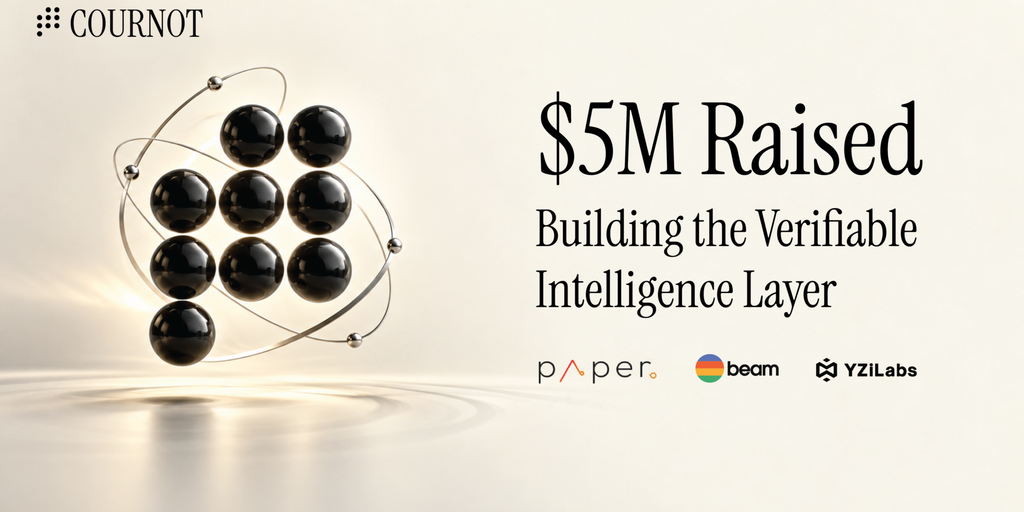
According to a tweet on Thursday, startup Cournot completed a $5 million strategic financing round, led jointly by Paper Ventures and Beam Foundation. Cournot is working on creating a AI native oracle to help applications and AI agents understand and verify real-world events.
The company previously received support from YZi Labs, which is an investment institution of Zhao Changpeng (the founder of Binance, known as Changpeng), and participated in the investment through its EASY Residency Season projects. Cournot stated that this funds will be used to develop products, expand integration in BNB Chain and other ecosystems, and enter areas such as real-world assets, trading, parameter insurance, private lending, and AI agents.
The co-lead investors, Paper Ventures and Danish Chaudhry, stated in their declaration: "As more and more financial activities and autonomous systems are moving onto the blockchain, the infrastructure surrounding them needs to go beyond merely transmitting data." They added that Cournot is making real-world intelligence "more verifiable, auditable, and capable of being applied and AI by agents."
Oracles bring external information onto the blockchain, enabling smart contracts to act accordingly. While most oracles provide structured data such as asset prices, Cournot focuses on issues that require interpretation, such as whether a certain real-world event has occurred or whether the existing evidence meets the contract's criteria.
Its Resolution Oracle uses AI to determine whether the established conditions have been met, while Intelligence Oracle provides probabilities, arguments, and supporting sources before the result is determined.
Proof of Reasoning How it works
Both of these products rely on the Proof, of, and Reasoning frameworks mentioned by Cournot. Their purpose is to demonstrate how the AI model arrives at its conclusions, rather than just presenting the conclusions themselves.
In a case study released by the company in February, Cournot outlined a four-stage process. First, the system defines the meaning of each term involved in the issue before collecting any evidence, and submits these definitions in the form of encrypted hashes, so that they cannot be reinterpreted later on. Subsequently, the system collects evidence only from pre-specified sources within a set time window.
For sources that may change, such as government websites, Cournot uses zkTLS – an encryption technique that can prove that a website displayed specific information at a certain point in time – to retain unalterable records. Ultimately, the conclusions drawn from AI can only be based on these verified evidences, and its rulings are derived from predefined rules, leaving a trail that can be audited and questioned.
This case study utilized the previous research on whether the U.S. government would experience another shutdown on Polymarket. Cournot also mentioned a shutdown market in November 2025: although traders correctly predicted the end date, relevant traders still lost money because the website of the U.S. Office of Personnel Management was updated only a day after President Trump signed the funding bill.
More than just predicting the market
Cournot is still targeting the growing agency economy, that is, autonomous AI. Before making financial or operational decisions, agents need reliable external information. According to the company, through Intelligence Oracle Skill, agents can request structured probabilities regarding events, specific arguments being evaluated, as well as supporting sources, and incorporate these evidence-based assessments into their own decision-making.
As of November 25, 2026, Cournot indicated that its Resolution Oracle has settled over $1.41 billion in nominal value across more than 29,200 rulings, with 99.8% of these settlements completed without any disputes. The company stated that the volume of rulings has increased fivefold over the past three months, and the business has now become profitable. Its oracle is used to predict markets, act as an agent for trading venues, and is also integrated into collectible card game platforms.
Cournot also indicates that the installation count of its Intelligence Oracle Skill has exceeded 20,000 times, with 18,000 paid wallets and 967,000 paid calls, and the business has already become profitable. Its oracle is used for market forecasting, acting as a trading venue, as well as in collectible card game platforms.
Cournot believes that the same issues are also applicable to a broader range of scenarios beyond betting. For example, the AI system could settle crop insurance by analyzing satellite images and local reports, or pay for software contracts by monitoring the GitHub activities of projects, while maintaining auditable records for each decision made.
Co-founder Daniel Wang stated in the declaration: "Manual voting is slow and prone to controversy, while black-box AI is fast, but lacks accountability."
Cournot indicates that the outcome will not be determined by token weight voting at any stage. This is also where the approach to handling disputes in the prediction market Polymarket differs; Polymarket relies on the Optimistic Oracle of UMA, and this system has been criticized for its dispute resolution outcomes. Polymarket has also provided data feeds for markets that depend on asset prices Chainlink.
Cournot also mentioned that CZ stated in a post from November 2025 that the industry needs more oracles, saying that "one or two are not enough."
In the longer term, the company stated that its goal is to expand oracles from structured data to the interpretation of real-world events, to provide verifiable intelligence, and ultimately to act on behalf of AI agents within established policy frameworks. As more applications and autonomous agents are brought onto the blockchain, the company expects the demand for infrastructure that helps them understand real-world information and weigh evidence before taking action to continue to grow.