Bitcoin is facing increasing liquidity pressures, as the market value of stablecoins has declined by about 12% over 30 days, despite a short-term rebound in the cryptocurrency market.
With the stablecoin supply contracting by 12% on a monthly basis, Bitcoin rose by 2% to $61,719.
Ethereum rose by 2.5% to $1,730.81, while Solana increased by 3.5% to $73.48.
The combined market value of Tether and USDC is approximately 243 billion US dollars.
CryptoQuant Contributor CW_ indicates that there are already signs that the selling pressure on Bitcoin is being absorbed.
CryptoQuant Contributor CryptoZeno warned in an analysis on November 27th that the decline in stablecoin supply was reducing the capital that could be readily utilized to absorb selling pressure and support a continued rebound in Bitcoin.
According to the data from crypto.news, as of November 27th, Bitcoin was trading at $61,720, up 2% in the past 24 hours; the daily trading volume reached $23.17 billion, with a market value of $1.24 trillion.
The main altcoins also recorded similar increases during the same period. Ethereum rose by 2.5% to $1,730; BNB rose by 1.8% to $560. Meanwhile, XRP rose by 2.6% to $0.98, and Solana rose by 3.5% to $73.
Despite the rebound in Bitcoin prices, the market value of stablecoins is still shrinking.
CryptoZeno explained that stablecoins provide dollar-denominated liquidity for transactions in cryptocurrency exchanges, trading pairs, and decentralized financial applications.
Although the market value of stablecoins does not directly measure the demand from buyers, an increase in supply means that traders have more funds that can be quickly deployed into the crypto market.
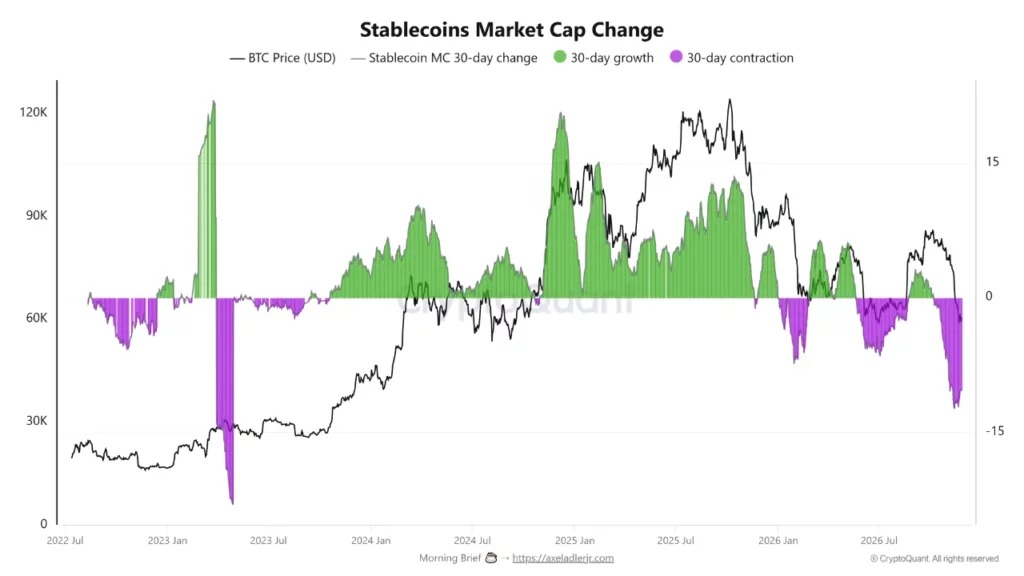
On the contrary, a decrease in supply will reduce the available pool of funds, making any attempt at a rebound increasingly dependent on the capital that is already circulating in the market.
"Stablecoins are not a direct measure of buying pressure," CryptoZeno pointed out.
This analyst observed that during the upward trend from 2024 to 2025, periods of stablecoin expansion often coincide with increases in Bitcoin prices. However, this relationship is not always consistent; changes in the supply of stablecoins can sometimes precede fluctuations in Bitcoin prices.
A temporary contraction in the supply of stablecoins does not necessarily lead to a long-term bear market, and the abnormal fluctuations that occurred at the beginning of 2023 also indicate that a single reading should not be taken as a definitive market signal.
CryptoZeno believes that for a sustained bullish reversal to be more convincing, three conditions need to be met: a slowdown in the contraction of stablecoins, a return to positive monthly supply growth, and an improvement in the Bitcoin price structure.
Before these conditions emerged, the analyst warned that limited liquidity could make rebound attempts more vulnerable to another pullback.
Despite CryptoZeno identifying recent contractions, Tether ( USDT ) and USD Coin ( USDC ) still occupy a large amount of dollar-denominated capital in the crypto market.
On November 27th, the market value of USDT was approximately 173.85 billion US dollars, while that of USDC was 69.15 billion US dollars.
The total daily trading volume of these two stablecoins reached $45.35 billion, of which Tether accounted for $35.79 billion, and USDC accounted for $9.55 billion.
Bitcoin demand shows signs of stabilizing, although selling pressure remains.
Despite concerns about the liquidity of stablecoins in the market, another contributor CryptoQuant named CW_ has identified signs that the recent selling pressure on Bitcoin is being absorbed.
In his assessment on November 27th, this analyst pointed out that during the observed period, the negative readings of Bitcoin demand had remained at a similar level for five consecutive days, yet the price did not deteriorate accordingly.
"Someone is absorbing the sell orders for Bitcoin, effectively offsetting the downward pressure," CW_ wrote.
This analyst explained that if negative demand readings decline while prices rebound, it could create more favorable conditions for a recovery.
Although the demand indicators for Bitcoin are still negative, CW_ points out that if the demand situation improves, this cryptocurrency's ability to withstand selling pressure could lay the foundation for a price rebound.
Institutional investment flows are another factor that affects the rebound of Bitcoin.
The balance of stablecoins held by exchanges decreased by 15%, while US spot Bitcoin and Ethereum exchange-traded funds saw a total net outflow of $3.9 billion between October 30 and November 13.
As previously reported by crypto.news, researchers consider the realized price of Bitcoin at $53,250 to be an important downward reference point. This indicator estimates the average on-chain cost of Bitcoin based on the price at the time of the last transaction for that particular coin.
After falling below the 200-week moving average of nearly $68,000, Bitcoin needs to rebound to the range of $73,000 to $75,500 to show stronger upward momentum, researchers say.
This asset management firm believes that the continuous attraction of institutional funds to spot Bitcoin ETF and the renewed growth in the balance of exchange stablecoins are two developments that could support a more sustained market recovery.