Key Points
- Amazon expects its capital expenditures to reach $220 billion in 2026.
- AWS The backlog of contracts has more than doubled to reach $578 billion
- Infrastructure spending drove a significant shift towards negative free cash flow
Amazon ( NASDAQ : AMZN ) refuses to slow down its expansion of artificial intelligence infrastructure, despite growing concerns on Wall Street about the financial sustainability of record-level technology spending.
The company expects capital expenditures to be around $220 billion in 2026, and management anticipates that the investment plan for 2027 will be even larger. Over the past 12 months, this expansion has resulted in a free cash flow deficit of $42.4 billion.
Amazon has a commitment of $578 billion from future customers
This represents an increase of $82 billion over the previous quarter's backlog of $496 billion in contracts. The weighted average remaining term for these long-term contracts is 6.1 years.
The main commitments include: OpenAI will expand its existing $38 billion AWS protocol by $100 billion, and Anthropic commits to spending over $100 billion within 10 years.
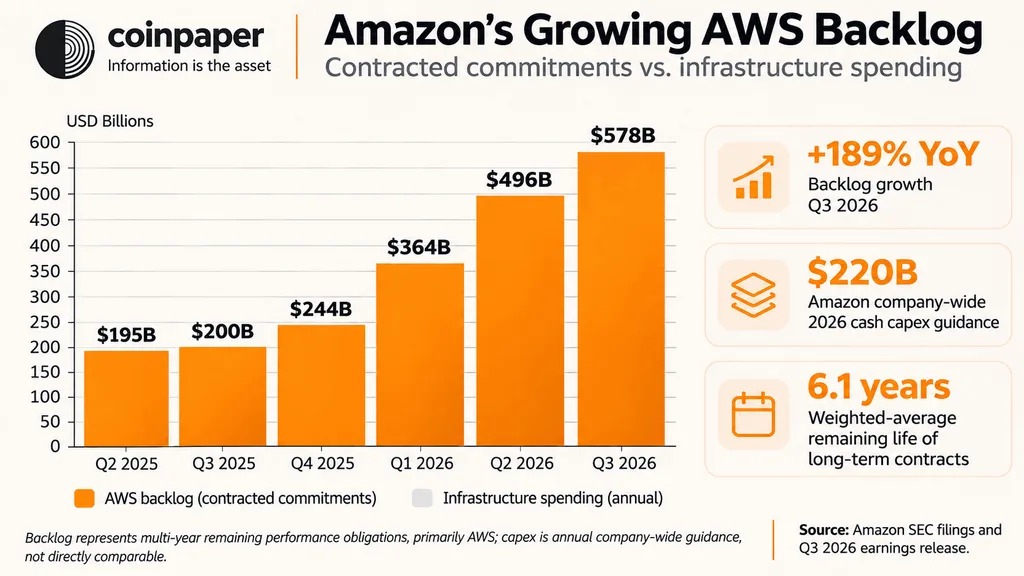
Such protocols provide cloud service providers with greater visibility into future computing demands. However, as increasingly large contracts worth tens of billions of dollars AI within the industry demonstrate, the commitments made in these contracts do not necessarily translate immediately into cash payments.
Amazon must first build the infrastructure, install computing equipment, and deliver the services stipulated in the contract before it can recognize the relevant revenue.
Therefore, if capital expenditures are cut too aggressively, it may limit the ability to fulfill existing obligations and to undertake additional demands.
The importance of AWS to Amazon's profits is continuously increasing.
AWS achieved operating profits of $17.8 billion, which is higher than the $11.4 billion in the same period last year.
Although AWS contributes only about 23% of Amazon's quarterly revenue, it accounts for approximately 63% of the consolidated operating profit.
These data help to explain why, despite the growing public sentiment of backlash against expenditures related to AI, Amazon continues to prioritize investment in cloud infrastructure.
Amazon is also expanding its self-developed Trainium computing technology, which could reduce its dependence on external semiconductor suppliers and enhance its ability to compete with NVIDIA's dominant chip position.
Will Amazon's AI expenditures ultimately be rewarded?
The core challenge remains the time lag between infrastructure spending and future revenues.
In just the third quarter alone, Amazon's cash capital expenditure reached $75.9 billion, more than twice the $34.2 billion in the same period of 2025.
In the past 12 months, despite a 29% increase in operating cash flow to $168.3 billion, free cash flow has still fallen into negative territory due to a significant rise in infrastructure expenditures.
Long-term commitments also carry implementation risks. Customer needs, performance of computing devices, power supply conditions, and financing terms can all affect the profitability of a new data center.
After all, to determine whether the AI expenditures of large technology companies have generated sufficient returns, one cannot rely solely on revenue growth.
Maya Bennett
Maya Bennett is a financial journalist whose reporting covers cryptocurrency, stocks, and a broader range of market trends. Her areas of focus include Bitcoin, major digital assets, the stock market, monetary policy, as well as economic developments that influence investor sentiment. She is adept at transforming rapidly changing market situations into clear and concise reports.