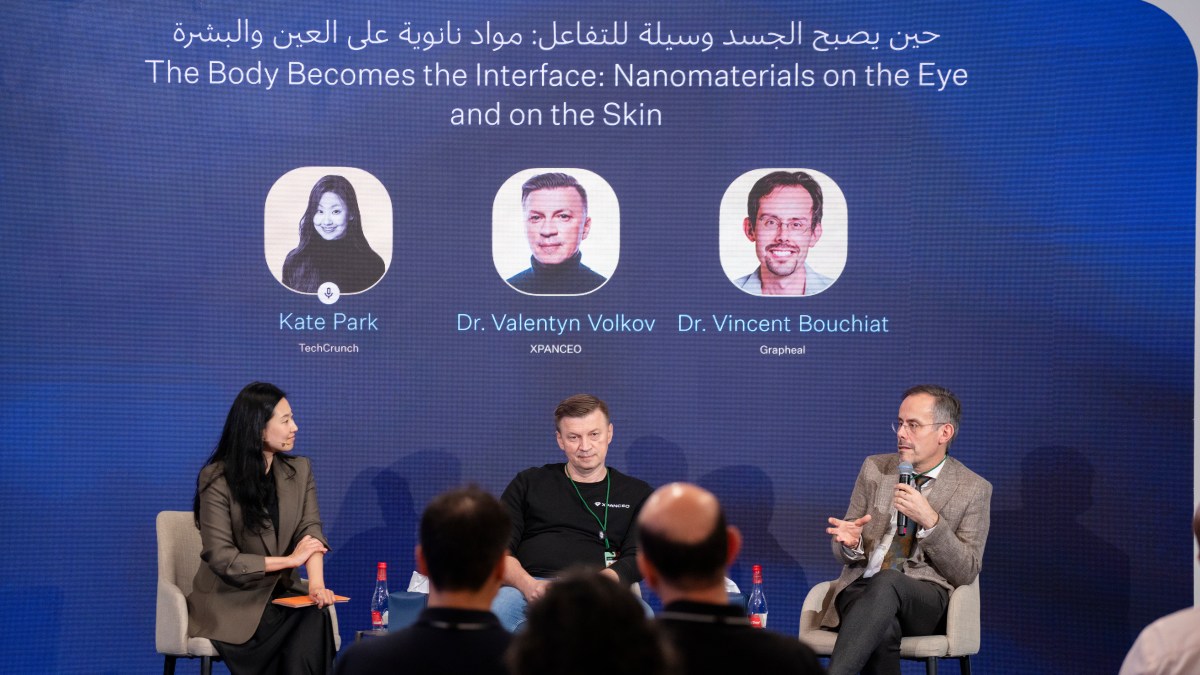


As more and more people use wearable devices such as smart glasses and smart rings to monitor their health and gain a deeper understanding of their bodies, two startups will be discussing the next frontier of wearable health technology with me at Future Week in Dubai. They believe that in the future, the human body itself may become the interface for this technology.
One of them is Xpanceo, a smart lens manufacturer headquartered in Dubai. The other is Grapheal, a deep-tech startup founded in 2019 that emerged from the academic community in Grenoble, France, and is developing smart bandages with graphene biosensors.
The founder and chief technology officer, Valentyn Volkov, stated that the company plans to release an integrated prototype at the beginning of 2027, which will combine multiple core functions including image display, connection to power systems, and health monitoring. He added that at that time, the founder of Xpanceo will be the first to wear this integrated smart contact lens on stage in person to demonstrate its functions in real-time, which will mark an important milestone in the development of smart contact lenses.
Volkov said, "The first fully integrated prototype is planned to be launched in early 2027, combining image display, wireless power supply, connectivity, and health monitoring."
When asked why people still need technology that interacts directly with the eyes and skin when devices such as smartwatches, rings, and AR glasses already exist, Volkov mentioned the fragmented nature of current digital experiences.
Volkov indicates that various devices each have their own functions, and users need to switch back and forth between smartphones, wearable devices, and other interfaces every day. This increases complexity and can also be distracting, pulling one's attention away from the real world. Xpanceo aims to integrate these functions into a single interface on the eye itself.
Grapheal, the Chief Executive Officer and Co-Founder, stated: "You need to take another step forward." He explained that while devices like smart glasses are already very close to the human body, the materials that come into direct contact with the body can capture and digitize biochemical information, which can then be transmitted to the device.
According to Bouchiat, the smart bandage technology of Grapheal can be used to monitor diabetic wounds and post-surgical wounds. The company is trying to solve a difficult problem in diabetic care. For example, foot ulcers may take more than six months to heal, and in severe cases, they can even lead to amputation. Bouchiat states that nurses usually change the bandages every two days, but often cannot keep track of the development of infections in real time; moreover, unnecessary dressing changes can also interfere with the healing process.
Bouchiat said, "What we have proposed is a type of bandage that operates through NFC. It can record and transmit wound conditions—such as pH values, temperature, early signs of infection—to the nurse or patient's mobile phone without the need to open it. This makes remote monitoring and early detection of infections possible."
Other potential applications include skin assessment in the retail of cosmetics and skincare products, as well as sweat analysis for runners, fitness enthusiasts, and professional athletes.
Grapheal is also exploring manufacturing opportunities in the Gulf region. Bouchiat stated: "Our graphene material is derived from natural gas and does not require any key materials. We hope to establish production facilities in the Gulf region."
At the same time, contact lenses have become a part of the daily lives of over 140 million people, used both for vision correction and for cosmetic purposes. Xpanceo regards current contact lens wearers as a potential early market for their smart contact lenses. Other potential applications include biometric authentication for payments and access control, as well as hands-free information display. In sports scenarios, these lenses can display indicators such as heart rate, hydration levels, and fatigue levels.
Volkov mentioned that this startup, headquartered in Dubai, is also developing technology that allows for continuous monitoring of biomarkers in tears without the need for invasive procedures. One potential application of this technology is glucose monitoring, which could make the daily management of diabetes patients easier.
The Chief Technology Officer stated that Xpanceo has demonstrated over 28 operational prototypes, including AR display, biosensing, and integrated power supply systems. Following a financing round in 2023, the startup completed a $250 million Series A financing in 2025, raising its valuation to $1.35 billion and thus joining the ranks of unicorns.
Multiple companies have explored smart or AR contact lenses, including Mojo Vision, InWith, Innovega, and Sensimed, as well as pharmaceutical companies like Johnson & Johnson Vision Care, Alcon, and Google / Verily. However, Volkov indicates that the goal and differentiator of Xpanceo lies in integrating AR, health monitoring, and other digital functions into a single smart contact lens, turning it into a type of computing interface.
Volkov indicates that this Dubai-based startup plans to expand its manufacturing scale in the second half of 2027 and will initiate B2B concept validation deployments across multiple industries in 2028. The company expects to finalize the product design between 2029 and 2030 and prepare to submit regulatory applications to the US Food and Drug Administration (FDA) and the Federal Communications Commission (FCC).
Both of these companies are striving to make electronic devices light, thin, and flexible enough to be directly attached to the human body. However, whether people are willing to let technology get so close to their bodies remains an unresolved question.