

According to on-chain data platform Arkham Intelligence, the Trump administration's official project team transferred 16.84 million Trump tokens to three Fireblocks escrow addresses on July 25, worth approximately $16.91 million at the time. This move occurred as the US Senate continued deliberations on the "Clarity of Digital Asset Markets Act," whose ethical constraints have yet to gain bipartisan support.
16.84 million tokens transferred to escrow address
Arkham stated that the tokens were split and transferred to three escrow wallets. These addresses had previously received Trump tokens before transferring them to BitGo. Arkham therefore questioned whether this transfer was related to the subsequent unlocking and distribution.
Currently, on-chain transfers themselves do not prove that tokens have been sold, nor do they show that funds have entered exchanges. However, since most of Trump's supply is still tied to internally controlled wallets, this transfer is still attracting market attention.
- The maximum transferable scale is approximately 96 million units.
- This accounts for approximately 9.6% of the total supply.
- Approximately 40% of the disclosed circulating shares.
The report cites on-chain data showing that approximately 80% of the total supply remains in the hands of internal addresses, and about 670 million tokens have been unlocked, representing about 67% of the total supply.
Prices fell sharply from their highs
The market data provided in the article shows that Trump was trading at approximately $1.57 on that day, a drop of nearly 98% from its high of $73.43 in January 2025. Based on its year-to-date high, the decline was also approximately 83%.
The market's focus now shifts to whether these custodian addresses will continue to transfer assets to trading platforms or other custodians, and whether there will be any further distribution related to unlocking.
The Senate remains stuck on the ethics and law enforcement clause.
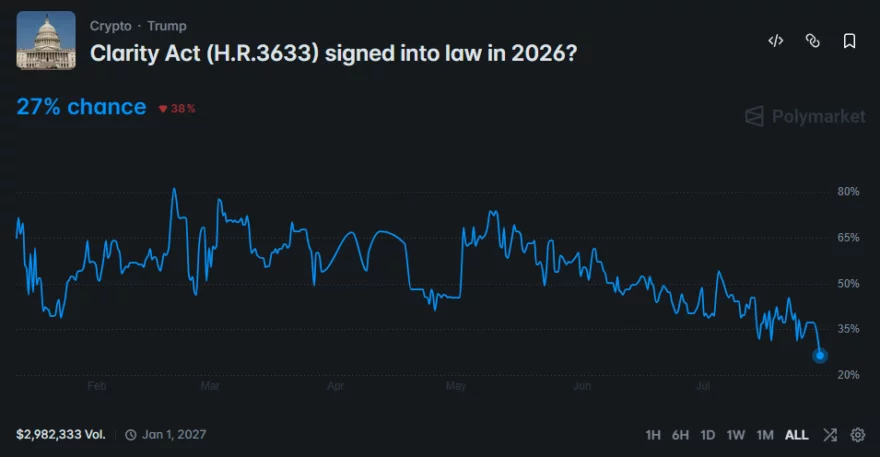
This transfer occurred as Senate Republicans attempted to push the CLARITY bill forward before the August recess. The House passed the bill in July 2025, and the Senate Banking Committee advanced its consideration in May 2026 by a 15-9 vote, but the bill still needs to garner more support from Democratic senators.
The current controversy centers on how the ethics provisions will be enforced. According to the draft, those bound by these provisions will include the president, vice president, members of Congress, federal judges, and their spouses. These officials will be prohibited from issuing or supporting digital assets and will be required to sell their crypto assets, establish blind trusts, or take both measures simultaneously.
The draft also stipulates that this restriction will expire at noon on January 20, 2029, which is the scheduled end of Trump's current term. For business arrangements that existed before the restriction, companies can continue to use the official's name, image, or likeness.
Democrats oppose law enforcement solely by the Department of Justice.
Democratic Senator Angela Alsobrooks opposes having the Department of Justice alone responsible for enforcing the relevant ethics provisions, and stated that she would vote against the bill if it were submitted directly to the Senate for a vote. Her stance is drawing attention because she was one of two Democratic senators who pushed the bill through the Banking Committee.
The report also stated that Trump accepted the relevant ethical clauses earlier this week, one of the conditions put forward by the Democrats for continuing negotiations. However, because the two parties have not yet reached an agreement on the enforcement body, a bipartisan agreement has not yet been reached.
In the short term, the market will be watching two clues simultaneously: first, the future flow of TRUMP token escrow addresses, and second, whether the Senate can resolve the enforcement differences on ethics provisions before the August recess.