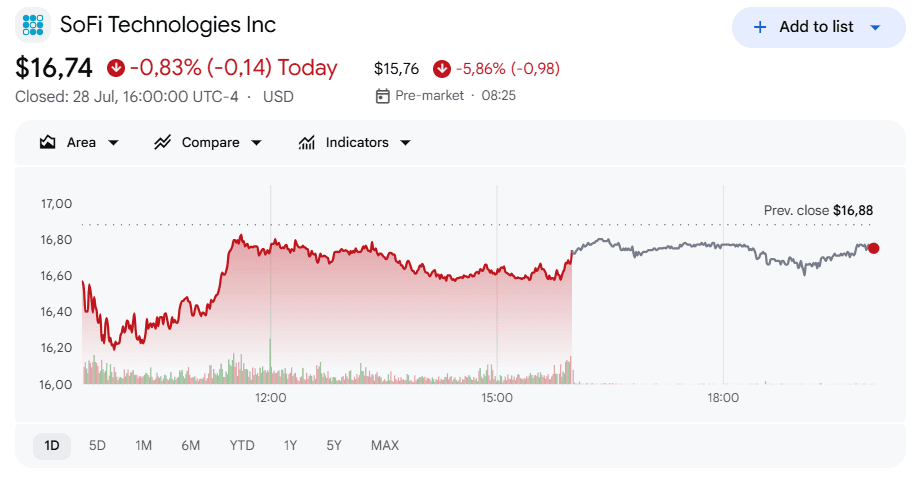


SoFi disclosed that its second-quarter revenue and net profit both exceeded market expectations, and it raised its full-year revenue guidance. However, its profit forecast was not revised upwards accordingly, and its technology platform business continued to decline. Following the earnings release, its stock price still fell by approximately 6%.
Second-quarter revenue rose to $1.2 billion
The company's adjusted net revenue for the quarter was $1.2 billion, a 40% increase year-over-year. GAAP net income was $156.6 million, up from $97.3 million in the same period last year. Net interest income increased by 52% year-over-year to $788.2 million.
SoFi also raised its full-year adjusted net revenue forecast to $4.75 billion to $4.85 billion, higher than the market's previous expectation of approximately $4.7 billion.
Membership and lending scale continue to expand
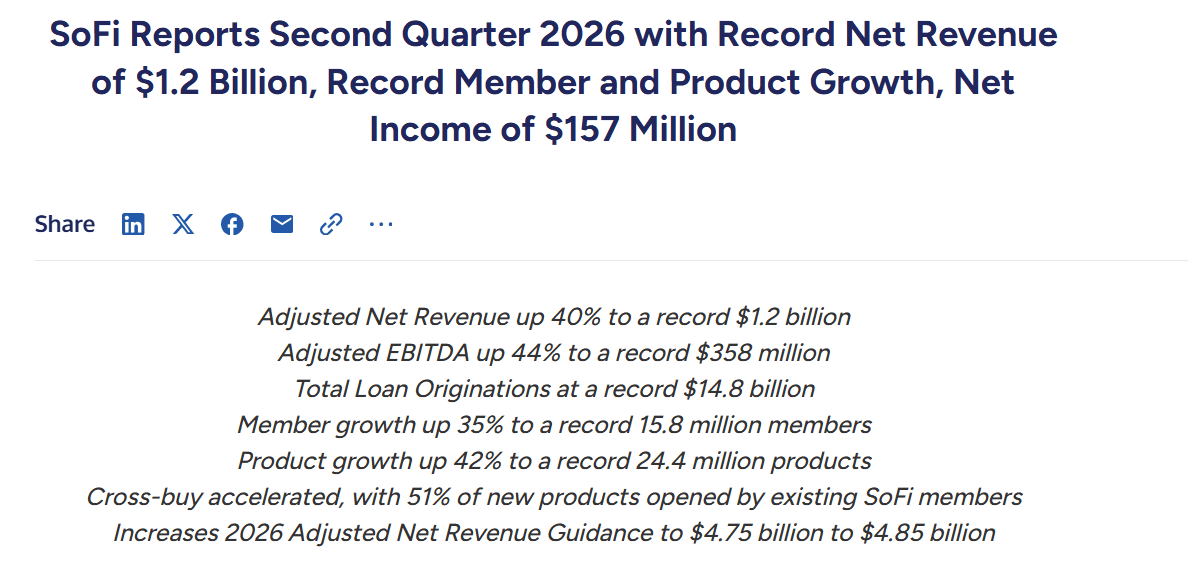
In the second quarter, SoFi added approximately 1.1 million new members, bringing its total membership to 15.8 million, a year-over-year increase of 35%. Total loan issuance increased by 69% year-over-year, reaching $14.8 billion.
- Personal loans issued reached $10.7 billion.
- Student loan disbursements rose to $2.7 billion.
- Housing loans amount to approximately $1.4 billion.
By business segment, loan revenue was $711.7 million, up 59% year-over-year; financial services revenue was $466.3 million, up 29% year-over-year.
Technology platform business revenue decline
Revenue from the technology platform business was $84.5 million, a 23% year-over-year decrease. SoFi attributed this contraction to the exit of a major customer by the end of 2025, which has become one of the main pressure points for the market.
The company also stated that existing members accounted for 51% of new products launched in the quarter, up from 43% in the previous quarter and 35% in the same period last year, indicating that their cross-selling capabilities have improved.
The annual membership growth target remains unchanged.
SoFi currently projects that its total membership will grow by at least 30% by 2026. However, despite strong revenue, profit, and user data this quarter, the market is more concerned about the lack of further upward revision to earnings guidance and signs of slowdown in some business segments.