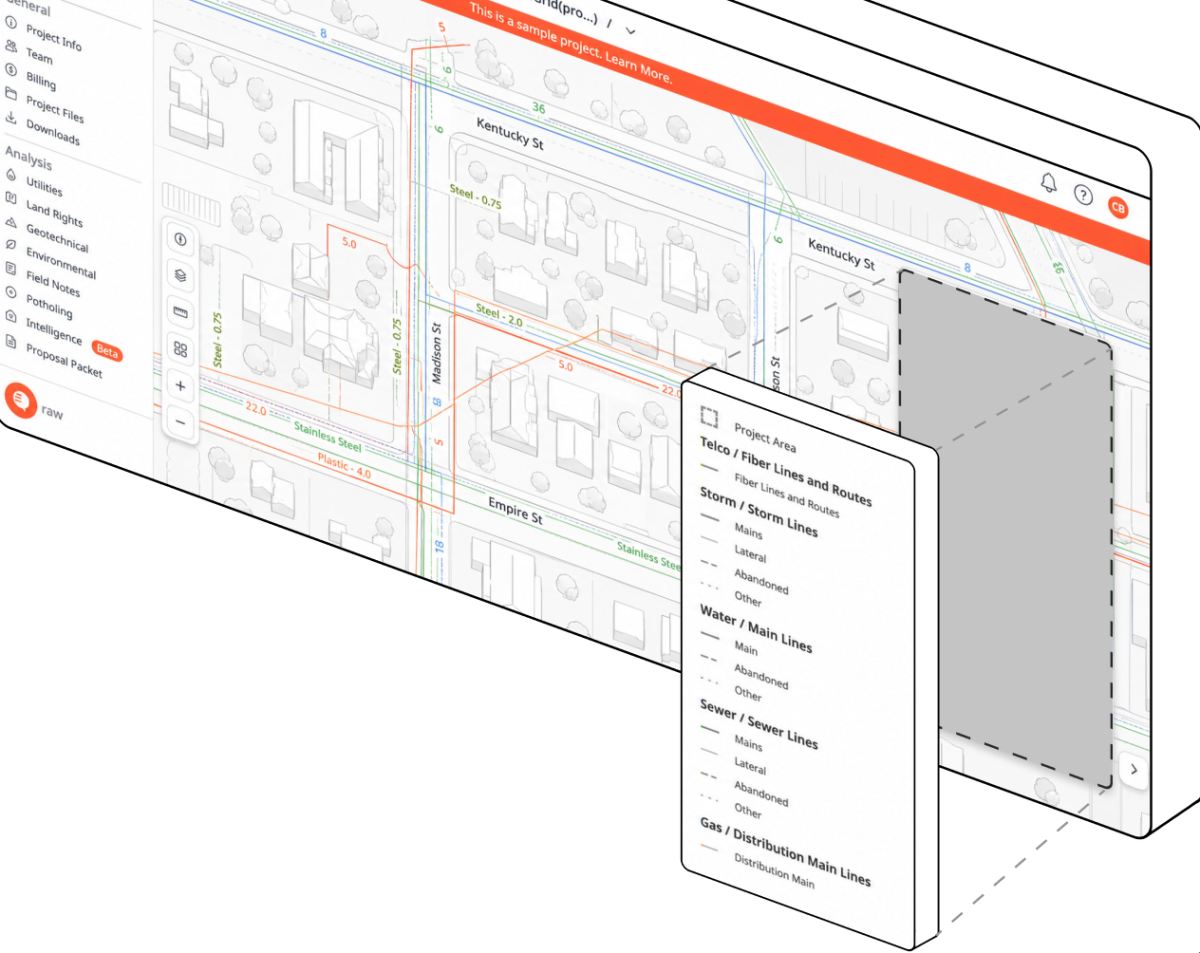


The American underground infrastructure data platform CivilGrid has completed a $26 million Series A financing round. This company aims to integrate information on underground pipelines, land ownership, and environmental regulations that is scattered across different institutions, helping engineering teams to more quickly determine whether a project can proceed before commencement.
This round of financing is led by Spark Capital.
CivilGrid was established in 2020. This round of Series A financing was led by Spark Capital, with Afore, A*, Ford Street Ventures, and SNR also participating in the investment. Energy Impact Partners also participated in the investment, and the limited partners of this fund include several utility companies.
The company currently sells platform access rights to government departments, civil engineering companies, and public utility enterprises. PG &E is also one of its customers.
Platform integrates underground asset information
The founder, Josh Mackanic, worked at Pacific Coal and Power Company PG &E for 10 years. He stated that the direct reason for starting his own business was a discovery of an unknown pipeline during a construction preparation process. It took the team three days to determine the ownership of the pipeline and whether it could be connected, and a single delay resulted in a cost of $60,000.
The core product of CivilGrid is to consolidate originally scattered data into a unified interface, covering underground public facility assets, property ownership, and environmental regulatory requirements. Mackanic describes it as the "underground version of Google Maps," with the goal of enabling engineering teams to identify construction limitations at an early stage of the project, thereby reducing rework and downtime.
PG &E Case Shows Space Savings
According to Mackanic, there are approximately 200,000 incidents of construction accidents that accidentally damage underground facilities in the United States each year. The problem lies not only in the complexity of the pipelines but also in the fact that different types of facilities are owned by different agencies, and the relevant data has been scattered for a long time.
A case study cited by PG &E shows that with the help of CivilGrid, approximately $60 million in avoidable paving costs were identified among 1,600 natural gas distribution projects. An executive from PG &E, Christine Cowsert, stated that such tools help teams identify risks earlier, improve construction efficiency, and reduce unnecessary expenditures.
Mackanic said that in the next step, the company not only aims to expand its customer base but also hopes to automate more of the preliminary processes. In addition to providing data support for site selection, it may also go further in the future to offer suggestions for pipeline laying and assist with preparing and submitting construction permits.