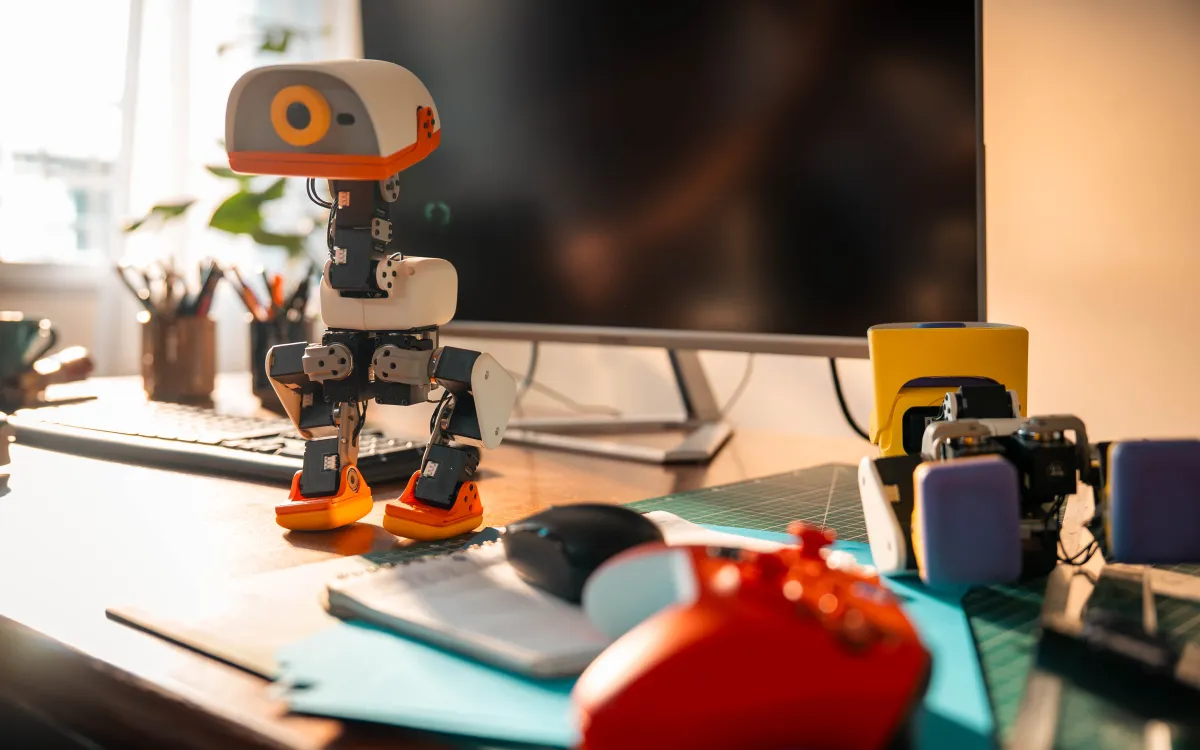


Hugging Face has released an open-source robot named Microduck, priced at $399, with plans to ship before Christmas. This product continues the company's strategy of focusing on low-cost AI hardware over the past two years, targeting developers, researchers, and robotics enthusiasts.
Focus on low-cost open-source robots
This robot is about 25 centimeters tall and has a shape similar to that of a little duck. According to the company's description, it can walk, squat, get up on its own after falling, and can also use its "beak" to grasp objects, with a maximum load capacity of about 800 grams. The official also demonstrated its pulley movement capabilities.
Hugging Face CEO Clem Delangue defines it as an "open-source robot that can teach new skills through reinforcement learning." The company hopes to use this to promote the development of AI with a lower barrier to entry.
Supports direct deployment after simulation training.
Microduck is equipped with a camera, lidar sensors, and two inertial measurement units to perceive the environment and motion status. Pollen Robotics indicates that developers can first train the robot's behavior in a simulation environment, then deploy the results directly onto the physical device. Subsequently, further fine-tuning, re-training, and redeployment are also possible.
Currently, the SDK of this robot, its simulation tools, and the complete reinforcement learning training stack are available on GitHub. For developers, this means that it is not only a consumer-grade robot but also a reusable experimental platform.
- Price: $399
- Delivery time: Before Christmas Day
- Open-source resources: SDK, simulation, and RL training stack are now online GitHub
Hugging Face Encrypted entity AI Hardware
Hugging Face was once better known as an open-source model weights and developer community platform. In April 2025, the company acquired a French robotics startup, Pollen Robotics, and began to promote low-cost open-source AI hardware.
A few months later, both parties launched the desktop robot Reachy Mini. The currently available versions include Reachy Mini which costs $499 and comes with Raspberry Pi built-in, as well as Reachy Mini Lite which costs $399 and relies on Mac or PC to operate. The launch of Microduck indicates that the company is continuing to expand its open-source robot product line.
The report also mentioned that Hugging Face is reportedly preparing to be acquired by Nvidia for a valuation of $13 billion. The two companies have maintained a cooperative relationship for many years, with Nvidia providing infrastructure support for them since at least 2023.
Privacy issues remain a real-world challenge.
As household robots equipped with cameras enter more private spaces, privacy concerns have once again come to the fore. Delangue previously stated that, compared to "black box systems" controlled by a few institutions, open-source models have advantages in terms of audibility and control.
However, open source itself does not automatically equate to privacy and security. If users install third-party applications on robots, these software programs may still access the camera or microphone and send data to external services. For such devices, how the software ecosystem manages permissions remains a key issue that needs to be addressed in subsequent implementation.