

Solana The community has completed voting on three major governance proposals. This is also the first comprehensive test after the launch of the new version of the Solana Governance Proposal system. The results show that two proposals were approved, while one was rejected. Among them, the most closely watched SGP-0002 proposal was only passed by a very narrow margin.
SGP-0002 Just made it over the threshold
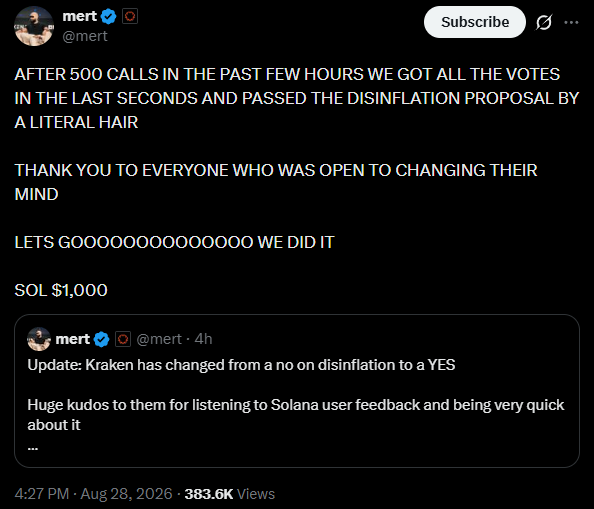
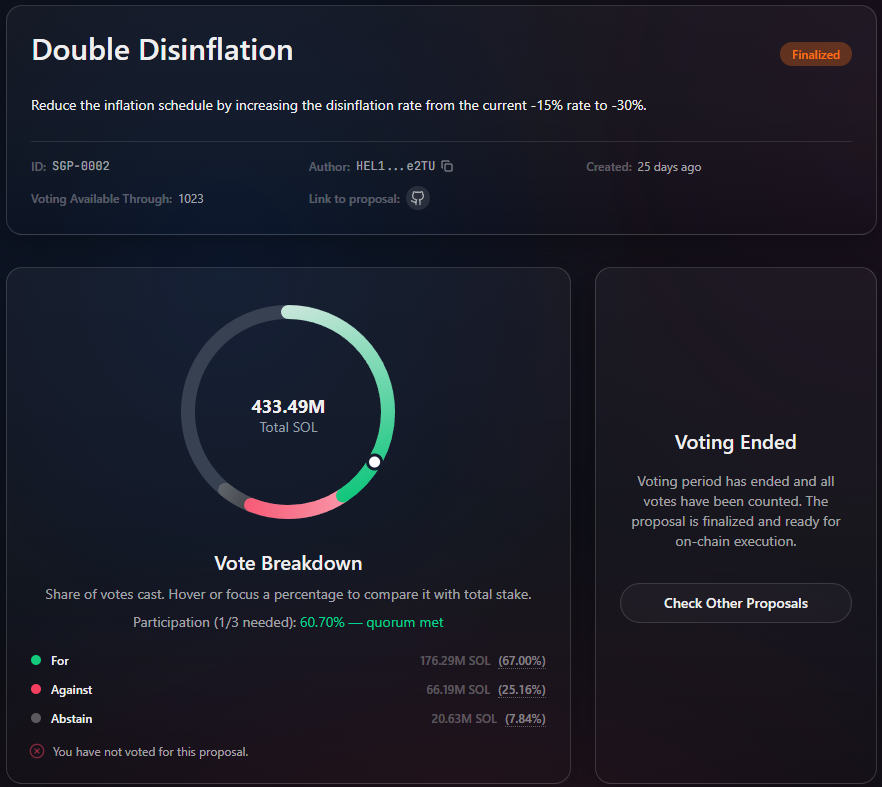
This proposal, known as "dual disinflation," received 67.0% support, which is just above the passing threshold of 66.67%. According to the proposal, the annual disinflation rate for Solana will be increased from 15% to 30%, thereby bringing it closer to a terminal inflation rate of 1.5% more quickly.
According to the calculations in the text, Solana was originally expected to achieve this goal around 2032. With the approval of the proposal, that timeline will be advanced to around 2029. It is estimated that approximately 18.9 million SOL units will not be issued in the next 6 years, which is valued at around 1.47 billion US dollars based on the prices mentioned in the text.
- Approximately 263 million SOL participated in the voting.
- 176.29 million votes in favor SOL
- 66.19 million votes against SOL
In the last hour, approximately 15.77 million SOL tokens shifted from opposition or abstention to support, ultimately enabling the proposal to pass the threshold. Helius, the CEO of Mert Mumtaz, stated that he made over 500 calls in the last few hours to secure support, and Kraken switching to a favorable vote near the deadline also had an impact on the outcome.
Differences between verifiers and stakers
The outcome of this close tug-of-war reflects the divergent interests among the Solana verifier community, the holders of SOL, and other participants in the ecosystem. Supporters believe that reducing new coin issuance helps to decrease the amount of SOL in circulation, which may potentially alleviate selling pressure in the long run.
However, inflationary issuance is also an important source of staking rewards. As the network gets closer to the target inflation rate, the SOL rewards obtained by validators and delegators from inflation will decrease. Validators who hold more than 17 million SOL voting rights Figment have voted against this, and some validators are also concerned that the reduction in rewards may not be offset by an increase in the coin price.
The new governance system allows individual stakers to directly override the voting choices of verifiers. Approximately 11.2 million SOL tokens, accounting for 4.25% of the total staked amount participating in the vote, were cast directly by the wallets, rather than simply following the stance of the verifiers. This mechanism played a practical role in this vote.
One by one, they are all rejected.
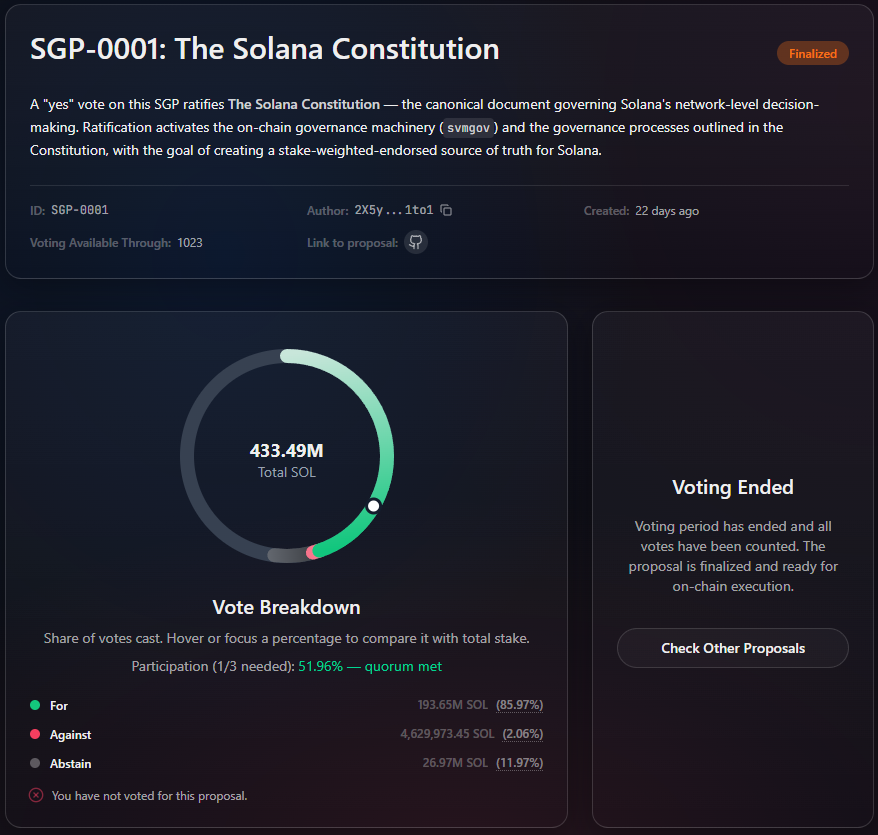
SGP-0001 The "Solana Charter" received 85.97% support and was passed relatively smoothly. This proposal officially established the governance framework for subsequent SGP votes. Solana, the Vice President of Technology at the Jacob Creech Foundation, stated that over 61% of staked participants voted in the entire governance process, setting a new high for online governance participation in Solana.
In contrast, SGP-0003 did not pass. The support rate for this proposal was 53.9%, which is significantly lower than the threshold of 66.67%. It originally planned to introduce resource-based fees linked to the complexity of transactions and computational consumption, and to directly destroy these fees rather than allocate them to verifiers.
Supporters believe that currently, most of the economic value of Solana remains at the application layer, with a relatively low proportion of revenue generated at the network layer. The article quotes DoubleZero co-founder Austin Federa as saying that in the broader concept of transaction fee economics, approximately 93% remains at the application layer, with only about 7% flowing to the network layer.
However, opponents worry that such fee structures will increase the costs of high-resource-consuming applications and deter developers from deploying complex on-chain products. After the voting concluded, Solana, co-founder with Anatoly Yakovenko, proposed that in the future, different objectives within SGP-0003 could be addressed separately, rather than being combined into a single proposal.
300-millisecond upgrade has been implemented.
In addition to the governance voting, Solana has also recently pushed forward another key upgrade. Through SIMD-0525, the target block time slot for the network has been reduced from 400 milliseconds to 300 milliseconds, with two further reductions within 8 days. According to the proposal, there will be two more reductions subsequently, with the goal of reaching 200 milliseconds.
This adjustment is aimed at reducing network latency and shortening the time that a single block producer leader controls block creation. For the network, this helps to enhance competitiveness and may also improve fairness between validators and users.